


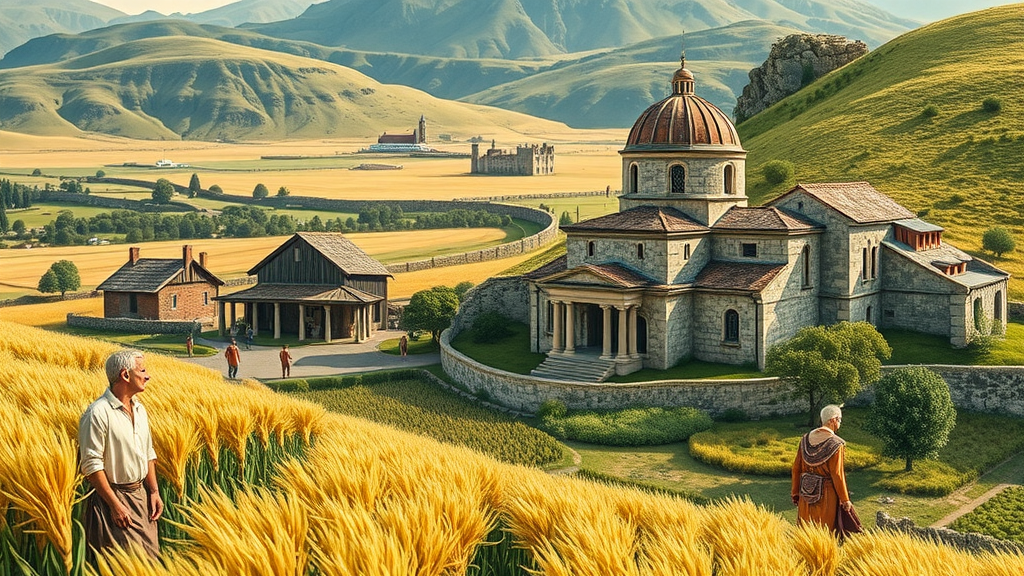
More than three thousand years ago, a small, fast-growing grass from the far side of the Eurasian continent began to change the way people lived on the loess plains of Central Europe. A new study published in Science Advances traces the arrival of broomcorn millet into the diets of Bronze Age communities in southeastern Poland, and the picture that emerges is not one of sudden invasion or mass migration, but of a quiet, gradual culinary shift that eventually reshaped the agricultural geography of an entire region. By combining isotope analyses of human skeletal remains with radiocarbon dating, palaeoproteomics and archaeological records, the research team has produced one of the most detailed reconstructions yet of how a novel crop entered and transformed an ancient food system.
The central finding is chronological. Millet, the researchers discovered, was already being consumed in southeastern Poland around 1590 BCE, more than a century earlier than previous estimates had suggested. That revision matters because the timing of millet’s arrival has long been debated among European archaeologists. The crop, domesticated originally in what is now Inner Mongolia, spread westward along trade and contact networks that connected the steppe with the settled farming societies of Europe. Knowing precisely when it appeared in local diets allows archaeologists to align that arrival with broader developments in Bronze Age society, including population growth, increasing food demand and shifting climatic conditions.
Equally significant is the manner of the adoption. The isotope data show that millet did not sweep through the region as an instant staple. Instead, it was consumed at first by only a handful of individuals, gradually working its way into foodways that had been dominated for millennia by wheat and barley. By analysing tissues that form at different stages of life, the team could reconstruct dietary change within individual lifetimes. Several early millet consumers had clearly grown up eating the traditional cereals, only incorporating the new grain later in adulthood. This within-lifetime evidence pins down the moment the crop entered existing diets with a precision that conventional archaeological methods rarely achieve.
The multi-proxy approach at the heart of the study is what makes such fine-grained conclusions possible. Carbon and nitrogen isotope ratios in bone collagen reflect a person’s average diet over the years, capturing the relative contribution of different plant and animal foods. Oxygen and strontium isotopes, by contrast, record the geology and hydrology of the places where an individual’s food was produced during tissue formation. Radiocarbon dating anchors the timeline, palaeoproteomic analysis of tooth proteins establishes biological sex, and previously published ancient genetic data situates individuals within the region’s population history. Each line of evidence answers a different question, and only by reading them together could the researchers distinguish local dietary change from the arrival of new people.
That distinction proved crucial. Both millet consumers and non-consumers in the study shared broadly similar archaeological and genetic backgrounds, and the earliest consumers carried strontium isotope signatures compatible with local origins. The data therefore offer little support for a simple migration-based explanation, in which the crop would have arrived with an incoming population that brought its own farming traditions. Instead, the evidence points to an innovation adopted from within, by communities already rooted in the region, in response to pressures and opportunities they faced in their own environment.
The environmental dimension of the story is where the study’s implications expand beyond diet. Broomcorn millet grows quickly, matures within a single summer season, and tolerates relatively dry conditions and poor soils far better than wheat or barley. Those qualities meant that cultivating it opened up parts of the landscape that had previously seen little agricultural use. According to the researchers, the different strontium isotope compositions found in the skeletal tissues of millet consumers compared with non-consumers likely point to the use of distinct geological zones within the same territory, rather than to different places of birth. In other words, the crop’s adopters were farming different ground.
Lead author Dr Depaermentier of Vilnius University frames the shift as a deliberate strategy. In response to increasing food demand and potential changes in climatic conditions, Bronze Age societies adopted a new resilient staple crop to optimise the use of previously marginal parts of their environment and improve food security. The phrase captures a logic that will feel familiar to modern agricultural planners: diversify the crop base, exploit underused land, and buffer the community against the risk of harvest failure. What the isotope evidence adds is proof that this logic was already operating in European prehistory, centuries before written records could document it.
Just as striking is what the study reveals about who adopted the crop. Millet consumption was not restricted to any particular sex, age group or social status, as co-author Prof Makarowicz of Adam Mickiewicz University in Poznań observes. Together with the strontium isotope evidence, this pattern indicates that access to particular parts of the landscape, rather than social identity, was the determining factor shaping who ate the new grain. The division between consumers and non-consumers mapped onto geography, not hierarchy. Senior author Prof Motuzaitė Matuzevičiūtė, also of Vilnius University and principal investigator of the ERC-CoG MILWAYS project, notes that the study is the first to link such a division of the landscape to the cultivation of a new summer crop and to the exploitation of areas that had previously seen little agricultural use.
That conclusion reframes how archaeologists think about prehistoric innovation. The spread of new crops is often narrated in terms of diffusion, trade or conquest, as if ideas and technologies simply travelled across maps. This study instead documents adoption as a local, negotiated process, unfolding over generations, unevenly distributed across a society, and driven by the practical realities of soil, water and subsistence. A handful of individuals began eating a new grain; their communities learned to grow it on land their ancestors had left uncultivated; and over time the practice spread until the crop became a staple. No single dramatic event marks the transition, yet the cumulative result was a fundamentally different relationship between people and their environment.
The findings also carry a contemporary resonance. As modern agriculture confronts climate change, water scarcity and degrading soils, crop diversification has returned to the centre of policy discussions, and researchers increasingly look to the past for evidence of how societies have managed similar challenges. The Bronze Age farmers of southeastern Poland offer a case study in successful adaptation: they identified a crop suited to marginal conditions, integrated it gradually into existing systems, and used it to expand production without abandoning their traditional cereals. Understanding how such transitions succeeded in prehistory, the authors suggest, can inform current debates about building resilient food systems. A grain that travelled from Inner Mongolia to the Carpathian foothills three and a half thousand years ago turns out to have lessons that still speak to the present.
Subject of Research: The adoption of broomcorn millet and its impact on Bronze Age land use in Central Europe
Article Title: The adoption of a new crop reshaped land use in Bronze Age Europe
Article References: The adoption of a new crop reshaped land use in Bronze Age Europe. (n.d.). Original publication
Image Credits: AI Generated
DOI: Not provided
Keywords: broomcorn millet, Bronze Age, Central Europe, isotope analysis, bioarchaeology, land use, food security, paleodiet, strontium isotopes, crop adoption, Science Advances, southeastern Poland
Cite Scienmag News
Alan Morgan. (September 12, 2026). How a Fast-Growing Crop Transformed Bronze Age Europe’s Landscape. Scienmag. https://scienmag.com/how-a-fast-growing-crop-transformed-bronze-age-europes-landscape/
Alan Morgan. "How a Fast-Growing Crop Transformed Bronze Age Europe’s Landscape." Scienmag, 12 September 2026, https://scienmag.com/how-a-fast-growing-crop-transformed-bronze-age-europes-landscape/. Accessed 12 September 2026.
Alan Morgan. "How a Fast-Growing Crop Transformed Bronze Age Europe’s Landscape." Scienmag. September 12, 2026. https://scienmag.com/how-a-fast-growing-crop-transformed-bronze-age-europes-landscape/


