


For more than a century, one of North America’s most enigmatic bird-like dinosaurs has been known to science by little more than a single tooth. Now, a comprehensive analysis of fossilized hip and leg bones recovered from western Montana is offering researchers an unprecedented window into how that dinosaur—Troodon formosus—grew from embryo to full adult, and may finally resolve a taxonomic headache that has frustrated paleontologists for generations.
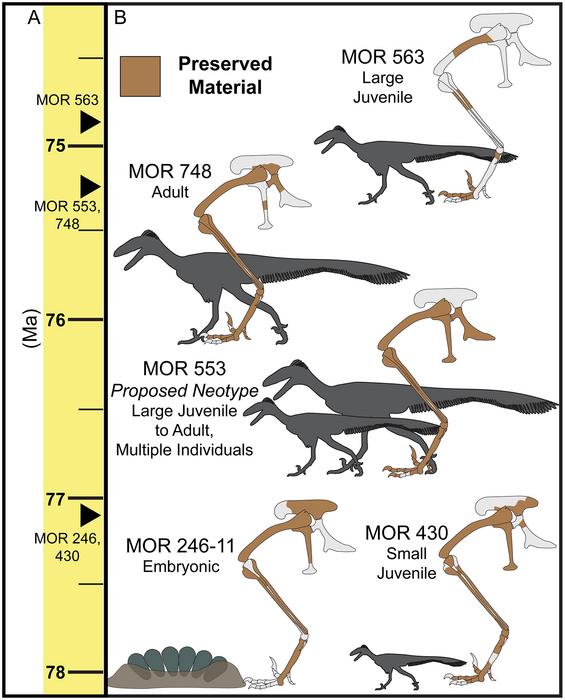
The new study, published in the open-access journal PLOS One on September 9, 2026, was conducted by David Varricchio of Montana State University and Heath Caldwell of North Carolina State University. Together, they examined a remarkably complete growth series of pelvic and hindlimb fossils drawn from animals that lived roughly 75 to 78 million years ago, during the late Cretaceous period, when the region they inhabited was a lush coastal plain bordering an inland seaway.
Troodontids were among the most distinctive dinosaurs of their era: small to medium-sized predators with long, slender legs, unusually large brains and eyes for reptiles, and bodies covered in feathers. Their closest relatives include the dromaeosaurids—the famed “raptors”—and their lineage sits tantalizingly close to the origin of birds. Yet despite their scientific importance, troodontids have long remained shadowy figures in the North American fossil record, known primarily from isolated teeth, fragmentary bones, and the occasional egg clutch.
That scarcity of material has created a persistent problem. The genus Troodon was established in 1856 on the basis of a single tooth, which has served as the type specimen—the anatomical benchmark against which all other members of the species must be judged—ever since. Teeth are notoriously poor anchors for species-level classification among closely related theropod dinosaurs, whose dentition can be remarkably similar across different genera. As a result, the very validity of the Troodon genus has been questioned repeatedly over the decades, with some researchers arguing the name should be abandoned entirely.
The Montana fossils change that calculus dramatically. The material analyzed by Varricchio and Caldwell comes from the upper member of the Two Medicine Formation, a geologically rich sedimentary sequence that has previously yielded eggs, nests, embryos, and adult skeletal remains attributed to a single troodontid population. Because the assemblage spans the full ontogenetic range—from embryonic individuals still inside their eggs to skeletally mature adults—the researchers could, for the first time, reconstruct how the species’ hip and leg bones changed shape, texture, and proportion throughout an individual’s life.
Among the most informative patterns documented in the study is a systematic shift in limb proportions. The ratio of femur length to tibia length, the researchers found, was consistently higher in adult specimens than in juveniles. In practical terms, this means that as these animals matured, their lower leg bones grew proportionally longer relative to their thigh bones—a developmental trajectory familiar from many fast-running animals, both extinct and modern. Such a shift suggests that young troodontids may have moved differently from adults, potentially relying on different locomotor strategies while their bodies were still developing.
Equally significant was the observation that many of these developmental changes occurred at consistent growth stages across multiple individuals. That consistency implies a strong genetic or intrinsic developmental program, relatively insulated from environmental noise. In paleontology, where distinguishing true species differences from individual or environmental variation is a constant challenge, this kind of reproducibility is gold: it demonstrates that the observed anatomical features are stable, species-level characteristics rather than artifacts of habitat, diet, or climate fluctuation.
The study also confirmed two other biological insights. First, adults of the species varied distinctly in body size, hinting at a level of individual variation—or perhaps sexual dimorphism—that future researchers will need to account for when assessing fragmentary troodontid remains. Second, in line with earlier research, the analysis suggests that foot injuries and pathologies may have been remarkably common in the species. Whether these stemmed from high-activity lifestyles, aggressive behavior, nesting-related stress, or something else entirely remains an open question, but the recurrence of foot problems across individuals adds an intriguing dimension to reconstructions of troodontid daily life.
Beyond the biological findings, the study carries a significant taxonomic proposal. Varricchio and Caldwell argue that a specific subset of the remains—a collection of pelvic and hindlimb fossils representing both juveniles and adults—should be formally designated as the type specimen of T. formosus, displacing the original single tooth that has anchored the species since the nineteenth century. Such a move would give the species a robust, diagnosable skeletal foundation and could go a long way toward securing the validity of the Troodon genus itself. However, the authors caution that this reassignment is not yet settled. The proposal depends on a decision currently pending before the International Commission on Zoological Nomenclature, the body that adjudicates disputes over scientific names. Until that ruling is issued, the tooth retains its official status.
For paleontologists who study small theropod dinosaurs, the implications extend well beyond taxonomy. Growth series of this quality are vanishingly rare in the fossil record, particularly for animals as small and lightly built as troodontids, whose delicate bones are less likely to survive fossilization than those of their larger cousins. Having a well-sampled embryonic-to-adult sequence of pelvic and hindlimb anatomy provides a reference framework that other researchers can use to identify isolated bones, assess growth stage in new discoveries, and test hypotheses about growth rates, locomotion, and life history across the broader troodontid family.
Future work is already being contemplated. The authors note that further research could illuminate how Troodon walked and ran—questions that depend critically on precisely the kind of limb-proportion and joint-architecture data this study provides. Understanding the biomechanics of an animal with proportionally long lower legs and a bird-like skeletal plan could offer fresh insights into the evolutionary transition toward the avian body plan and the range of ecological roles small feathered predators occupied in late Cretaceous ecosystems.
The research also underscores the continuing scientific value of long-term, careful fieldwork in well-studied formations like the Two Medicine. The fossils analyzed in this study were not the product of a single spectacular discovery but of accumulated collecting across decades, in an area where the same troodontid population left behind eggs, embryos, juveniles, and adults in close geological proximity. It is precisely this kind of cumulative evidence that allows paleontologists to move beyond naming new species and toward reconstructing the lives of animals that have been extinct for 75 million years.
As the authors themselves put it, the analysis of these bones “provided an unprecedented opportunity for understanding the biology of a historically enigmatic group of animals and will serve as a valuable resource for paleontologists for years to come.” Whether or not the International Commission approves the proposed type-specimen change, the study stands as a landmark in the rehabilitation of a dinosaur that science has known longest by its teeth—and is only now beginning to know by its bones.
Cite Scienmag News
Courtney Benton. (September 9, 2026). Embryo-to-adult fossils reveal growth of mysterious bird-like dinosaur. Scienmag. https://scienmag.com/embryo-to-adult-fossils-reveal-growth-of-mysterious-bird-like-dinosaur/
Courtney Benton. "Embryo-to-adult fossils reveal growth of mysterious bird-like dinosaur." Scienmag, 9 September 2026, https://scienmag.com/embryo-to-adult-fossils-reveal-growth-of-mysterious-bird-like-dinosaur/. Accessed 9 September 2026.
Courtney Benton. "Embryo-to-adult fossils reveal growth of mysterious bird-like dinosaur." Scienmag. September 9, 2026. https://scienmag.com/embryo-to-adult-fossils-reveal-growth-of-mysterious-bird-like-dinosaur/


