


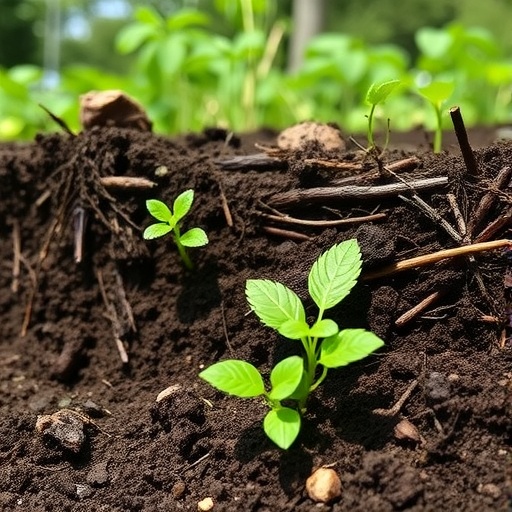
Deep beneath the recovering forests of subtropical China, a quiet chemical partnership between microbes and iron-rich minerals appears to be locking away carbon more effectively than scientists had fully appreciated. A new study published in the journal Plant and Soil reports that as degraded red soils undergo natural vegetation restoration, the way carbon is stored shifts decisively from fast-cycling, vulnerable pools toward mineral-associated forms that can persist for decades or centuries. The findings offer a mechanistic explanation for why reforested landscapes in the tropics and subtropics can become increasingly powerful carbon sinks over time, and they suggest that soil management strategies may need to account for the microscopic players who do much of the work.
The research, led by Yilin Fan and Ying Li of Nanjing Forestry University, together with colleagues from the Nanjing Soil and Water Conservation Management Center, the Tingjiangyuan National Nature Reserve in Fujian Province, and the International Centre for Bamboo and Rattan, focused on a restoration chronosequence of subtropical forests in China. The team compared soils across a gradient of forest development: young coniferous forest stands, developing coniferous forests, mixed coniferous and broad-leaved forests, and mature broad-leaved forests. These red soils, which are widespread in tropical and subtropical regions and are notoriously prone to erosion and degradation, are rich in iron and aluminum oxides, minerals that are known to bind organic matter, but the precise links between restoration, these minerals, and the soil microbial communities that process carbon have remained murky.
To unravel those links, the researchers combined three complementary techniques. They used sequential selective dissolution, a chemical fractionation method that releases organic carbon associated with progressively stronger mineral bonds, ranging from water-soluble fractions to organo-metal complexes, poorly crystalline co-precipitates, and carbon locked within crystalline mineral lattices. They measured the activities of extracellular enzymes involved in degrading carbon compounds. And they deployed metagenomic sequencing, which reads the collective genetic potential of the entire soil microbial community, to determine which functional genes related to carbon cycling were present and abundant at each stage of restoration.
The central finding concerns a category of soil carbon known as mineral-associated organic carbon, or MAOC. Unlike particulate organic carbon, which consists of recognizable fragments of plant litter that decompose relatively quickly, MAOC consists of organic molecules bonded to mineral surfaces or trapped within mineral structures. Because these associations physically and chemically shield the carbon from microbial enzymes, MAOC is considered one of the most stable reservoirs of soil organic carbon on the planet. Globally, mineral-associated carbon represents a vast store, and understanding how it forms is critical for predicting how soils will respond to climate change and whether restoration projects can genuinely sequester carbon over the long term.
The results were striking. Vegetation restoration promoted the accumulation of MAOC and enhanced its stabilization potential by reorganizing the distribution of mineral-associated carbon pools. In the younger coniferous forests, carbon associated with crystalline minerals and residual pools accounted for about 24 percent of the total extracted carbon. In the mature broad-leaved forests, that proportion had fallen to just 11 percent. In their place, non-crystalline colloidal organo-metal complexes came to dominate, accounting for between 62 and 76 percent of the total extracted carbon across the restoration gradient. These complexes, formed when organic molecules bind to poorly crystalline iron and aluminum phases, are among the most effective carbon-stabilizing associations in acidic, oxide-rich soils.
The strengthening of iron-associated carbon protection emerged as a key signature of restoration. The concentration of iron within the organo-metal complex pool increased steadily along the gradient, reaching 6146.97 milligrams per kilogram in the broad-leaved forest soils. In practical terms, this means that as forests matured, more and more carbon was becoming wrapped in iron-rich chemical embrace, effectively converting plant- and microbe-derived organic matter into forms that resist decomposition. Because red soils are already iron-rich, restoration appears to capitalize on this inherent geochemical capacity, channeling carbon into the compartments where it is best protected.
But minerals alone do not tell the whole story. The microbial analysis revealed a functional transition that tracks the restoration gradient with remarkable coherence. In the early-stage forests, the microbial communities were relatively enriched in Chloroflexi and Actinobacteria, bacterial groups associated with the degradation of labile, easily decomposed carbon compounds, and their metagenomes were enriched in genes for labile carbon degradation and for Calvin cycle pathways, suggesting active autotrophic carbon fixation. As forests matured toward broad-leaved dominance, the community shifted, with Acidobacteria and the fungal phylum Basidiomycota, organisms known for breaking down complex, recalcitrant substrates such as lignin, becoming relatively more abundant. Correspondingly, the metagenomic functional profile shifted toward genes for recalcitrant carbon degradation and for the reductive tricarboxylic acid cycle, or rTCA, an alternative carbon fixation pathway.
The activities of carbon-degrading extracellular enzymes increased along the restoration gradient, confirming that microbial communities in the older forests were actively dismantling more chemically complex organic matter. At first glance, this might seem counterintuitive, since more enzyme activity might suggest more carbon loss. But the authors argue that the opposite is occurring in terms of net stabilization. The strong statistical associations they observed among recalcitrant carbon degradation genes, rTCA-related genes, and the size of the MAOC pools point to a coordinated system in which microbes break down complex organic matter, partially assimilate the products, and generate microbial residues and transformed compounds that then bind to reactive iron minerals. This microbial processing, coupled with the mineral matrix, appears to be what drives carbon from fast-cycling pools toward mineral-associated forms.
The study’s conclusion frames this as microbial-mineral coupling. Vegetation restoration, the authors write, was associated with coordinated changes in iron-associated mineral fractions, microbial functional groups, and mineral-associated carbon pools. These linked changes suggest that the coupled action of microbes and minerals contributes to the transformation of soil carbon from fast-cycling pools toward mineral-associated forms, thereby promoting MAOC accumulation and enhancing carbon stabilization potential in eroded red soils. In other words, restoring the vegetation does not simply add carbon to the soil; it rewires the entire belowground machinery that determines whether that carbon stays put.
The implications extend well beyond Chinese subtropical forests. Soil organic carbon is the largest terrestrial carbon pool, and its management is a central lever in climate mitigation strategies. Eroded red soils represent some of the most degraded and carbon-depleted landscapes in the world, and restoration programs across Asia, Africa, and South America are actively reforesting millions of hectares of such terrain. Understanding that the carbon gains from restoration depend partly on iron-mediated mineral protection and on specific microbial functional transitions gives restoration ecologists a set of measurable indicators. Monitoring the shift in carbon pool distribution, particularly the rise of organo-metal complexes, and tracking the relative abundance of recalcitrant-carbon-degrading taxa and rTCA genes could provide early evidence that a restored forest is genuinely building long-term soil carbon stocks rather than merely accumulating transient litter.
There are also implications for how restoration is designed. Mature broad-leaved forests in the study showed the strongest mineral-associated carbon accumulation and the most protective iron chemistry, suggesting that allowing succession toward diverse broad-leaved communities, or planting mixtures that facilitate such succession, may deliver greater long-term carbon benefits than monoculture conifer plantations, which in these soils remained locked in an earlier functional state dominated by labile carbon processing.
The work was supported by the National Key Research and Development Program of China under a key special project. The datasets generated during the study are available from the corresponding author upon reasonable request. While the study is observational, tracking a natural restoration gradient rather than an experimentally controlled one, the convergence of chemical fractionation data, enzyme assays, and metagenomic evidence paints a coherent and technically grounded picture of how carbon stabilization emerges from the interplay of geology and biology in recovering forest ecosystems. As restoration continues to scale up globally as a climate strategy, understanding these hidden partnerships between microbes and minerals may prove essential to distinguishing between forests that store carbon briefly and forests that store it for centuries.
Cite Scienmag News
Morgan Morrow. (September 5, 2026). Vegetation restoration boosts soil carbon storage via microbial–mineral interactions. Scienmag. https://scienmag.com/vegetation-restoration-boosts-soil-carbon-storage-via-microbial-mineral-interactions/
Morgan Morrow. "Vegetation restoration boosts soil carbon storage via microbial–mineral interactions." Scienmag, 5 September 2026, https://scienmag.com/vegetation-restoration-boosts-soil-carbon-storage-via-microbial-mineral-interactions/. Accessed 5 September 2026.
Morgan Morrow. "Vegetation restoration boosts soil carbon storage via microbial–mineral interactions." Scienmag. September 5, 2026. https://scienmag.com/vegetation-restoration-boosts-soil-carbon-storage-via-microbial-mineral-interactions/


