


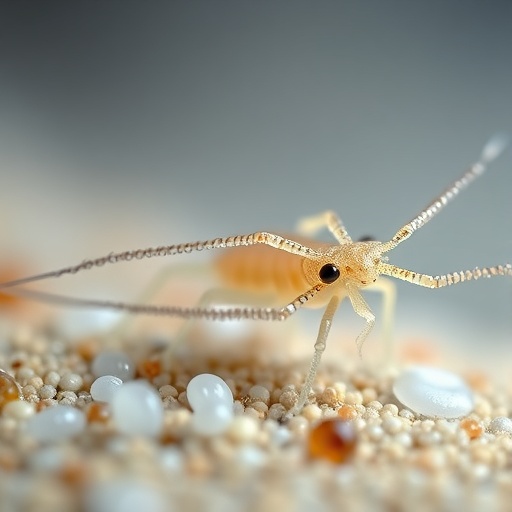
On the rocky shorelines of Japan, small crustaceans known as wharf roaches spend their lives performing one of nature’s least glamorous but most essential jobs: cleaning up. These nimble isopods, members of the genus Ligia, scuttle across rocks and pilings at the edge of the sea, devouring organic debris and recycling nutrients back into coastal ecosystems. But in recent decades, their cleaning duties have expanded to include something their evolutionary history never prepared them for—plastic. Among the debris washing ashore, few materials are as ubiquitous as expanded polystyrene, the lightweight foam commonly known by the trade name Styrofoam. Now, a team of researchers at Kyushu University has taken one of the most detailed looks yet at what happens inside the body of a shoreline scavenger when its diet consists of plastic foam, and the findings reveal a subtle but consequential biological drama playing out in the guts of these unassuming animals.
The study, led by Professor Emeritus Yuji Oshima of Kyushu University’s Faculty of Agriculture and published in the journal Marine Pollution Bulletin, combined laboratory exposure experiments with multi-omics analysis—a suite of techniques that simultaneously examines gene expression and microbial communities to build a comprehensive picture of an organism’s internal state. The choice of the wharf roach as a study subject was deliberate. Previous fieldwork by the team had shown that these animals chew up expanded polystyrene and excrete it as much smaller fragments, raising the possibility that wharf roaches act as unwitting factories converting bulky foam debris into microplastics. But while that ecological role was becoming clear, the biological cost to the animals themselves remained an open question. “We wanted to find out whether swallowing foam comes at a biological cost for these shoreline scavengers,” Oshima explained in the announcement of the findings.
The experimental design was elegantly simple. Field-collected wharf roaches were divided into two groups: one received nothing but pieces of a commercially available polystyrene foam board for one week, while a control group received no food at all. The first measure the researchers examined was survival. Foam-fed wharf roaches lived for an average of 27.8 days, compared with 31.6 days for the starved controls—a difference of 3.8 days that, despite its direction, did not reach statistical significance. On the surface, then, the animals appeared remarkably resilient. The plastic did not visibly shorten their lives under laboratory conditions, and the feeding animals looked outwardly healthy. Had the researchers stopped there, the story might have ended with a reassuring conclusion: eating polystyrene foam, at least for a week, does not kill a wharf roach.
But the multi-omics analysis told a far more intricate story. When the researchers examined gene expression in the digestive tracts of the EPS-fed roaches, they found a suite of changes centered on the animal’s chemical defense machinery. Three families of detoxification enzymes were expressed at elevated levels: cytochrome P450 enzymes, UDP-glucuronosyltransferases, and sulfotransferases. These enzyme families are the workhorses of xenobiotic metabolism, the biochemical system by which organisms neutralize foreign compounds. Cytochrome P450 enzymes typically handle the initial chemical modification of harmful molecules, while UDP-glucuronosyltransferases and sulfotransferases carry out the subsequent phase, conjugating those modified compounds with molecules that make them water-soluble and easier to excrete. Together, the elevated expression observed in the foam-fed roaches represents both major phases of the classical detoxification pathway firing in response to the ingested plastic.
The pattern of gene expression changes extended beyond detoxification. A gene involved in DNA repair also showed higher expression in the EPS-fed animals, a change that may reflect cellular stress or damage to genetic material, though the precise trigger remains to be determined. At the same time, several genes encoding digestive enzymes were expressed at lower levels in the foam-fed group, including one involved in breaking down plant fibers. This downregulation of digestive machinery makes intuitive sense: an animal consuming a nutritionally barren substrate like polystyrene foam may have little use for the full complement of enzymes designed to extract energy from genuine food. The gut, in effect, was reprogramming itself around a diet that provides bulk but no nourishment.
Perhaps the most surprising findings came from the microbiome analysis. The researchers expected that a radical dietary shift from normal scavenged organic matter to pure plastic foam would restructure the community of microbes living in the roaches’ guts. It did not. Microbial diversity within individual animals and the overall composition of gut communities were essentially unchanged across the four microbial domains the team examined. The core microbial ecosystem of the wharf roach gut, it seems, is stable enough to weather a week of plastic dining without wholesale disruption. But beneath that stable surface, the researchers detected something intriguing: several rare organisms appeared exclusively in the plastic-fed animals. Three archaeal taxa, including Methanospirillum, a genus of methane-producing archaea, along with one family of bacteriophages, were detected in all three of the EPS-fed specimens examined but in none of the controls.
The appearance of methane-producing archaea in the guts of plastic-fed roaches is a detail with potentially broad implications. Methanogens are typically associated with anaerobic, fermentative environments, and their presence suggests that the digestion of polystyrene foam may alter the chemical microenvironment of the gut in ways that favor these specialized microbes. Similarly, the appearance of specific bacteriophages—viruses that infect bacteria—only in the foam-fed group hints at subtle shifts in microbial dynamics that standard diversity metrics failed to capture. Rare taxa, the researchers note, can serve as sensitive indicators of environmental change, and their group-specific patterns here suggest that even a microbiome that looks statistically “unchanged” may be harboring meaningful shifts beneath the surface.
For Oshima, the discrepancy between the animals’ outward health and their internal molecular activity is the central lesson of the study. “The foam-fed animals appeared healthy and had lifespans similar to those of the controls; however, their guts showed differences in the expression of genes involved in chemical defense,” he noted. “This tells us ‘no visible harm’ does not necessarily mean ‘no biological effect.'” That distinction matters far beyond the wharf roach. Environmental toxicology has long grappled with the problem of sublethal effects—changes in an organism’s physiology that do not cause obvious illness or death but may nevertheless impose energetic costs, reduce reproductive success, or compromise resilience to other stressors. Running a detoxification system at elevated capacity, repairing DNA, and remodeling digestive machinery all consume energy and resources that the animal cannot then spend on growth, reproduction, or immune defense. Whether the gene expression changes observed here translate into functional consequences for wharf roach populations in the wild is a question the researchers say demands further work.
The broader context of the study is the escalating global problem of expanded polystyrene pollution. EPS is inexpensive, lightweight, and easy to manufacture, which has made it a staple material in the fishing and packaging industries. Those same properties—low density and high buoyancy—make it an exceptionally persistent marine pollutant, capable of drifting across vast ocean distances before accumulating on beaches and shorelines. Once in the environment, EPS fragments readily into smaller and smaller pieces, seeding coastal habitats with microplastics. The Kyushu team’s earlier fieldwork added a troubling dimension to this picture: wharf roaches themselves may actively accelerate this fragmentation, chewing foam into particles small enough to enter food webs at multiple trophic levels. Shoreline scavengers, in other words, are not merely victims of plastic pollution—they may be agents in its dispersal and transformation.
The findings arrive at a moment of growing scientific concern about the biological effects of microplastics on invertebrates, which form the foundation of many marine food webs. Wharf roaches occupy a particularly valuable position as a study organism and as a potential sentinel species for coastal plastic pollution. Because they live at the land-sea interface, consume whatever washes ashore, and are abundant and easy to collect, changes in their physiology and microbiomes could serve as an early warning system for the biological impacts of plastic accumulating along the world’s coastlines. A sentinel that displays measurable molecular responses to a common pollutant, even without overt signs of harm, offers researchers a sensitive instrument for tracking environmental contamination.
The research team, which included Seokhyun Lee, Hirokuni Miyamoto, Yuki Takai, Wataru Suda, Hiroshi Ohno, and Yohei Shimasaki alongside Oshima, frames its results as yet another argument for managing expanded polystyrene waste more responsibly. The message is twofold. First, improving the design, recovery, and disposal of EPS products would reduce the volume of foam entering marine environments in the first place. Second, prioritizing coastal cleanup efforts remains essential, because stranded foam does not simply sit inertly on the beach—it is eaten, fragmented, and biologically transformed by the very animals that help keep shorelines clean. The wharf roach, it turns out, pays a molecular price for its cleanup work. Whether that price compounds across generations and ecosystems is the question this research now opens.
News Publication Date: 4-Sep-2026
Web References: Kyushu University Faculty of Agriculture; Kyushu University
References: Lee, S., Miyamoto, H., Takai, Y., Suda, W., Ohno, H., Shimasaki, Y., & Oshima, Y. (2026). Changes in dysbiosis and gene expression in the gut of wharf roach (Ligia spp.) fed with expanded polystyrene. Marine Pollution Bulletin. https://doi.org/10.1016/j.marpolbul.2026.120200
Cite Scienmag News
Reese Ellison. (September 4, 2026). Tiny beach creatures reveal how microplastics move through food webs. Scienmag. https://scienmag.com/tiny-beach-creatures-reveal-how-microplastics-move-through-food-webs/
Reese Ellison. "Tiny beach creatures reveal how microplastics move through food webs." Scienmag, 4 September 2026, https://scienmag.com/tiny-beach-creatures-reveal-how-microplastics-move-through-food-webs/. Accessed 4 September 2026.
Reese Ellison. "Tiny beach creatures reveal how microplastics move through food webs." Scienmag. September 4, 2026. https://scienmag.com/tiny-beach-creatures-reveal-how-microplastics-move-through-food-webs/


