


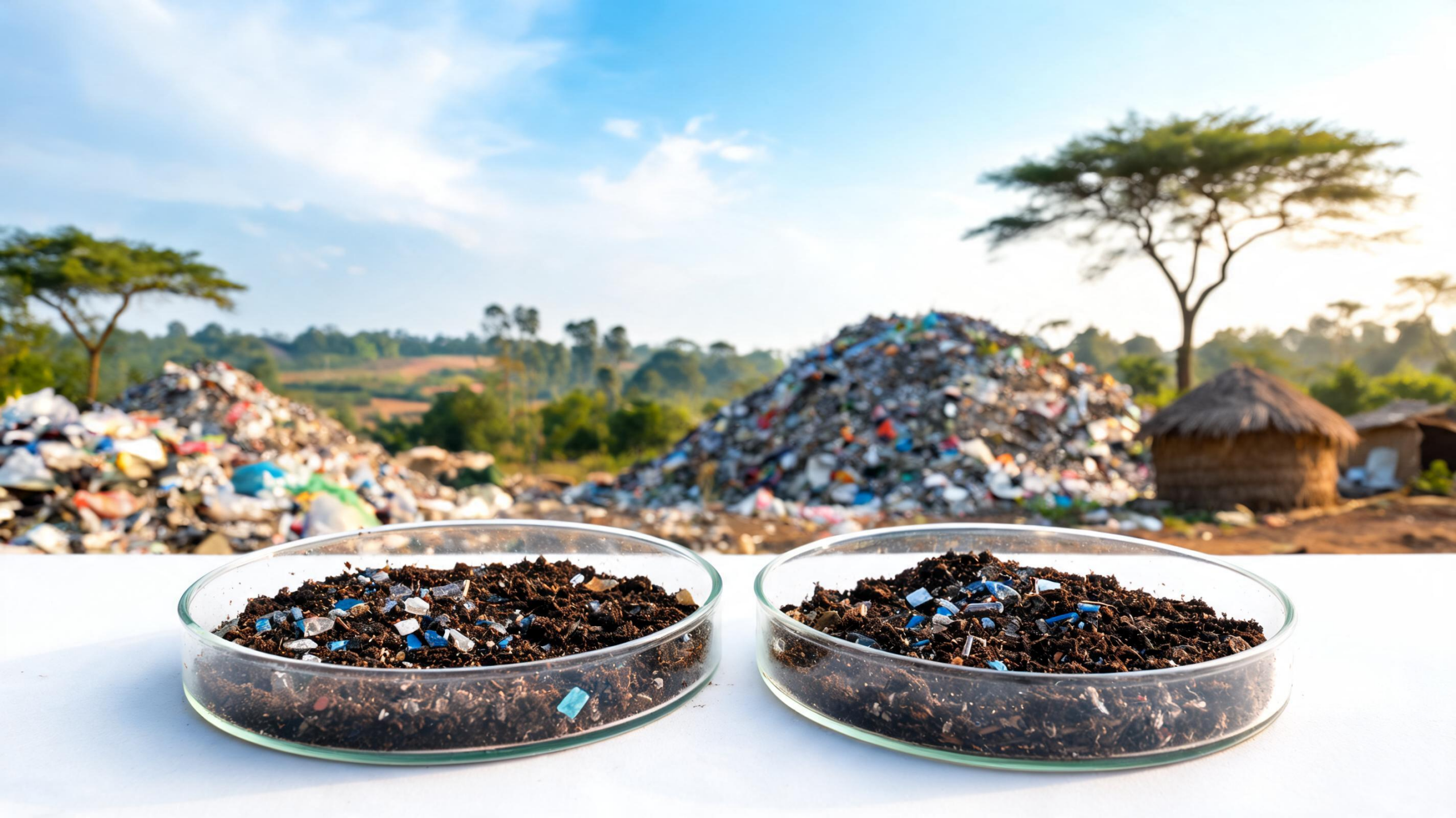
Every bag of compost produced from Uganda’s municipal landfill waste carries a hidden cargo of plastic particles, according to a new study that offers one of the first systematic measurements of microplastic contamination in compost across sub-Saharan Africa. Researchers from Uganda’s National Environment Management Authority examined compost from eleven composting sites spanning eight cities and three municipalities, and found microplastics at every single location, with an average abundance of 2,100 ± 409.4 particles per kilogram of dry compost. The findings, published in BMC Environmental Science, reveal how a waste treatment practice widely promoted as environmentally friendly may be quietly transporting plastic pollution into agricultural soils and, potentially, the food chain.
The scale of the underlying waste problem in Uganda provides essential context for the results. The country’s eleven major cities are home to roughly 5.5 million residents and visitors, about 12.1 percent of the national population, and this urban concentration has driven a sharp rise in solid waste generation. Kampala Capital City alone produces approximately 28,000 tons of municipal solid waste every month, a figure that has more than doubled over the past two decades. Globally, the World Bank projects that waste generation could reach 27 billion metric tons per year by 2050, and developing countries with limited collection infrastructure and low recycling rates face the steepest challenges. In Uganda, the waste stream is dominated by food scraps, paper, cloth, plastic bags and bottles, glass, medical waste, and metals, with plastics accumulating across all landfills in forms that include polyethylene, polypropylene, polystyrene, polyethylene terephthalate, polycarbonate, polyurethane, and polyvinyl chloride.
Composting has been embraced as a practical response to this mounting waste burden. By converting biodegradable material into nutrient-rich manure, composting reduces waste volume, recycles organic matter back into farmland, lessens dependence on commercial fertilizers, and improves soil quality. The technology adopted at Ugandan landfill sites is conventional and simple, consisting mainly of open windrows in which mixed waste is left to decompose. The trouble is that very little of the incoming waste is segregated. Only three of the eleven sites studied, Mukono, Lira, and Fort Portal, perform any manual pre-treatment to remove non-compostable materials before composting begins, and even that removal is incomplete. When plastic-laden mixed waste enters the windrows, mechanical weathering, oxidation, and photocatalytic breakdown progressively fragment the larger plastic items into microplastics, defined as synthetic polymer particles smaller than 5,000 micrometers.
To quantify this contamination, the research team designed a sampling campaign that controlled for both spatial and temporal variability. All samples were collected during a single two-week window in the dry season of June 2025. At each site, three mature compost piles were independently sampled, with each pile divided into top, middle, and bottom sections sampled at a depth of 5 to 15 centimeters using a stainless-steel shovel. The sections were homogenized, and material from the three piles was combined into a single composite sample of 300 grams per site, which was then sieved through a 5-millimeter stainless-steel mesh, sealed in airtight paper bags, and transported in a cool box to the laboratory. Compost maturity was verified before analysis: every sample exceeded a germination index of 70, showed a carbon-to-nitrogen ratio below 20, total nitrogen below 3.0 percent dry weight, and a pH between 7 and 9, confirming that the material analyzed was genuinely finished compost rather than raw waste.
The laboratory extraction followed an adapted wet peroxide oxidation protocol. Twenty grams of sieved, oven-dried compost were digested with Fenton reagent, a mixture of 20 milliliters of 30 percent hydrogen peroxide and 20 milliliters of 0.05 molar acidified ferrous sulphate, heated to approximately 75 degrees Celsius in a laminar flow fume hood until the organic matter disappeared. Density separation followed, using a saturated zinc chloride solution at 700 grams per liter with a density of 1.7 grams per cubic centimeter. After an hour of settling, the supernatant was filtered through a glass microfiber filter with an 11-micrometer pore size, and the captured particles were air-dried for three to four days before examination under a ZEISS Stemi 508 stereomicroscope fitted with an Axiocam 208 color camera. The researchers distinguished genuine plastic from natural particles using the hot needle and break tests, and rigorous quality controls, including blank tests with distilled water, non-plastic sampling equipment, cotton lab clothing, and glassware cleaned three times with distilled water, confirmed that no contamination was introduced during handling. Statistical comparisons across sites used a one-way ANOVA followed by Tukey’s HSD test at a significance threshold of 0.05.
The results painted a picture of pervasive but uneven contamination. Hoima’s compost site exhibited the highest microplastic abundance, more than double the eleven-site average, and was identified as a statistical outlier, significantly exceeding Jinja (p = 0.030), Mbale (p = 0.013), Soroti (p = 0.012), Kabale (p = 0.010), and Fort Portal (p = 0.0027). Jinja, which deploys an advanced Komptech Cribus 3800 mobile screening machine for post-composting processing, recorded a high abundance of 3,050 ± 304.63 particles per kilogram with relatively low variation, suggesting that mechanical screening without upstream segregation may actually break plastics down further and distribute them through the compost. At the low end, Mukono (1,250 ± 312.77 particles/kg) and Kasese (1,300 ± 316.58 particles/kg) showed statistically indistinguishable levels (p = 0.86), while Gulu and Hoima displayed the greatest variability, pointing to intermittent plastic inputs. The Ugandan average sits close to figures reported elsewhere: 2,400 ± 358 particles per kilogram in rural domestic waste compost in Zhejiang Province, China, and 2,800 ± 616 particles per kilogram in municipal organic waste compost in the Netherlands.
Perhaps the most telling result concerned particle shape. Fibres dominated at every site, accounting for 54.98 percent of all identified microplastics, followed by pellets at 15.37 percent, fragments at 15.15 percent, films at 6.06 percent, filaments at 5.41 percent, and foams at just 3.03 percent. Fibrous particles are strongly associated with synthetic textiles, ropes, and sacks, and Soroti’s profile was almost entirely fibrous, suggesting a single dominant source such as woven packaging material. Pellets, which are industrially manufactured primary microplastics often used in personal care products, featured prominently in Jinja, Fort Portal, Gulu, and Mbale. Fragments arise from the degradation of hard plastics such as high-density polyethylene, while films trace back to plastic bags and food packaging. The overwhelming presence of secondary microplastics, particles formed by the breakdown of larger plastic items, led the authors to conclude that poor waste management and inadequate segregation practices are the root cause of the contamination, rather than any single industrial source.
The environmental implications extend well beyond the compost pile itself. Previous research has shown that microplastics alter soil physical properties, including porosity, water-holding capacity, structure, and bulk density, and that polypropylene additions to loess soils can raise concentrations of nitrogen, phosphorus, and dissolved organic matter. Microplastic surfaces also adsorb hydrophobic organic compounds and heavy metals, acting as vectors that transport toxic chemicals through soil, and they can host distinct microbial communities that facilitate the spread of pathogens. Because compost is applied directly to farmland, the particles it carries enter the soil-plant system, where they may influence crop growth rates and nutrient uptake. Studies in both China and Europe have further demonstrated that the composting process itself can increase microplastic abundance by fragmenting larger plastics, with one study recording a rise from 5,133 particles per kilogram in raw material to as much as 11,200 particles per kilogram in finished compost, which helps explain why even screened compost retains substantial plastic loads.
The human health dimension adds urgency to the findings. Microplastics in compost can enter the food chain, and growing research interest now focuses on how these particles are absorbed, distributed, metabolized, and excreted in the human body. Continuous exposure has been linked to inflammation, and microplastics are suspected of interfering with metabolic processes. The authors of the Ugandan study acknowledge important limitations, including the compositing of three piles into a single site-level sample, which prevented assessment of within-site variability, the reliance on stereomicroscopy and the heated needle test rather than advanced techniques such as micro-Raman spectroscopy, FTIR, or pyrolysis-GC/MS for polymer verification, and the absence of recovery-efficiency testing. They also note the lack of standardized protocols for microplastic sampling and extraction. Even so, the central message is unambiguous: compost from municipal solid waste sites across Uganda is considerably contaminated with microplastics, and the most effective remedy lies upstream. Enhancing source segregation at the household and municipal levels, the researchers argue, would reduce the plastic entering composting facilities in the first place and lower microplastic concentrations in the final product applied to the nation’s farmland.
Subject of Research: Microplastic contamination of compost produced from municipal landfill waste in Uganda
Article Title: Identification and quantification of microplastics in compost from municipal landfills in Uganda
Article References: Tumwebaze, A., Twinomujuni, D., Baluku, E., Ogwal, F. S., Akankwasah, B., & Komakech, R. (2026). Identification and quantification of microplastics in compost from municipal landfills in Uganda. BMC Environmental Science, 3(1), Article 22. https://doi.org/10.1186/s44329-026-00064-8
Image Credits: AI Generated
DOI: 10.1186/s44329-026-00064-8
Keywords: microplastics, compost, Uganda, municipal solid waste, landfills, waste management, soil contamination, food chain, plastic pollution, composting, environmental science, zinc chloride density separation
Cite Scienmag News
Sloane Callahan. (September 3, 2026). Microplastics Found in Every Compost Sample From Ugandan Landfill Sites. Scienmag. https://scienmag.com/microplastics-found-in-every-compost-sample-from-ugandan-landfill-sites/
Sloane Callahan. "Microplastics Found in Every Compost Sample From Ugandan Landfill Sites." Scienmag, 3 September 2026, https://scienmag.com/microplastics-found-in-every-compost-sample-from-ugandan-landfill-sites/. Accessed 3 September 2026.
Sloane Callahan. "Microplastics Found in Every Compost Sample From Ugandan Landfill Sites." Scienmag. September 3, 2026. https://scienmag.com/microplastics-found-in-every-compost-sample-from-ugandan-landfill-sites/


