

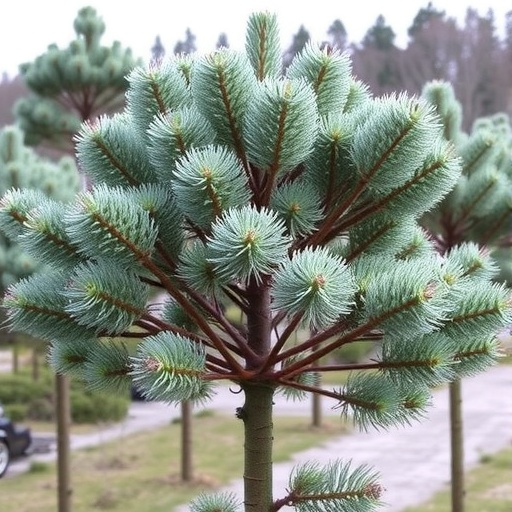
A simple combination of grass mulch and weekly watering could dramatically improve the survival of young pine trees facing lethal frost in Ethiopia’s highlands, according to a three-year field experiment. The low-cost approach increased seedling height, stem thickness and survival by about 34 percent compared with unmanaged trees, offering a potentially practical tool for reforestation projects in landscapes where frozen nights routinely undo months of planting work. The study focused on Pinus patula, a fast-growing tree widely used in tropical and subtropical forestry, but the implications reach beyond a single species. In many restoration programs, the decisive battle is not whether a seedling can germinate, but whether it can survive its first few cold, dry seasons in the field.
The research was conducted in Angolelana Tera District in Ethiopia’s North Shewa Zone, at an elevation of about 2,779 metres. The site experiences a sharp daily temperature contrast: average annual temperatures are relatively mild, but minimum temperatures can fall below freezing during the dry-season months from October through January. Under clear skies, the ground loses heat rapidly through infrared radiation, cooling the air immediately above the soil. This produces frost even when daytime temperatures may rise to 18–22 °C. Such rapid thermal swings are particularly dangerous for recently planted trees, whose small root systems, limited leaf area and tender tissues leave little physiological margin for error.
Frost injury is more than a superficial coating of ice. When temperatures fall sufficiently, water outside plant cells freezes first, lowering the water potential of the surrounding tissue and drawing liquid water out of cells. The resulting dehydration can rupture membranes, damage proteins and interrupt the transport systems that move water and nutrients through the plant. Ice can also spread through natural openings or damaged tissue, extending injury from leaves and shoots into stems. Young seedlings are especially vulnerable because they have not yet developed the structural reserves or cold-acclimation capacity of mature trees. In highland Ethiopia, where frost has been reported as a major cause of seedling mortality and can kill more than 80 percent of exposed plantings, this biological process becomes a major barrier to ecological restoration.
To test possible solutions, the researchers established a randomized complete block experiment with three replications. The field plots measured 6 by 6 metres, with spacing between plots and blocks designed to reduce interference among treatments. The team compared six management strategies: grass mulch combined with watering, watering alone, mineral fertilization, copper oxychloride spraying, physical sack barriers and an untreated control. Seedlings in the two watering treatments received eight litres of water per plant each week during the frost-prone period. The fertilization treatment received triple superphosphate and urea at planting, followed by additional urea applications at six, 12, 18 and 24 months. Copper oxychloride was applied to target ice-nucleation-active bacteria, while sack structures were placed around seedlings to interrupt cold-air drainage.
The strongest performance came from the most straightforward interventions. After three years, seedlings receiving watering alone reached an average height of 77 centimetres, while those receiving mulch plus watering reached 66 centimetres. Their root-collar diameters—the width of the stem at the transition between root and shoot—were 2.03 and 1.93 centimetres, respectively. Untreated seedlings averaged just 49 centimetres in height and 1.3 centimetres in root-collar diameter. The mulched and watered treatment also produced the highest reported survival, at 83 percent. Although watering alone generated greater average height and stem diameter in the reported measurements, both moisture-based treatments substantially outperformed the control in the combined assessment of growth and survival.
The result may appear surprising because mulch can reduce the flow of heat from deeper soil layers toward the surface. Yet mulch also changes the seedling’s immediate microclimate in several beneficial ways. A layer of grass or other plant material shades the soil by day, slows evaporation and keeps moisture available around the roots. At night, the mulch-covered surface can reduce convective heat loss and moderate abrupt temperature changes. It can also limit frost heaving, a mechanical process in which freezing water expands in the soil and lifts or tears fine roots. Watering contributes through a different physical pathway: moist soil has greater thermal mass than dry soil and can absorb more solar energy during the day, releasing some of that stored heat after sunset. Together, these effects help keep the root zone from undergoing extreme temperature fluctuations.
The researchers found statistically significant treatment effects for the main growth measurements. One-way analysis of variance produced a probability value of 0.03 for height and 0.02 for root-collar diameter, both below the conventional 0.05 threshold. Survival showed an even stronger treatment effect, with a reported probability value of 0.001; the researchers analyzed survival using a Poisson log-linear model as well as post-hoc comparisons. They also reported that the data met checks for normality, independence and homogeneity where these assumptions applied. These results indicate that the differences among management strategies were unlikely to be explained solely by random variation within the experiment, although the relatively small number of replications means the findings should be tested across more sites, seasons and planting conditions.
Other treatments did not emerge as clear winners under the field conditions. Fertilization can support cell division and recovery, particularly when phosphorus is limiting, but adding nutrients may also accelerate shoot growth, increase leaf area and reduce stored non-structural carbohydrates. Those changes can make plants less cold-hardy if tissues remain physiologically active when freezing arrives. Nitrogen, in particular, can promote vulnerable new growth. Copper compounds were intended to suppress ice-nucleation-active bacteria such as Pseudomonas syringae, which can trigger ice formation at relatively warm sub-zero temperatures on plant surfaces. However, the study notes that these bacteria may be less abundant in warm, humid tropical and subtropical environments than in temperate regions. The sack barriers, meanwhile, could reduce wind exposure but offered limited protection against the radiative cooling that drives many frost events.
For restoration planners, the attraction of the winning treatments lies in their relative simplicity. Unlike heated shelters, mechanical sprinklers operated during individual frost nights or chemical interventions, weekly watering and locally available grass mulch can be incorporated into routine seedling care. The approach is not a universal prescription: water availability, mulch thickness, soil texture, labour costs and the timing and severity of frost will determine whether it is practical elsewhere. Excessive moisture can also create disease risks, and poorly managed mulch may compete with seedlings or harbour pests. Nevertheless, the experiment shows that managing the seedling’s water balance and root-zone climate can be more valuable than simply adding fertilizer or erecting a barrier.
The authors argue that protecting seedlings during their earliest years could help restore degraded highland landscapes where frost, low soil fertility and seasonal drought act together. Pinus patula is already important in Ethiopia for reforestation, erosion control, fuelwood and construction, and it grows across a broad elevation range in the country. But the researchers emphasize that further work is needed before the strategy is generalized. Larger trials should compare different mulch materials and depths, optimize watering schedules, quantify costs and test combinations of phosphorus, urea and copper treatments under controlled conditions. For now, the central message is strikingly concrete: in a landscape where a single clear night can destroy a forest’s future, keeping young trees watered and their roots covered may provide the most effective first line of defence.
Cite this news
SCIENMAG. (August 27, 2026). Management strategy boosts Pinus patula survival and growth in frost-prone areas. https://scienmag.com/management-strategy-boosts-pinus-patula-survival-and-growth-in-frost-prone-areas/
SCIENMAG. "Management strategy boosts Pinus patula survival and growth in frost-prone areas." Scienmag, 27 August 2026, https://scienmag.com/management-strategy-boosts-pinus-patula-survival-and-growth-in-frost-prone-areas/. Accessed 27 August 2026.
SCIENMAG. "Management strategy boosts Pinus patula survival and growth in frost-prone areas." Scienmag. August 27, 2026. https://scienmag.com/management-strategy-boosts-pinus-patula-survival-and-growth-in-frost-prone-areas/


