


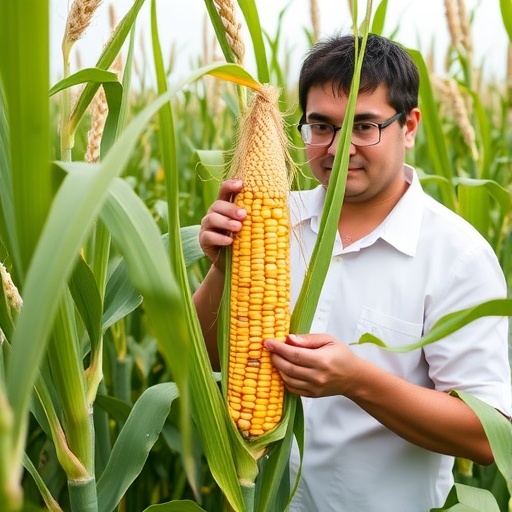
Maize breeders in Nepal have identified a set of genetically distinct inbred lines that could help produce higher-yielding hybrid varieties, according to a study combining field measurements with DNA-based analysis. The research examined 24 maize inbred lines maintained by Nepal’s National Maize Research Program and found substantial differences in growth, flowering, ear structure, kernel production and grain yield. Three lines—RML76, RML17 and RML96—performed particularly well, producing between 2,190 and 2,240 kilograms of grain per hectare under the study conditions. The findings offer breeders a detailed map of useful variation within Nepal’s maize germplasm, potentially accelerating the development of hybrids better adapted to local farming environments.
The work addresses a practical problem facing maize production in Nepal. Maize is the country’s second-most important cereal crop, occupying roughly 0.91 million hectares and producing about 3.19 million tonnes annually, according to figures cited by the researchers. Yet average productivity remains below what improved genetics and management could achieve. Farmers’ access to high-performing hybrid seed is limited by fragmented seed systems, while crops are also exposed to diseases, pests, drought, temperature variation and other environmental stresses. Hybrid breeding depends on crossing genetically different but complementary parental lines. When the parents are sufficiently distinct, their offspring can display heterosis, or hybrid vigor—a biological effect that can produce stronger plants, greater resilience and higher yields than either parent.
Finding the right parents requires more than simply choosing the plants that look most productive in one field. The researchers therefore assessed the lines in two consecutive growing seasons, from October 2022 to March 2023 and from October 2023 to March 2024, at Rampur in Chitwan, Nepal. The experimental site lies at an elevation of 228 meters, on sandy loam soil with an average pH of 6.36. Each line was grown in an alpha lattice design with three replications. This design divides the field into smaller incomplete blocks, reducing the effects of soil and microenvironmental differences that might otherwise obscure genetic contrasts. Plants were grown with 20-centimeter spacing within rows separated by 75 centimeters, under standard fertilizer, irrigation and weed-management practices.
The team recorded 17 characteristics from selected plants, including flowering time, maturity, plant and ear height, stem diameter, leaf dimensions, tassel structure, ear length and diameter, kernel rows, kernels per row, thousand-kernel weight and grain yield. One especially important flowering measurement was the anthesis-silking interval, or ASI: the number of days between pollen release from the male flower and silk emergence from the female flower. A short ASI generally indicates that pollination is more likely to succeed under stress, because pollen and receptive silks are available at nearly the same time. Across the lines, ASI ranged from 2.17 to 2.91 days, with an average of 2.50 days. Although the interval was relatively narrow, the broader combination of plant architecture and yield traits revealed pronounced differences among the genotypes.
Grain yield varied from 1,245 to 2,240 kilograms per hectare, with a mean of 1,779 kilograms per hectare. RML76 was the leading line at 2,240 kilograms per hectare, followed by RML17 at 2,207 kilograms per hectare and RML96 at 2,190 kilograms per hectare. The three highest-yielding lines were grouped together in Cluster V, a classification generated from the combined pattern of measured traits. They were characterized not only by high yield but also by more kernel rows per ear, greater plant height, greater ear height and comparatively longer anthesis-silking intervals. This combination illustrates why breeders rarely select parents on yield alone: a high-yielding line may carry valuable ear traits or adaptation characteristics, but its usefulness in a cross also depends on how those traits complement the second parent.
To determine which traits contributed most strongly to overall variation, the researchers used principal component analysis, a statistical method that compresses many correlated measurements into a smaller number of composite axes. The first principal component accounted for 26.16 percent of the cumulative variance and was influenced heavily by grain yield, ear length, leaf length, leaf breadth, leaf area, ear height and plant height. In practical terms, these traits were among the strongest contributors to the differences separating the lines. Cluster analysis produced a maximum distance of 862.61 between cluster centroids, with Clusters II and V showing the greatest genetic dissimilarity according to the phenotypic dataset. Such separation may be useful in breeding programs because crosses between carefully selected, contrasting groups can increase the chance of generating offspring with desirable combinations of traits.
Field appearance, however, is not a perfect measure of inherited genetic difference. Plant height, leaf size, flowering time and yield can all change in response to temperature, rainfall, soil fertility, planting date and other environmental conditions. To obtain a more stable picture of genetic relationships, the researchers analyzed simple sequence repeat markers, commonly known as SSRs or microsatellites. SSRs are short, repeated stretches of DNA that can vary in length among individuals. Because the variation is encoded in the genome rather than produced by the growing environment, SSR profiles can reveal relationships that may be hidden or distorted in field observations. They are also codominant markers in many applications, meaning different versions of a DNA region can be distinguished, making them useful for identifying alleles and organizing breeding material.
The team tested 29 SSR primers on DNA extracted from young maize leaves. The leaves were ground in liquid nitrogen, treated with a cetyltrimethylammonium bromide, or CTAB, extraction solution, purified through chloroform and isopropanol steps, and then used as templates for polymerase chain reaction amplification. The resulting DNA fragments were separated on agarose gels and scored according to whether a band of a particular size was present or absent. Of the 29 markers, 26 were polymorphic, meaning they detected differences among the inbred lines. Together, these markers revealed 77 alleles, with fragment sizes ranging from 50 to 1,000 base pairs. Polymorphic information content, or PIC, ranged from 0.15 to 0.68. PIC is a measure of how informative a genetic marker is: markers with alleles distributed more evenly among samples provide greater power to distinguish lines.
The SSR data confirmed that the 24 inbred lines contained meaningful molecular diversity, supporting the field-based evidence that Nepal’s breeding material is not genetically uniform. The researchers used the marker profiles to calculate genetic similarities and construct groups with the unweighted pair-group method using arithmetic averages, or UPGMA. Combining these molecular relationships with agro-morphological data gives breeders two complementary forms of evidence. Field traits show how a line behaves under cultivation, while DNA markers help reveal how closely related the lines are and whether apparently similar plants may carry distinct genetic backgrounds. The study does not itself demonstrate that any particular cross will produce a superior commercial hybrid, and the reported results come from one research location and two seasons. Further crossing trials, multilocation testing and evaluation under drought, disease or other stresses will be needed before recommendations can be made for farmers.
Even so, the findings provide a valuable starting point for targeted hybrid development. RML76, RML17 and RML96 emerge as promising high-yielding candidates, while genetically distant lines from contrasting clusters may serve as complementary parents rather than being judged solely by their individual grain production. The study’s central message is that Nepal’s maize breeding resources contain enough phenotypic and molecular variation to support more strategic selection. By combining measurements such as ear architecture and flowering behavior with allele-level DNA profiles, breeders can reduce the guesswork involved in assembling parental combinations. In a crop that supports food, livestock feed, household income and rural employment, that genetic inventory could help turn local diversity into hybrids capable of raising productivity and strengthening maize production under Nepal’s changing agricultural conditions.
Cite Scienmag News
Alan Morgan. (August 27, 2026). Scientists Characterize Maize Inbred Lines Using Agronomic Traits and SSR Molecular Markers. Scienmag. https://scienmag.com/scientists-characterize-maize-inbred-lines-using-agronomic-traits-and-ssr-molecular-markers/
Alan Morgan. "Scientists Characterize Maize Inbred Lines Using Agronomic Traits and SSR Molecular Markers." Scienmag, 27 August 2026, https://scienmag.com/scientists-characterize-maize-inbred-lines-using-agronomic-traits-and-ssr-molecular-markers/. Accessed 3 September 2026.
Alan Morgan. "Scientists Characterize Maize Inbred Lines Using Agronomic Traits and SSR Molecular Markers." Scienmag. August 27, 2026. https://scienmag.com/scientists-characterize-maize-inbred-lines-using-agronomic-traits-and-ssr-molecular-markers/


