

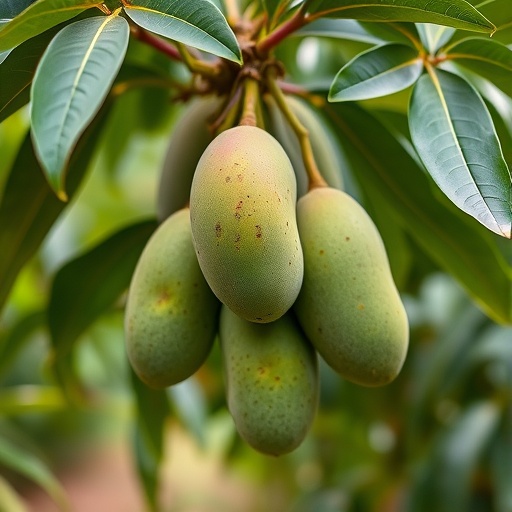
A Three-Part Disease-Fighting Strategy Could Dramatically Increase Ghana’s Mango Yields
A new study from southern Ghana suggests that mango farmers can more than double productivity gains from bacterial black spot disease by combining orchard hygiene, locally developed treatments and targeted chemical control. The finding comes as the disease continues to threaten one of Ghana’s most valuable fruit industries, damaging mangoes before they reach domestic or export markets and putting pressure on the incomes of thousands of smallholder farmers.
Mango bacterial black spot, or MBBS, is caused by the plant-pathogenic bacterium Xanthomonas citri pathovar mangiferaeindicae. The infection produces dark, expanding lesions on leaves, stems and fruit. These lesions are more than a cosmetic problem: they can weaken trees, reduce photosynthetic tissue and make fruit unmarketable. The bacterium spreads efficiently in warm, humid conditions, moving between plants in wind-driven rain or splashing water and entering through natural openings or wounds. In untreated orchards, previous studies have reported yield losses approaching 72 percent, while infected fruit may be rejected by export buyers because of strict quality and phytosanitary standards.
The stakes are unusually high for Ghana. Mango cultivation has expanded from a largely subsistence activity into a commercial sector supporting rural employment, processing and international trade. Around 81,000 hectares are reportedly devoted to mango production in the country, generating approximately 98,500 metric tons annually. In 2023, mango exports brought in about $55.1 million, although earnings have declined from previous years amid competition in major markets such as the United Kingdom and the Netherlands. The crop is particularly important in rural communities, where reduced harvests can affect household income, education, food security and the ability to maintain farms over the long term.
To investigate which disease-management approaches actually improve productivity, researchers surveyed 270 mango farmers in Ghana’s Eastern Region, focusing on the Yilo Krobo and Lower Manya Krobo municipalities. The two areas account for more than 60 percent of the region’s mango-growing land and have experienced serious MBBS losses. The participants were selected from a population of 831 identified mango farmers using a multistage sampling process. The average farmer was 46 years old, had approximately nine years of mango-growing experience and managed a plantation about 12 years old. Average yield across the sample was 22.37 tons per hectare, but the wide variation between farms indicated substantial differences in disease pressure, resources and management.
The researchers divided disease-control practices into three broad categories. Cultural control involved pruning infected branches, removing fallen fruit and plant debris, controlling weeds, improving tree spacing and managing canopies to increase airflow. These measures reduce the amount of infectious material in the orchard and make conditions less favourable for bacterial spread, but they require regular labour and careful timing. Indigenous control included locally accessible materials such as wood ash and plant-based extracts, as well as windbreaks that can reduce the movement of wind-driven rain. Chemical control relied mainly on copper-containing products and plant-defence activators such as Actigard. Although farmers often refer to these products as fungicides, copper compounds can act against bacteria and are commonly used to suppress bacterial diseases in fruit crops.
The study used two statistical approaches to separate farmers’ choices from the effects of the treatments themselves. A multivariate probit model was used because farmers could adopt several strategies at once rather than choosing only one. This model also allowed the researchers to account for hidden factors that might make the decisions to use cultural, indigenous and chemical methods related to one another. To estimate yield effects, the team used inverse probability weighting regression adjustment, or IPWRA. In practical terms, this method first estimates how likely each farmer was to adopt a particular strategy based on characteristics such as farm size, training and market access, then weights the yield comparisons to reduce bias caused by those differences. Diagnostic tests showed good overlap and balance among treatment groups, strengthening confidence that the estimated differences were not simply due to comparing fundamentally different kinds of farmers.
The raw yield patterns were striking. Farmers using cultural practices alone recorded an average of 8.18 tons per hectare, the lowest figure in the comparison. Indigenous methods alone were associated with 15 tons per hectare, while chemical control alone produced 19.35 tons per hectare. Combining indigenous and chemical methods raised average yield to 27.50 tons per hectare. Cultural and indigenous methods together reached 23.88 tons per hectare, and cultural plus chemical control produced 32.50 tons per hectare. The highest observed average, 32.63 tons per hectare, came from using all three approaches simultaneously.
The adjusted analysis produced an even clearer picture of the benefits associated with combining strategies. Compared with the study’s baseline cultural-management category, chemical control alone was associated with a yield increase of 9.19 tons per hectare, while indigenous control alone produced a gain of 5.80 tons per hectare. Combining indigenous and chemical methods increased yield by 14.73 tons per hectare. Cultural and indigenous practices together generated a gain of 21.14 tons per hectare, and cultural plus chemical control produced a 23.32-ton increase. The largest estimated gain, 24.27 tons per hectare, came from the full combination of cultural, indigenous and chemical measures.
The results reflect the biology of disease management. Sanitation and pruning can remove sources of bacterial inoculum, but they may not be enough when disease pressure is high. Copper-based treatments can reduce pathogen populations quickly, but their effectiveness comes with costs, repeated-application requirements and potential risks to workers, soil and the wider environment. Locally available materials may provide affordable supplementary protection, but their performance can vary with preparation, concentration and timing. Used together, however, the methods attack different stages of the disease cycle: cultural practices reduce opportunities for spread, indigenous measures provide accessible additional protection, and chemical treatments deliver targeted suppression during vulnerable periods such as flowering and fruit development.
The analysis also revealed why farmers do not all adopt the same strategy. Larger farms were more likely to use chemical treatments because they are relatively quick to apply across extensive areas. Farmers relying on hired labour were less likely to choose labour-intensive cultural controls and more likely to use chemicals. By contrast, farmers with MBBS-specific training were more likely to adopt indigenous methods. Access to agricultural extension services was associated with lower reliance on chemical control, suggesting that advisers may help farmers use more diverse and sustainable management systems. Certification also mattered: GLOBALG.A.P.-certified farmers showed a greater tendency to use indigenous practices, potentially because certification and export markets place greater emphasis on food safety, traceability and limits on chemical residues.
Market destination influenced decisions as well. Farmers supplying processing markets were more likely to adopt indigenous controls, which may reflect pressure to meet standards for safer or residue-conscious production. Such incentives could become increasingly important as Ghana competes for space in international mango markets. But the study also highlights a practical barrier: only 58.15 percent of surveyed farmers reported access to agricultural extension services, and roughly half had received no formal training specifically related to MBBS. Nearly 39 percent had no formal education, making clear, hands-on instruction especially important for practices that depend on recognizing symptoms, timing applications and maintaining orchard sanitation.
The authors caution that the findings do not mean farmers should simply increase chemical use. Copper compounds can be valuable tools, but repeated or inappropriate application can increase costs, expose workers and contribute to environmental contamination or selection for less-sensitive bacterial populations. Farmers may also lack protective equipment and safe disposal systems. An integrated approach is intended to reduce dependence on any single intervention, not to add inputs indiscriminately. It requires disease monitoring, pruning and sanitation, locally suitable preventive measures and carefully timed chemical applications supported by technical advice.
Because the research was based on a survey rather than a randomized field experiment, the yield estimates should be interpreted as strong adjusted associations rather than an absolute guarantee of the same increase on every farm. The IPWRA method corrects for measured differences among farmers, but unmeasured factors may still influence both management choices and productivity. The researchers also note that the dataset is not publicly available because respondents were concerned that financial information could be used by third parties. Even with these limitations, the consistency of the yield pattern across observed and adjusted analyses provides a compelling signal: MBBS control works best as a coordinated system rather than as a single-product solution.
For Ghana’s mango sector, the message is both scientific and economic. Improving disease management could protect export quality while raising the output available for fresh sales, juice, pulp and dried-fruit processing. The researchers recommend expanding farmer training, demonstration plots and extension services, alongside better access to certification and markets that reward sustainable production. They also call for further research into the long-term environmental and financial trade-offs of each strategy and into whether the same combinations work across Ghana’s different growing regions. If those efforts succeed, a disease that has become a symbol of vulnerability in Ghana’s mango orchards could instead help drive a broader shift toward integrated, climate-resilient and more productive farming.
Cite this news
SCIENMAG. (August 27, 2026). Disease Management Boosts Mango Yields Amid Bacterial Black Spot in Southern Ghana. https://scienmag.com/disease-management-boosts-mango-yields-amid-bacterial-black-spot-in-southern-ghana/
SCIENMAG. "Disease Management Boosts Mango Yields Amid Bacterial Black Spot in Southern Ghana." Scienmag, 27 August 2026, https://scienmag.com/disease-management-boosts-mango-yields-amid-bacterial-black-spot-in-southern-ghana/. Accessed 27 August 2026.
SCIENMAG. "Disease Management Boosts Mango Yields Amid Bacterial Black Spot in Southern Ghana." Scienmag. August 27, 2026. https://scienmag.com/disease-management-boosts-mango-yields-amid-bacterial-black-spot-in-southern-ghana/


