


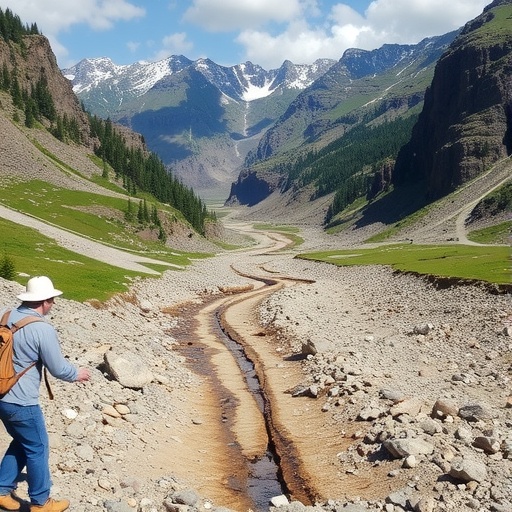
A mathematical model of how earthquake faults permanently deform the ground has revealed that the complex internal makeup of an alluvial valley may matter less than expected—unless the soil’s stiffness changes sharply across the valley. The finding, reported by Hasan Faik Kara in Earthquake Engineering and Engineering Vibration, addresses a deceptively simple question with major consequences for earthquake engineering: when a strike-slip fault ruptures beneath or beside a sediment-filled valley, how much does the valley’s gradual variation in material properties alter the final displacement left at the surface? The study suggests that, for many realistic cases, engineers may be able to treat the valley as homogeneous without losing much accuracy. But the result comes with an important warning. If the material properties vary substantially within a functionally graded zone, the surface pattern of permanent ground dislocation can change enough to require a more detailed analysis.
Permanent ground dislocation is the part of an earthquake’s deformation that remains after the shaking has stopped. Unlike temporary vibrations, which send waves through the ground and then decay, permanent displacement records the lasting rearrangement caused by fault slip. A strike-slip fault moves mainly horizontally, with one block of crust sliding laterally past the other. In an idealized setting, the ground surface might shift in a relatively direct and predictable way. Real landscapes are less uniform. Valleys are often filled with alluvium—layers of sediment deposited by rivers, floods and other geological processes—which can be softer and mechanically different from the bedrock around them. That contrast can bend, amplify or redistribute deformation. The central challenge is therefore to understand how fault-induced displacement interacts with the geometry and changing stiffness of sedimentary basins.
Kara represented the valley as a two-dimensional half-cylindrical basin embedded in a surrounding elastic half-space. In a cross-sectional view, the alluvial material forms a curved, semicircular depression, while the neighboring half-space represents homogeneous bedrock extending beneath and around it. This geometry is an idealization, not a literal description of every valley, but it provides a mathematically tractable approximation for studying how curved basin boundaries affect surface motion. The model assumes that both the valley and the surrounding medium are isotropic, meaning their mechanical response is the same in every direction, and linearly elastic, meaning stress is proportional to strain within the range considered. The surrounding half-space is homogeneous, whereas the valley’s shear modulus—the parameter describing its resistance to shearing deformation—is allowed to vary spatially.
That spatial variation is the defining feature of a functionally graded material. Rather than placing an abrupt boundary between two soils with sharply different stiffnesses, a graded model permits the shear modulus to increase or decrease continuously from one location to another. Such a description can capture sediment that becomes denser with depth, deposits that transition gradually from loose soil to compact material, or a basin whose geological history has produced a smooth mechanical gradient. The distinction matters because waves and static deformation respond differently to abrupt and gradual contrasts. A sudden change in stiffness can reflect and concentrate mechanical disturbances, while a gradual change may distribute them over a broader region. By incorporating a position-dependent shear modulus into the valley, the study examines whether that added realism substantially changes the final surface dislocation generated by a fault.
The fault in the model lies at the intersection between the alluvial valley and the surrounding half-space. This arrangement allows the calculation to focus on a fault crossing the boundary between mechanically distinct geological regions, where deformation may be especially sensitive to material contrast. The researchers treated the problem as a static dislocation problem: the fault slips, the surrounding elastic medium responds, and the resulting permanent displacement field is calculated. This does not reproduce every feature of an actual earthquake. It does not, for example, model the full time history of rupture, nonlinear soil behavior, pore-fluid pressure changes or liquefaction. Instead, it isolates the lasting geometrical and mechanical response of the ground after a prescribed fault movement. That isolation helps expose the role of material grading without mixing it with the many additional variables present in a dynamic earthquake simulation.
To solve the equations, Kara used a finite Fourier transform, a mathematical technique that converts spatially varying functions into combinations of simpler wave-like components. In transformed space, the governing equations and boundary conditions can often be manipulated more efficiently than in their original coordinate form. The resulting displacement functions were expressed in closed form using power series and series involving hypergeometric functions. Hypergeometric functions are broad families of special functions that arise in many problems involving curved geometries, variable coefficients and boundary-value conditions. Here, they provide a compact way to represent the response of the graded valley. Unknown coefficients in the series were then determined by imposing the physical requirements at the boundaries: continuity and compatibility where the valley meets the surrounding medium, and the appropriate traction or stress conditions at the ground surface and fault. The authors describe the resulting expression as an analytical exact solution within the assumptions of the model.
Analytical solutions of this kind are valuable even when they simplify the real world. Numerical methods such as finite-element modeling can represent irregular topography, complicated soil layers and nonlinear constitutive behavior, but they may require substantial computation and can obscure which physical parameters control the result. A closed-form or semi-closed-form solution acts as a benchmark: researchers can use it to test numerical codes, identify limiting cases and rapidly explore how changes in geometry or stiffness influence displacement. It also makes it easier to distinguish effects caused by material variation from artifacts of mesh resolution or numerical approximation. In this study, the analytical formulation enables systematic numerical evaluation of the surface dislocation for different levels of nonhomogeneity within the valley.
The calculations produced a result that may surprise anyone expecting every geological detail to strongly affect earthquake deformation. In the scenarios examined, nonhomogeneity within the alluvial valley had only a limited influence on the permanent surface dislocation when the material properties varied modestly. In practical terms, replacing the functionally varying valley with an equivalent homogeneous medium often produced a sufficiently similar estimate. The researchers found that the simplifying approximation becomes less reliable when the shear modulus changes significantly across the graded zone. Under those conditions, the distribution of displacement at the surface can depart more noticeably from the homogeneous prediction. The key variable is therefore not simply whether the valley is nonhomogeneous, but how large and spatially consequential the stiffness variation is.
That distinction could be important for assessing earthquake hazards in sediment-filled valleys, where detailed subsurface information is often incomplete. Engineers routinely have to balance the desire for highly realistic models against the cost and uncertainty of obtaining the necessary geological data. If stiffness changes gradually and within a relatively narrow range, a homogeneous approximation may provide a practical first estimate of permanent fault displacement. Such a model could support preliminary evaluations of roads, pipelines, foundations and other infrastructure crossing or approaching active faults. However, the study should not be interpreted as evidence that all valleys can safely be modeled as uniform blocks of soil. Strong contrasts in stiffness, unusual basin geometry or highly variable deposits could produce a larger effect, and the analytical model does not include soil yielding, liquefaction or other irreversible mechanisms that can dominate real earthquake damage.
The work also highlights why permanent displacement should be considered separately from the intensity of shaking. A valley can modify seismic waves through reflection, diffraction and resonance, potentially changing the amplitude and duration of ground motion experienced during an earthquake. Permanent dislocation, by contrast, is the residual offset after those transient motions have passed. The two phenomena are related through the geological setting but are not interchangeable measures of hazard. Kara’s model focuses on the static displacement field associated with strike-slip faulting and asks how a graded valley transmits that lasting deformation to the surface. Its conclusion is therefore specific: moderate spatial variation in elastic properties may not greatly alter the permanent offset predicted by a simpler model, while large variations deserve explicit treatment. The result offers a sharper rule for deciding when geological complexity is essential—and when it may be safely simplified.
Cite Scienmag News
Violet Maxwell. (August 27, 2026). Study reveals permanent ground displacement from strike-slip fault in variable alluvial valley. Scienmag. https://scienmag.com/study-reveals-permanent-ground-displacement-from-strike-slip-fault-in-variable-alluvial-valley/
Violet Maxwell. "Study reveals permanent ground displacement from strike-slip fault in variable alluvial valley." Scienmag, 27 August 2026, https://scienmag.com/study-reveals-permanent-ground-displacement-from-strike-slip-fault-in-variable-alluvial-valley/. Accessed 4 September 2026.
Violet Maxwell. "Study reveals permanent ground displacement from strike-slip fault in variable alluvial valley." Scienmag. August 27, 2026. https://scienmag.com/study-reveals-permanent-ground-displacement-from-strike-slip-fault-in-variable-alluvial-valley/


