


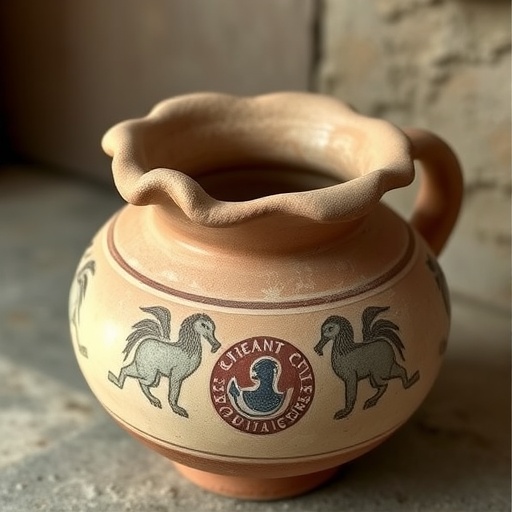
For centuries, handmade pots in the Roman province of Thrace were treated as the humble leftovers of archaeology: rough, locally made vessels assumed to belong to ordinary households and to express a vaguely defined “Thracian” identity. A new multidisciplinary investigation now suggests that these unassuming objects were far more significant. In rural settlements along Bulgaria’s Tundzha River, handmade pottery appears to have formed part of a coordinated regional tradition, with vessels made in small workshops, transported across distances of roughly 40 kilometres and used to store valuable animal products such as meat and fat. The findings recast the pots not as isolated household products, but as specialized containers moving through the Roman countryside.
The study, published in Archaeological and Anthropological Sciences, examined handmade ceramics from four Roman-period rural settlements in the Yambol District of southeastern Bulgaria. The principal site, Yurta-Stroyno, was occupied mainly during the second and third centuries AD, while comparable pottery came from surface surveys at Karavelovo, Robovo and Kozarevo. The settlements lay within the fertile valley of the Tundzha River, a landscape of farms, crafts and expanding communities incorporated into the Roman Empire around AD 45–46. By the second and third centuries, the area had grown around the important settlement of Kabyle and its military presence, creating a network in which local producers and consumers could interact with wider regional markets.
Handmade pottery was not a marginal component of these communities. Across the four sites, it accounted for between 8 and 19 percent of the recorded ceramic assemblages. At several settlements, it was more common than wheel-made coarse cooking ware, the type of vessel traditionally associated with Roman domestic life. The forms themselves were limited but distinctive. Most were pots with flat bases, curved S-shaped bodies and simple rims, sometimes fitted with looped strap handles. A second form had straighter or slightly inward-sloping walls. The surviving fragments indicate considerable variation in size rather than standardized production: rim diameters ranged from about 90 to 200 millimetres, with two unusually large examples approaching 300 millimetres. Approximate capacities of two well-preserved vessels were 2.2 and 3.8 litres.
To discover where the vessels were made, the researchers combined several forms of archaeometry. Thin sections of the pottery were examined under polarized light microscopes, allowing mineral grains and rock fragments embedded in the ceramic fabric to be identified. X-ray powder diffraction revealed the crystalline minerals present, while wavelength-dispersive X-ray fluorescence measured 26 major, minor and trace elements. These results were compared with a new reference database built from 93 clay and rock samples collected across approximately 85 by 85 kilometres of the Tundzha region. The geological fingerprints separated the pottery into three main fabric groups, each reflecting a different raw-material landscape.
The first fabric, called HM F01 or the gabbroic fabric, contained abundant fragments of dark, basic igneous rock rich in plagioclase and pyroxene. Its closest geological match was found on the southeastern slopes of the Monastery Heights, a mountainous area roughly 40 kilometres from several of the settlements. The second, HM F02 or the granitic fabric, was dominated by quartz, feldspar and mica derived from granite or metagranite. Its likely sources lay in a broad zone around the Dereorman River, closer to Yurta-Stroyno and Karavelovo. The third, HM F03 or the volcanic fabric, contained fine-grained volcanic rocks, including trachyte, and was most closely matched by clays near Kozarevo itself. These were not merely visual similarities: the geological and ceramic samples also displayed corresponding elemental patterns in multivariate statistical analyses.
The provenance evidence revealed a consistent pattern at each settlement. Communities typically used one locally available fabric but also received vessels made from another source area. At Yurta-Stroyno and Karavelovo, granitic HM F02 was the local pottery, while gabbroic HM F01 from the Monastery Heights region was imported. At Kozarevo, volcanic HM F03 was locally produced, whereas HM F01 arrived from the Monastery Heights. The imported vessels therefore travelled approximately 38 to 45 kilometres, despite the fact that broadly similar pots could have been made from nearby clay. This pattern suggests that transport was not driven simply by a shortage of suitable raw materials. Instead, the pots may have been moving because of what they were designed to contain.
Their manufacture also points to a shared technological tradition. The researchers used X-ray microtomography, or micro-CT, to scan 28 pottery fragments without destroying them. The technique produces three-dimensional images of the ceramic’s internal structure, including pores, inclusions and constructional joints. By studying the shape and orientation of these features, the team could distinguish between alternative hand-building methods. Experimental replicas made by sequential slab building and by transforming thick coils provided a control for interpreting the archaeological scans.
The scans showed that the vessels were primarily built by joining broad, irregular slabs of clay one after another. In parallel sections, the joints formed fluid, arched structures, while horizontal sections exposed discontinuities where separate slabs had been joined. These signatures differed from those expected in coil-built vessels, where horizontal joints and flattened chains of pores would be more prominent. The slab-built walls were attached to bases that had apparently been formed as separate clay elements. Handles were attached in two interchangeable ways: either by pressing a clay strip onto the vessel exterior and reinforcing the joint, or by inserting the handle ends through perforations in the wall and smoothing them on the inside. The same construction methods appeared across different fabrics, indicating that potters working in distinct production zones shared technical knowledge.
The vessels were also fired under relatively low and poorly controlled conditions. Mineral transformations identified through X-ray diffraction indicate firing temperatures generally ranging from about 600–650 °C to 800–850 °C, with some samples potentially reaching 900 °C. Remnants of minerals that would disappear at higher temperatures, including clay minerals and calcium-bearing phases, helped establish these limits. Uneven coloration and locally reduced surfaces suggest that the pots may have been fired in pits or bonfires, although poorly controlled kilns could produce similar results. The combination of local clays, simple firing installations and decentralized production is consistent with small-scale workshops rather than a centralized industrial pottery industry.
The most revealing evidence came from the chemistry of the pots’ former contents. Organic residue analysis was carried out on 13 sherds from Yurta-Stroyno, and 12 retained sufficient quantities of lipids for identification. The residues included long-chain saturated fatty acids, especially palmitic and stearic acids, together with compounds associated with animal adipose fats. Carbon-isotope measurements indicated both ruminant and non-ruminant fats, or mixtures of the two, consistent with products derived from animals such as cattle, sheep, goats or pigs. In five vessels, plant lipids were also detected, and two contained miliacin, a chemical biomarker associated with broomcorn millet. One vessel contained molecular markers produced when fats are strongly heated, suggesting that it may have been used for cooking or reheating.
The distribution of the lipids inside the vessels offers a clue to their main purpose. Cooking pots often accumulate their highest concentrations of absorbed fats below the rim, where food and liquid repeatedly contact the walls. In contrast, containers used to store rendered fat or meat preserved in fat can develop a more even chemical signature across the interior. The Thracian pots showed uniformly distributed and sometimes exceptionally concentrated lipids, supporting the interpretation that they were used to store animal products for extended periods. Four vessels also contained compounds associated with beeswax, implying that their interiors may have been deliberately coated to improve sealing and preservation, although some of the signal could derive from honey.
Five sherds were subjected to compound-specific radiocarbon dating of purified fatty-acid residues. The calibrated results placed the fats between AD 26 and 362, firmly within the Roman period and ruling out the possibility that the pottery was merely older Iron Age material surviving in later contexts. This matters because handmade pottery in Thrace had a history stretching back roughly 1,600 years, and archaeologists had often struggled to determine whether Roman examples represented an ancient residual tradition or active contemporary production. The dates, together with the regional clay sources and the technological evidence, show that the vessels were being made and used during the Roman occupation.
The researchers propose that some of the imported pots may have functioned as ancient “meat cans”—containers for preserving, transporting or distributing meat and animal fat. Comparable practices are known elsewhere in the Roman world, including vessels associated with preserved meat and tallow in northern Italy and containers linked to food transport across parts of the Alps. At Yurta-Stroyno, animal bones from cattle, pigs and sheep or goats support the chemical evidence for a meat-based economy. The presence of millet and other plant signals suggests that the pots could also have held mixed dishes or been reused for cooking, but animal products appear to have been their defining contents.
The Monastery Heights production zone presents an intriguing mystery. No securely identified Roman settlement has yet been found there, although inscriptions dedicated to Apollo point to a possible sanctuary in the area during the second and third centuries AD. The researchers suggest that pottery production may have been connected to episodes of animal sacrifice, feasting and the redistribution of surplus meat. Such an interpretation remains provisional, but it could explain why vessels from the same mountainous source travelled repeatedly to rural communities many kilometres away. The pots may have been part of a wider supply chain linking ritual gatherings, local producers and agricultural settlements.
Taken together, the evidence overturns the idea that handmade pottery was simply low-quality household ware with little capacity to circulate. These vessels were made from geographically distinctive clays, transported between production zones and settlements, built according to a shared slab-based tradition and repeatedly used with animal fats and meat. Their survival alongside Roman wheel-made ceramics reflects not cultural isolation, but technological continuity and functional success. In the rural landscape of Roman Thrace, a modest handmade pot could preserve food, carry the products of a feast and connect communities across the countryside—leaving behind a chemical and geological record that modern science is only now beginning to read.
Cite Scienmag News
Courtney Benton. (August 27, 2026). Scientists reveal Roman Thrace’s handmade pottery tradition through integrated clay analysis. Scienmag. https://scienmag.com/scientists-reveal-roman-thraces-handmade-pottery-tradition-through-integrated-clay-analysis/
Courtney Benton. "Scientists reveal Roman Thrace’s handmade pottery tradition through integrated clay analysis." Scienmag, 27 August 2026, https://scienmag.com/scientists-reveal-roman-thraces-handmade-pottery-tradition-through-integrated-clay-analysis/. Accessed 4 September 2026.
Courtney Benton. "Scientists reveal Roman Thrace’s handmade pottery tradition through integrated clay analysis." Scienmag. August 27, 2026. https://scienmag.com/scientists-reveal-roman-thraces-handmade-pottery-tradition-through-integrated-clay-analysis/


