


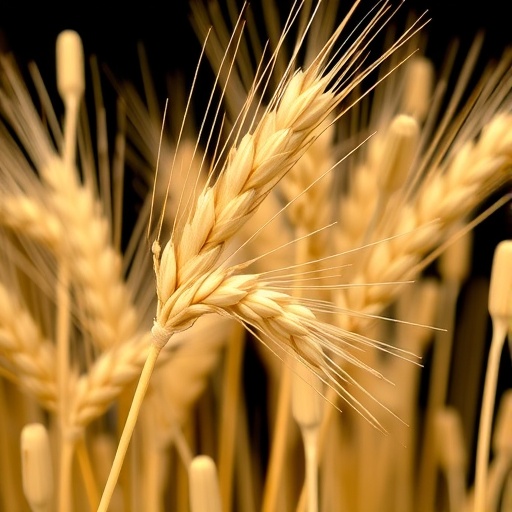
Wheat plants deprived of nitrogen do not simply shrink or produce less valuable grain. In some varieties, they appear to redirect part of their chemistry toward protective compounds that could improve the nutritional profile of wheat kernels. A two-year field study in southern Italy has found that several traditional wheat landraces and older cultivars maintained unusually favorable combinations of grain protein and antioxidant phenolic acids when grown without added nitrogen fertilizer. The results point to an overlooked resource for sustainable agriculture: wheat diversity developed before modern farming became heavily dependent on synthetic nitrogen. The findings do not suggest that farmers can eliminate fertilizer without consequences. Nitrogen deficiency reduced grain protein in both durum and bread wheat, and yield responses varied sharply with weather. But the study shows that some genotypes can preserve grain quality better than others under low-input conditions, offering breeders a set of traits that could become increasingly important as fertilizer prices, pollution and climate instability intensify.
Nitrogen is indispensable to wheat biology. Plants use it to build chlorophyll, amino acids, enzymes and storage proteins, making nitrogen availability a major determinant of both yield and the baking or pasta-making quality of grain. Yet supplying more nitrogen than a crop can absorb creates serious environmental costs. Nitrate can leach into groundwater and rivers, where it contributes to eutrophication, while soil microbes convert some fertilizer nitrogen into nitrous oxide, a powerful greenhouse gas. The challenge is therefore not simply to maximize wheat production, but to produce enough grain with less nitrogen waste. Researchers from the University of Bari Aldo Moro examined whether genetic differences could help meet that challenge. Their field panel contained 29 genotypes: 15 durum wheats, the species widely used for pasta, and 14 common or bread wheats. The collection included regional landraces, cultivars released during the first half of the twentieth century and modern varieties bred under more intensive agricultural systems.
The plants were grown during two consecutive seasons, 2023–2024 and 2024–2025, at Valenzano near Bari. Each genotype was tested under two nitrogen regimes. The first received no nitrogen fertilizer, designated N0; the second received 80 kilograms of nitrogen per hectare, supplied partly before sowing and partly as a top dressing. The researchers measured grain yield per spike, thousand-kernel weight, kernel number per spike, heading time and grain protein content. They also milled whole grains and used high-performance liquid chromatography to identify and quantify six phenolic acids: p-hydroxybenzoic, syringic, vanillic, p-coumaric, ferulic and sinapic acids. These compounds are secondary metabolites, meaning they are not directly required to build the plant’s basic tissues, but they can strengthen cell walls and help defend plants against environmental stress. More than 80 percent of wheat’s phenolic acids are found in insoluble bound forms, concentrated largely in the bran and aleurone layers surrounding the starchy endosperm.
Ferulic acid dominated the chemical profile by a wide margin. Across the genotypes, it accounted for more than 80 percent of the total phenolic acids measured in both wheat species. In durum wheat, total phenolic acid concentrations ranged from 481 to 742.9 micrograms per gram of dry matter, while common wheat ranged from 508.9 to 845.4 micrograms per gram. The difference between wheat types was less important than the effects of year, genotype and growing conditions. Under the wetter 2025 season, nitrogen deprivation generally increased ferulic acid: the average concentration rose from 407.8 to 511.9 micrograms per gram in durum wheat and from 506 to 594.4 micrograms per gram in common wheat when nitrogen was withheld. A similar pattern was not visible in the drier 2024 season, when ferulic acid values under zero and full nitrogen were nearly identical. This contrast is central to the study’s message: the biochemical response to fertilizer depends heavily on the environment in which the crop is grown.
The researchers suggest two biological explanations for the increase in phenolic acids under nitrogen limitation. One is the carbon–nitrogen balance hypothesis. When nitrogen is scarce, plants have less capacity to invest in nitrogen-rich molecules such as proteins. Carbon skeletons produced through photosynthesis may then be diverted toward carbon-based secondary metabolites, including phenolic compounds. The second involves stress protection. Phenolic acids can become incorporated into cell walls, increasing rigidity and potentially reducing water loss or helping tissues tolerate drought. The 2024 crop experienced only 298.6 millimeters of rain between November and June, including an exceptionally dry April with just 10 millimeters. In those conditions, drought stress may have already activated phenylpropanoid metabolism, masking any additional influence from nitrogen supply. The phenylpropanoid pathway produces hydroxycinnamic acids such as ferulic acid, and enzymes including phenylalanine ammonia-lyase are thought to help regulate its activity. The study did not measure enzyme activity or gene expression, however, so this mechanism remains a plausible interpretation rather than a demonstrated causal pathway.
Nitrogen had a much clearer effect on grain protein. In 2024, durum wheat averaged 12.2 percent protein without added nitrogen and 14.4 percent with the fertilizer treatment. Common wheat averaged 13.6 percent under N0 and 15 percent under N80. In the wetter 2025 season, protein levels were lower overall: durum wheat averaged 9.1 percent at N0 and 12.1 percent at N80, while common wheat averaged 10.6 and 13 percent, respectively. These results reinforce nitrogen’s established role in determining grain protein concentration. Yield was more complicated. In the relatively dry 2024 season, nitrogen treatment did not significantly change grain yield per spike in either species. Durum wheat showed little change in kernel number or thousand-kernel weight, suggesting a degree of tolerance to the combined stress of low nitrogen and limited rainfall. Common wheat produced fewer kernels but somewhat heavier ones, a possible compensatory response. In 2025, when moisture was more favorable, nitrogen increased grain yield per spike and kernel number in both species.
The study also revealed why comparing raw protein or phenolic acid concentrations can be misleading. A small grain may contain a high concentration of a compound simply because the compound has not been diluted by starch accumulation, while a high-yielding plant may appear less nutritious on a concentration basis. To separate these effects, the researchers calculated grain protein deviation, or GPD. This statistical index estimates whether a genotype contains more or less protein than expected from its yield and kernel size. They applied a similar approach to ferulic acid, creating a ferulic acid deviation, or FERD. These residual measurements allowed the team to search for plants that genuinely accumulated more protein or phenolic acid than their yield would predict. The analysis showed that low nitrogen weakened the usual negative relationship between yield and protein, probably because severe nitrogen limitation constrained protein accumulation across genotypes and reduced the differences normally associated with yield.
Several varieties stood out under zero nitrogen. Among the durum wheats, the landrace Saragolla locale di Puglia and the old cultivar Appulo showed positive deviations for both grain protein and ferulic acid after accounting for yield and thousand-kernel weight. Other durum genotypes displayed strength in one of the two traits: Grano Ricco, San Pasquale, Dauno III and Polesine performed well for protein, while Zingarello and Saragolla locale di Puglia performed well for ferulic acid. Among common wheats, the landrace Gentil Rosso and the modern cultivars Blasco and Aca 360 combined positive protein and ferulic acid deviations under nitrogen deprivation. The presence of modern varieties in this group is important. The results do not support a simple division in which old wheats are always superior and modern wheats are always dependent on fertilizer. Instead, they show that particular genetic combinations matter more than release date alone. Breeding history can influence nitrogen uptake, nitrogen-use efficiency, remobilization of nitrogen into the grain and regulation of stress-related metabolism, but those traits are distributed unevenly across both traditional and modern germplasm.
The findings arrive as farmers and plant breeders search for ways to reduce fertilizer use without compromising food security. Landraces and older cultivars were often maintained in heterogeneous environments with limited inputs, where survival and reliable harvests mattered as much as maximum yield. Their genetic diversity may include traits for extracting nitrogen efficiently from poor soils, maintaining grain composition during stress or adjusting growth to unpredictable rainfall. Modern breeding, by contrast, has often emphasized high yield and strong responses to abundant fertilizer and water. Yet the study’s results caution against romanticizing traditional wheat or treating phenolic acids as a guaranteed nutritional bonus. Nitrogen-free plots generally produced less protein, and phenolic acid increases were inconsistent between years. Phenolic acids are also concentrated in bran and aleurone, meaning their dietary contribution depends on milling and food processing. Their reported antioxidant and health-related properties do not automatically translate into clinical benefits from eating a particular wheat variety. The practical opportunity lies in using these compounds as breeding targets alongside yield, protein, drought tolerance and nitrogen-use efficiency.
A single location and two seasons cannot determine how these wheat genotypes will perform across Europe’s soils, climates and farming systems. The Valenzano trials were conducted in a Mediterranean environment, and the strong year-by-nitrogen interaction shows how quickly weather can change the outcome. Future experiments will need to test promising genotypes across multiple sites and under realistic reductions in fertilizer, rather than only comparing zero nitrogen with a single 80-kilogram rate. Researchers will also need to determine whether the elevated phenolic acid concentrations survive milling, fermentation and cooking, and whether the compounds remain bioavailable in foods made from the grain. Even so, the study provides a striking proof of concept. The next generation of wheat may not be defined solely by how much grain a plant can produce when heavily fertilized, but by how intelligently it allocates resources when conditions are harsh. Preserving and breeding from landraces such as Saragolla locale di Puglia and Gentil Rosso, together with carefully selected modern cultivars, could help turn wheat’s genetic history into a tool for lower-pollution, climate-resilient farming.
Cite Scienmag News
Alan Morgan. (August 26, 2026). Phenolic Acids and Protein Levels in Wheat Landraces and Cultivars Without Nitrogen. Scienmag. https://scienmag.com/phenolic-acids-and-protein-levels-in-wheat-landraces-and-cultivars-without-nitrogen/
Alan Morgan. "Phenolic Acids and Protein Levels in Wheat Landraces and Cultivars Without Nitrogen." Scienmag, 26 August 2026, https://scienmag.com/phenolic-acids-and-protein-levels-in-wheat-landraces-and-cultivars-without-nitrogen/. Accessed 4 September 2026.
Alan Morgan. "Phenolic Acids and Protein Levels in Wheat Landraces and Cultivars Without Nitrogen." Scienmag. August 26, 2026. https://scienmag.com/phenolic-acids-and-protein-levels-in-wheat-landraces-and-cultivars-without-nitrogen/


