


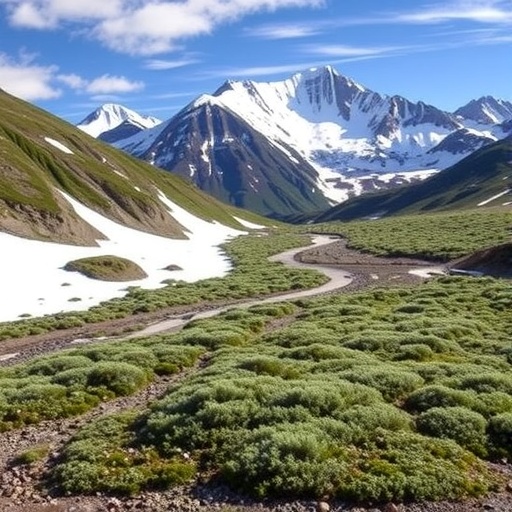
A warming Arctic is changing more than the familiar lowland tundra. New research published in Communications Earth & Environment reports that shrubs have expanded into high-elevation subarctic landscapes both during the Holocene Thermal Maximum, a naturally warm interval thousands of years ago, and during the rapid warming of the 21st century. The comparison links two periods separated by millennia and suggests that mountain tundra is not simply responding to modern climate change in an unprecedented way. Instead, today’s shrubification may be reactivating a climate-sensitive ecological pattern that has appeared before—although the speed, scale and broader consequences of the modern transformation could be fundamentally different.
The study, led by D.J. Harning with S. Sacco, J.H. Raberg and colleagues, focuses on “high elevation shrubification,” the process by which woody shrubs become more abundant, taller or more widely distributed in environments historically dominated by grasses, sedges, mosses, lichens and low-growing tundra plants. In subarctic mountains, elevation creates a sharp environmental gradient. Temperature declines with altitude, growing seasons become shorter, soils may remain frozen for longer, and exposure to wind can limit plant height. These constraints traditionally helped maintain open alpine and subalpine ecosystems. When temperatures rise, however, shrubs can gain a competitive advantage, particularly where longer summers allow more photosynthesis and improved survival of young plants.
The Holocene Thermal Maximum, generally dated to several thousand years ago but varying in timing from region to region, was a period when parts of the Northern Hemisphere experienced unusually warm conditions because of changes in Earth’s orbit and incoming solar radiation. It was not a single, globally identical event, and its climate dynamics differed from those driving current warming. Nevertheless, the interval provides a natural laboratory for testing how northern vegetation responded to a warmer world before industrial greenhouse-gas emissions. By identifying evidence of shrub expansion during that ancient warm period and comparing it with evidence from the 21st century, the research places modern ecological change within a much longer environmental history.
That long view matters because present-day observations often capture only a small portion of an ecosystem’s response. A shrub may establish during a warm decade, but its effects can continue for generations as it grows taller, produces seeds, changes snow accumulation and alters the conditions experienced by neighboring plants. Ancient evidence can reveal whether a modern vegetation shift is a short-lived fluctuation or part of a recurring climate response. Studies of past vegetation commonly draw on biological traces preserved in natural archives, including pollen, plant fragments, sediment layers or other indicators of former plant communities. Such records can connect vegetation changes to periods of altered temperature and seasonality, while modern observations show how quickly the transition is unfolding today.
Shrubification is technically important because shrubs are not passive replacements for existing tundra plants. Their branches can trap blowing snow, creating deeper winter insulation over the ground. That insulation may keep soils warmer during the cold season, influence the depth and timing of freezing, and affect microbial activity and nutrient cycling. Above the snow, taller vegetation changes wind exposure and the exchange of heat and moisture between the land surface and atmosphere. During summer, shrubs can shade the ground and modify the reflectivity, or albedo, of the landscape. Darker vegetation generally absorbs more solar energy than bright snow or low-lying tundra, potentially creating a feedback in which warming encourages shrubs and shrubs further alter local energy balance.
The shift also has implications for permafrost, the perennially frozen ground that stores enormous quantities of carbon. A thicker snow layer can insulate soil from extreme winter cold, sometimes encouraging permafrost thaw, while shrub roots and changing vegetation cover can influence soil structure, moisture and carbon inputs. The exact outcome depends on local conditions, including snow depth, soil drainage, plant composition and the duration of warming. This complexity is why the finding cannot be reduced to a simple statement that more shrubs always mean more carbon release. Instead, it indicates that vegetation change may interact with frozen soils and climate processes in ways that vary across the subarctic, potentially reshaping the stability of carbon-rich mountain environments.
For wildlife and human communities, the consequences may be equally significant. Shrubs can provide food and shelter for some animals while reducing the open habitat favored by others. Changes in plant height and composition may affect herbivores, insects and migratory species, and could influence the availability of forage across seasons. In many subarctic regions, landscapes are also part of longstanding Indigenous cultural and economic systems. Altered vegetation can affect travel routes, grazing conditions, hunting patterns and the timing of seasonal activities. The research therefore speaks not only to botanical change, but to the transformation of entire ecological networks. A mountain slope becoming visibly greener or taller may signal deeper changes below ground and across the food web.
The comparison between the Holocene Thermal Maximum and the 21st century also raises a critical question about pace. Ancient warming unfolded under orbital conditions and atmospheric compositions unlike those of the industrial era, while modern warming is driven primarily by human emissions and is occurring over decades rather than centuries or millennia. If shrubs responded during the earlier warm interval, that demonstrates the sensitivity of high-elevation subarctic vegetation to climate. It does not mean the two periods are equivalent. Modern ecosystems may be forced to change faster than plants, soils, animals and permafrost can adjust, increasing the risk of ecological mismatches. A species may find temperatures suitable before it can disperse to a new elevation, while existing plants and animals may face unfamiliar competition, snow conditions or seasonal timing.
The study’s broader message is that Arctic and subarctic mountains should not be treated as static refuges from climate change. Their apparent openness can conceal rapid biological reorganization, and shrub expansion may be one of the most visible indicators that thermal limits are moving upward. By connecting ancient environmental history with contemporary change, Harning and colleagues provide a framework for understanding why today’s shrubification matters beyond the present landscape. The evidence suggests that warming can repeatedly push woody vegetation into colder, higher terrain—but the modern climate signal is arriving with unprecedented speed and alongside other pressures. The future of subarctic mountains may therefore be defined not merely by whether shrubs appear, but by how quickly they spread, which ecosystems they replace and how their expansion feeds back into snow, soil, carbon and climate.
Cite Scienmag News
Violet Maxwell. (August 26, 2026). Shrub Expansion Swept Subarctic High Elevations During Ancient and Modern Warming. Scienmag. https://scienmag.com/shrub-expansion-swept-subarctic-high-elevations-during-ancient-and-modern-warming/
Violet Maxwell. "Shrub Expansion Swept Subarctic High Elevations During Ancient and Modern Warming." Scienmag, 26 August 2026, https://scienmag.com/shrub-expansion-swept-subarctic-high-elevations-during-ancient-and-modern-warming/. Accessed 4 September 2026.
Violet Maxwell. "Shrub Expansion Swept Subarctic High Elevations During Ancient and Modern Warming." Scienmag. August 26, 2026. https://scienmag.com/shrub-expansion-swept-subarctic-high-elevations-during-ancient-and-modern-warming/


