


Germany could face a sharply heavier dementia burden by 2060, with the number of people living with the condition potentially rising from about 1.4 million in 2018 to more than 2.1 million, according to a new nationwide microsimulation study. The analysis, published in the European Journal of Epidemiology, suggests that longer lives will bring major gains for population health but may also produce a substantial increase in dementia cases unless prevention succeeds in reducing the rate at which new cases develop. The researchers also found that the future burden will not be distributed evenly. Rural and ageing counties, particularly in eastern Germany, could experience far higher prevalence than large metropolitan areas, creating a complex challenge for healthcare planners, care providers and families.
The study used Germany’s MikroSim model, a dynamic computer simulation designed to reproduce how populations change over time. Rather than treating the population as a single statistical block, microsimulation follows large numbers of hypothetical individuals through yearly transitions. Each person can age, move between regions, die, enter the workforce, leave it or develop dementia. In the dementia module, individuals occupy one of three principal states: dementia-free, living with dementia or dead. During each simulated year, age- and sex-specific probabilities determine whether a person remains healthy, develops dementia or dies. By repeating these transitions across 400 German counties, the model can estimate not only national totals but also the changing geography of dementia.
To supply the model with medical data, the researchers analysed routine health insurance records covering approximately 27 million people insured through the AOK system, roughly one-third of Germany’s population. They used information from 2017 to 2019, deliberately avoiding the immediate effects of the COVID-19 pandemic on diagnosis patterns, healthcare use and mortality. Dementia was identified through documented inpatient and outpatient diagnoses, including Alzheimer’s disease, vascular dementia and other specified or unspecified dementia disorders. The researchers required evidence of persistent disease rather than relying on a single isolated diagnostic code. In most cases, a dementia diagnosis had to be repeated within three consecutive quarters; diagnoses shortly before death were also retained because there might not have been enough time for a repeat record.
This conservative case definition reduced the estimated number of dementia cases by approximately 15 percent compared with a definition that included all recorded diagnoses. The authors argue that excluding potentially reversible or transient conditions makes the simulated dementia state more consistent with a chronic, absorbing condition: once a person enters the dementia state, the main model does not assume recovery. A sensitivity analysis did include reversible cases and added a fourth state representing recovery. That alternative produced higher numbers of people with dementia, but the broad pattern remained unchanged. Population ageing still increased the future burden, while sustained reductions in dementia incidence substantially moderated it.
The researchers tested several possible futures. In the main scenario, life expectancy continued to increase, with annual mortality reductions of 0.85 percent for men and 0.75 percent for women, while dementia incidence remained at its baseline level. Under this scenario, Germany’s total population reached approximately 79 million in 2060, and dementia cases climbed to around 2.1 million. Dementia prevalence, defined as the proportion of the entire population living with the condition, increased from about 1.6 percent in 2018 to more than 2.6 percent. The rise was not immediate. The model projected a modest decline in cases and prevalence during the early decades, followed by growth from the 2030s onward as large postwar birth cohorts entered the oldest age groups, when dementia risk is greatest.
Three prevention scenarios combined longer life expectancy with declining dementia incidence. The researchers modelled annual incidence reductions of 1 percent, 1.4 percent and 2 percent. The middle estimate was based on international studies reporting an approximately 10 percent reduction in dementia incidence per decade, equivalent to roughly 1.4 percent annually. The most optimistic scenario assumed that incidence could fall rapidly until reaching 55 percent of its 2018 level, reflecting the estimate that up to 45 percent of dementia cases may be preventable through improvements in health, education, lifestyle and environmental exposures. By 2060, these scenarios produced between 1.3 million and 1.5 million cases, with prevalence between 1.6 percent and 1.9 percent. Under the strongest prevention assumption, the total reached approximately 1.28 million, well below the 2.1 million projected without an incidence decline.
The study highlights why dementia prevention could matter even if it does not eliminate the effects of demographic ageing. The researchers examined the ratio of dementia cases to the population aged 20 to 65, using this group as a proxy for the working-age population available to support health and social care systems. In 2018, Germany had approximately 2.6 people with dementia for every 100 working-age individuals. In the main scenario, that ratio rose to 4.7 by 2060, nearly doubling as the number of older people increased and the working-age population contracted. Even the most favourable prevention scenario produced a ratio of 2.9, while the other prevention scenarios resulted in values between 3.0 and 3.4. The figures indicate that stabilising dementia case numbers would not necessarily stabilise the demand for care.
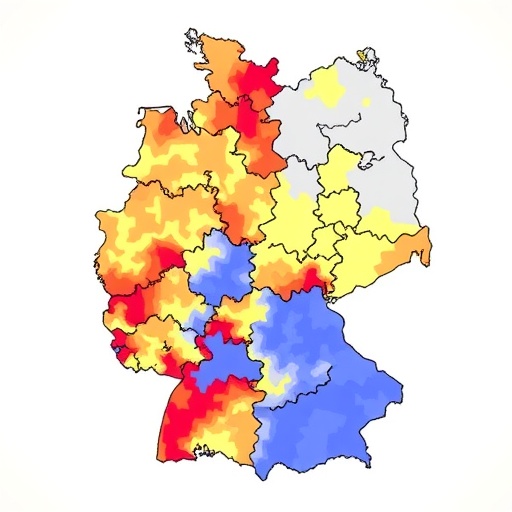
The regional results reveal an even sharper divide. In the main scenario, some eastern German counties could reach dementia prevalence levels of up to 6 percent by 2060. Large cities, including Berlin, Hamburg, Munich and Cologne, generally showed lower prevalence and lower ratios of dementia cases to working-age residents. In 2020, county-level prevalence ranged from approximately 1.0 percent to 2.6 percent, with an interquartile range of 0.4 percentage points. The regional RWA ranged from 1.6 to 4.6 cases per 100 working-age people. By 2060, existing differences expanded across all scenarios. The model attributes this divergence primarily to demographic change: rural eastern regions are ageing more rapidly, while younger residents are more likely to move toward urban areas.
An important technical finding is that the apparent regional differences were driven mainly by the projected age and sex composition of each county rather than by evidence that dementia itself is intrinsically more common in particular regions. When the researchers standardised county estimates for age and gender, the values became very similar, with only minor deviations attributable to random variation. This distinction matters because it suggests that regional dementia inequality is closely tied to migration, birth patterns and survival rather than necessarily reflecting large geographic differences in biological risk. It also means that health authorities cannot rely on national averages when planning services. A county with a smaller population may still require a disproportionately large care workforce if it contains a high share of very old residents.
The authors caution that the figures are scenarios, not predictions guaranteed to come true. The model does not incorporate individual dementia risk factors such as hypertension, diabetes, obesity, education or physical activity because sufficiently detailed German data were not available for all regions. It also applies national incidence and excess-mortality estimates across counties, meaning that possible regional differences in diagnosis, treatment and survival are not directly modelled. The source data come from medical claims, which may miss undiagnosed dementia or capture diagnostic behaviour rather than the full biological prevalence of disease. Nevertheless, the study’s central message is clear: rising life expectancy alone could push Germany’s dementia burden substantially higher, while even moderate prevention could change the scale of the challenge. For policymakers, the most urgent task is therefore twofold—reduce modifiable risks across the population and prepare regional care systems for a future in which dementia will be increasingly concentrated in ageing communities.
Cite Scienmag News
Cassandra Pierce. (August 26, 2026). Microsimulation Forecasts Dementia Prevalence Across Germany and Its Regions Through 2060. Scienmag. https://scienmag.com/microsimulation-forecasts-dementia-prevalence-across-germany-and-its-regions-through-2060/
Cassandra Pierce. "Microsimulation Forecasts Dementia Prevalence Across Germany and Its Regions Through 2060." Scienmag, 26 August 2026, https://scienmag.com/microsimulation-forecasts-dementia-prevalence-across-germany-and-its-regions-through-2060/. Accessed 4 September 2026.
Cassandra Pierce. "Microsimulation Forecasts Dementia Prevalence Across Germany and Its Regions Through 2060." Scienmag. August 26, 2026. https://scienmag.com/microsimulation-forecasts-dementia-prevalence-across-germany-and-its-regions-through-2060/


