


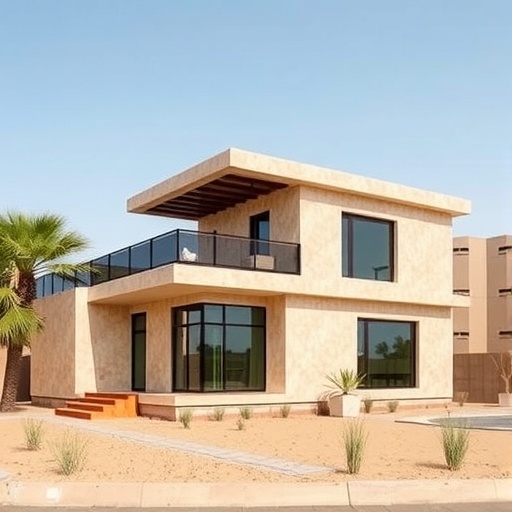
A villa on Saudi Arabia’s Red Sea coast has become the focus of a new study testing how far the Passive House concept can be pushed in one of the world’s most demanding residential climates. Located in Al Wejh, a hot, arid coastal region where intense solar radiation, long cooling seasons, salt-laden air and occasional humid conditions can place enormous pressure on buildings, the two-storey home was assessed using the Passive House Planning Package, or PHPP. The design-stage analysis suggests that a carefully engineered residence can meet the main Passive House indicators even where cooling, rather than heating, dominates energy use. The findings offer a striking counterpoint to the idea that ultra-low-energy buildings are mainly suited to cool European climates. Instead, the study presents a desert-coastal villa as a potential model for high-performance housing in Saudi Arabia and other rapidly developing regions around the Red Sea and Gulf.
The case-study building has a treated floor area of 237.9 square metres and was developed as a detached family residence. Its performance depends on a combination of measures rather than a single technological breakthrough. The proposed envelope uses high levels of insulation, carefully selected windows, solar-control strategies and a continuous approach to airtightness. Mechanical ventilation with heat recovery is included to provide fresh air while reducing the energy penalty normally associated with exchanging indoor and outdoor air. In a hot climate, the central challenge is not primarily retaining heat but preventing unwanted heat from entering the building and controlling the heat generated by occupants, lighting, appliances and equipment. Every watt of heat that enters or is produced indoors can eventually increase the demand on the cooling system, making the building envelope and operational assumptions particularly important.
According to the PHPP v9 assessment, the villa is predicted to achieve a specific cooling load of approximately 9 watts per square metre. This figure describes the peak cooling capacity required per unit of treated floor area under the modelled conditions, rather than the total amount of electricity consumed over a year. The predicted annual cooling demand is 58 kilowatt-hours per square metre per year, while heating demand remains below 1 kilowatt-hour per square metre per year. These results reflect the climate’s energy balance: the building requires very little heating, but cooling remains a substantial annual service because outdoor temperatures and solar gains remain high for much of the year. The findings also illustrate an important distinction in building science. A low peak load does not automatically mean negligible annual energy consumption; the duration and severity of the cooling season can make annual demand significant even when the building’s instantaneous cooling requirement is modest.
The study’s most prominent result is that the proposed design is predicted to satisfy the principal Passive House verification indicators under the assumptions used by the researchers. Non-renewable primary energy demand is reported at 105 kilowatt-hours per square metre per year. Primary energy accounts not only for energy used inside the building but also for the wider energy implications of supplying that energy, including generation and distribution. The modelled airtightness target is n50 = 0.6 air changes per hour. This means that, during a pressurisation test at a 50-pascal pressure difference, the building would exchange an air volume equivalent to 0.6 times its interior volume each hour. Achieving such a result in practice requires a continuous air barrier, carefully sealed junctions and rigorous construction quality. In a dusty desert environment, airtightness can also support indoor air quality by reducing uncontrolled infiltration through cracks and gaps, although it cannot replace effective filtration and ventilation.
The ventilation system proposed for the villa uses mechanical ventilation with heat recovery, commonly known as MVHR. In a balanced MVHR system, stale air is extracted from wet rooms and other occupied areas while filtered outdoor air is supplied to living spaces and bedrooms. A heat exchanger transfers thermal energy between the two air streams without mixing them directly. In a cold climate, this process helps preserve indoor heat. In a hot climate, it can reduce the amount of heat entering with the incoming air, particularly when indoor air has been cooled. The technology is not a magic solution: fan electricity, maintenance, filter replacement, system balancing and correct installation all influence real-world results. Nevertheless, in a tightly sealed villa, controlled ventilation can offer a more predictable alternative to relying on uncontrolled infiltration or permanently open windows, especially when outdoor air is hot, dusty or humid.
Summer comfort emerged as one of the study’s most sensitive issues. The PHPP model predicts overheating above 25 degrees Celsius during 7 percent of occupied hours. The researchers emphasise that this is a design-stage Passive House comfort indicator, not a complete physiological assessment of how people experience heat. The study does not calculate the Predicted Mean Vote or Predicted Percentage Dissatisfied indices, known as PMV and PPD, because those methods require broader information about indoor environmental conditions and occupant behaviour. Air speed, mean radiant temperature, clothing, metabolic activity, humidity and individual adaptation can all affect thermal comfort. A room at 25 degrees Celsius with moving air and low radiant temperatures may feel very different from a room at the same air temperature surrounded by hot surfaces. The reported overheating percentage should therefore be read as an early warning metric and a basis for design decisions, rather than as proof that every occupant will feel comfortable at all times.
The sensitivity analysis points to occupant behaviour as a decisive factor in the building’s summer performance. The researchers used a one-at-a-time directional approach to examine how individual assumptions influence cooling demand and compliance margins. Shading behaviour was especially important. External shading can prevent solar radiation from passing through windows and becoming indoor heat, often making it more effective than attempting to remove that heat later with air-conditioning. In a Red Sea climate, the position and timing of shading devices matter because the sun’s angle changes throughout the day and across seasons. The model also identified night purge ventilation as influential. When outdoor conditions become cooler than indoor conditions after sunset, ventilating the building can remove accumulated heat from the air and internal surfaces. However, this strategy depends on actual nighttime temperatures, humidity, wind, security, dust levels and whether occupants or automated controls operate windows and vents as assumed.
The study also documents the contribution of renewable-energy systems. The proposed photovoltaic installation is predicted to produce 80.3 kilowatt-hours per square metre per year, calculated on the basis of module aperture area. Solar thermal collectors are expected to provide a further 6.1 kilowatt-hours per square metre per year, also reported per aperture area. Photovoltaic panels can offset electricity used by cooling equipment, ventilation fans, pumps, appliances and lighting, while solar thermal systems can reduce the energy required to produce domestic hot water. Yet the coastal desert environment introduces a practical complication: dust and soiling. Fine particles settling on PV modules reduce the sunlight reaching the cells and can lower annual generation. The model therefore includes an explicit soiling assumption, and the authors caution that predicted PV yields must be connected to realistic maintenance schedules, cleaning practices, water availability and long-term system operation.
That caution is central to the study’s broader significance. A computer model can demonstrate that a design is technically capable of meeting performance targets, but construction quality and daily operation determine whether those targets survive outside the spreadsheet. The reported results are based on architectural drawings, envelope and system specifications, local climate information and stated assumptions about cooling setpoints, shading, night ventilation, internal gains and PV soiling. If occupants use lower cooling setpoints, leave shading devices open, disable night ventilation or operate equipment differently from the model, energy demand and overheating could rise. Similarly, a small weakness in an airtight layer, an unsealed service penetration or a poorly installed window can undermine the intended performance. The authors frame their results as a design-stage assessment rather than a completed-building monitoring campaign, meaning that future validation through airtightness testing, indoor temperature measurements, energy metering and occupant surveys will be essential.
The Al Wejh villa study arrives as Saudi Arabia undergoes rapid urban and infrastructure development, including major projects along the Red Sea coast. Residential buildings in these regions face a difficult combination of intense cooling demand, water and energy pressures, rapidly growing floor areas and expectations for high indoor comfort. The study suggests that Passive House principles can be adapted to this context, but it also shows that success depends on climate-specific design rather than simply importing a checklist from colder regions. Deep insulation, airtight construction, solar control, efficient cooling, heat-recovery ventilation and renewable generation can work together, but they must be supported by realistic assumptions about people, maintenance and weather. The result is not a claim that every desert villa will automatically become a net-zero home. It is a more measured and potentially more useful message: even in a hot coastal desert, rigorous passive design can sharply reduce cooling loads, while careful operational planning determines whether the promised comfort and energy savings are achieved in everyday life.
Cite Scienmag News
Violet Maxwell. (August 26, 2026). Assessing Passive House Performance in Saudi Arabia’s Hot Red Sea Coastal Climate. Scienmag. https://scienmag.com/assessing-passive-house-performance-in-saudi-arabias-hot-red-sea-coastal-climate/
Violet Maxwell. "Assessing Passive House Performance in Saudi Arabia’s Hot Red Sea Coastal Climate." Scienmag, 26 August 2026, https://scienmag.com/assessing-passive-house-performance-in-saudi-arabias-hot-red-sea-coastal-climate/. Accessed 4 September 2026.
Violet Maxwell. "Assessing Passive House Performance in Saudi Arabia’s Hot Red Sea Coastal Climate." Scienmag. August 26, 2026. https://scienmag.com/assessing-passive-house-performance-in-saudi-arabias-hot-red-sea-coastal-climate/


