


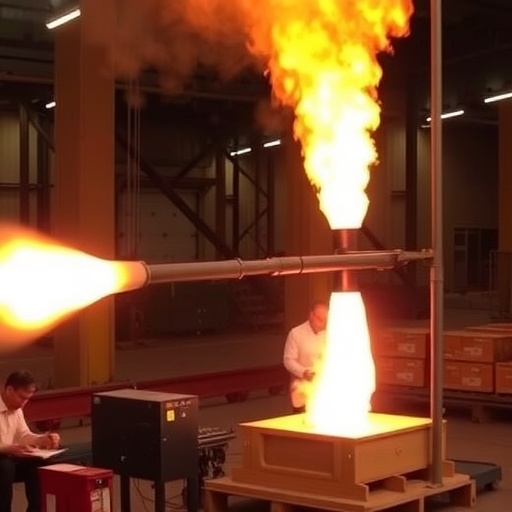
A new electric ignition system could help transform the way small spacecraft engines start in orbit, replacing catalyst-dependent technology with a faster, potentially safer alternative. Researchers from Beijing Jiaotong University have demonstrated an ammonium dinitramide-based thruster that can ignite at room temperature without a catalytic bed or lengthy preheating sequence. In hot-fire tests, the experimental engine achieved stable combustion and produced operating conditions consistent with a 5-newton-class propulsion system. The findings, published in Space: Science & Technology, address one of the most persistent challenges facing green space propulsion: how to rapidly and reliably ignite high-performance propellants without relying on catalysts that degrade at extreme temperatures.
Ammonium dinitramide, commonly known as ADN, has attracted growing interest as a less toxic alternative to hydrazine, the highly hazardous propellant traditionally used in many spacecraft attitude-control and orbital-maneuvering systems. ADN-based liquid propellants can offer high specific impulse while reducing handling risks on the ground. However, most existing ADN thrusters depend on catalytic decomposition. Before ignition, the catalyst bed must be heated to more than 623 kelvin, and the catalyst may eventually lose activity when exposed to temperatures above approximately 1500 kelvin. This preparation can delay startup and consume substantial electrical energy. During the Prisma mission, for example, in-flight preheating reportedly lasted between 600 and 720 seconds and required about 25 kilojoules for a single event.
The danger is not limited to wasted time or power. If the catalyst does not reach a sufficient temperature before propellant injection, decomposition may occur unevenly, producing a “hard start” in which pressure rises abruptly. In the worst case, the accumulated unreacted propellant can ignite explosively. The Beijing Jiaotong University team therefore pursued a different approach: use electrical resistance to initiate decomposition and an electric arc to support combustion after ignition. The concept eliminates the catalytic bed altogether. It is designed to allow a cold start, meaning the thruster can begin its ignition sequence at room temperature rather than waiting for a large internal component to reach operating temperature.
The experimental system combined a propellant supply unit, the thruster, electrical ignition hardware, data acquisition equipment, and an automated control system. At the heart of the engine was a multi-layer honeycomb decomposition electrode. This structure increases the area over which the liquid propellant contacts electrically heated surfaces, allowing energy to be transferred more efficiently. Its cellular geometry also helps limit the secondary splashing of droplets produced by microscopic explosive events during decomposition. The thruster incorporated a swirl injector, a decomposition zone, a combustion chamber, arc electrodes, and a Laval nozzle. The injector promoted atomization and mixing, while the nozzle converted the hot, pressurized gases into directed exhaust capable of producing thrust.
The propellant used in the tests was an ADN-based liquid formulation containing methanol. During the initial heating stage, the methanol undergoes dehydrogenation while water evaporates and ADN begins to thermally decompose. This sequence generates strongly oxidizing intermediate species. Those products then react rapidly with methanol and its dehydrogenation products inside the combustion chamber, releasing heat and sustaining the reaction. Unlike a conventional catalytic thruster, in which a catalyst accelerates decomposition across a heated porous bed, the new design uses electrical energy and electrode geometry to establish the first reactive environment. Once the reaction becomes self-sustaining, the arc can help maintain a more stable combustion process.
The researchers conducted hot-fire experiments at a propellant mass flow rate of 2.5 grams per second and a nominal thrust level of 5 newtons. Under the most successful configuration—an ignition voltage of 80 volts, an electrode gap of 3 millimeters, and an electrode orifice diameter of 0.8 millimeters—the thruster ignited from room temperature and maintained combustion during a 30-second test. The average combustion-chamber pressure reached 0.93 megapascals. Ignition delay time was 0.64 seconds, while pressure became established within 1.02 seconds. The measured characteristic velocity, a key indicator of propellant combustion performance, reached 1168.7 meters per second. In the decomposition-zone circuit, the average current was approximately 3.3 amperes and the electrical power consumption was about 263 watts.
Ignition voltage strongly influenced how quickly the system responded. When the voltage increased from 60 to 100 volts, the ignition delay fell from 0.93 seconds to 0.47 seconds. Yet the highest voltage was not considered the best overall operating point because performance must balance response time, electrical demand, component durability, and combustion stability. The team identified 80 volts as the most favorable condition in its tested range. The electrode arrangement also proved important. Narrowing the gap shortened both ignition delay and pressure establishment time by making it easier to form the required thermal and electrical environment. Increasing the electrode orifice diameter from 0.3 to 0.8 millimeters raised average chamber pressure from 0.70 to 0.94 megapascals and reduced ignition delay from 1.70 to 0.59 seconds.
Larger openings, however, did not continue to improve the engine. When the diameter reached 1.2 millimeters, performance deteriorated. The researchers attribute this decline to a reduced residence time: propellant and partially decomposed products moved through the reaction zone too quickly for decomposition reactions to develop fully. The result illustrates the narrow design balance required in an electrically ignited liquid thruster. The electrodes must expose enough propellant to electrical energy, but the flow must also remain in the decomposition region long enough to produce the reactive intermediates needed for stable combustion. The honeycomb geometry was intended to address both requirements by increasing contact area without excessively obstructing the flow.
The arc itself did not substantially accelerate ignition, but it played an important role after ignition by suppressing low-frequency pressure oscillations. Measurements showed that chamber-pressure fluctuations were concentrated below 10 hertz. Their frequencies closely matched oscillations in the electrical current, but the two signals were out of phase. This relationship indicates that unstable propellant decomposition, rather than spray atomization alone, was driving the combustion instability. Analysis of droplet-size fluctuations found a dominant frequency above 50 hertz, showing no direct match with the low-frequency pressure oscillations. The findings suggest that the arc can stabilize the reaction zone even though resistance heating remains the primary ignition mechanism.
The study provides the first reported system-level demonstration of catalyst-free electric ignition for an ADN-based thruster, moving the technology beyond earlier single-droplet experiments involving resistive or laser heating. Its principal promise is rapid cold startup without a vulnerable catalyst and without the long preheating period associated with existing ADN engines. That could be valuable for spacecraft requiring frequent short maneuvers, rapid attitude corrections, or emergency response. The approach is not without a cost: an average electrical demand of roughly 263 watts would place additional requirements on spacecraft batteries, power electronics, and thermal management. Further development will need to reduce ignition energy, improve long-duration electrode life, control pressure oscillations, and validate performance under vacuum and repeated restart conditions. Even so, the experiments offer a significant step toward safer, faster, and more durable green propulsion systems for future spacecraft.
News Publication Date: 2 July 2026
Web References: https://doi.org/10.34133/space.0493
References: Space: Science & Technology, DOI: 10.34133/space.0493
Keywords
Ammonium dinitramide, ADN propellant, electric ignition, arc-assisted combustion, green space propulsion, catalyst-free thruster, cold-start ignition, spacecraft propulsion, combustion instability, Beijing Jiaotong University
Cite Scienmag News
Grant Pearson. (August 25, 2026). Preliminary Hot-Fire Test of Electrically Ignited Ammonium Dinitramide Thrusters. Scienmag. https://scienmag.com/preliminary-hot-fire-test-of-electrically-ignited-ammonium-dinitramide-thrusters/
Grant Pearson. "Preliminary Hot-Fire Test of Electrically Ignited Ammonium Dinitramide Thrusters." Scienmag, 25 August 2026, https://scienmag.com/preliminary-hot-fire-test-of-electrically-ignited-ammonium-dinitramide-thrusters/. Accessed 3 September 2026.
Grant Pearson. "Preliminary Hot-Fire Test of Electrically Ignited Ammonium Dinitramide Thrusters." Scienmag. August 25, 2026. https://scienmag.com/preliminary-hot-fire-test-of-electrically-ignited-ammonium-dinitramide-thrusters/


