


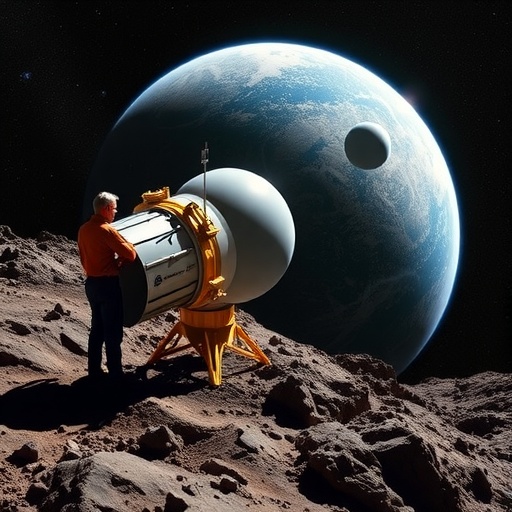
A new optical seismometer designed for the Moon and small asteroids could transform how scientists listen to worlds beyond Earth. Called BroadSCOPE—short for Broadband Seismic Characterization using Optics for Planetary Exploration—the instrument combines laser interferometry, a force-balanced mechanical system and compact electronics to detect extremely weak ground motion. Developed by researchers at the University of Arizona’s Lunar and Planetary Laboratory and Silicon Audio, BroadSCOPE is engineered to capture signals ranging from relatively rapid surface disturbances to long-period vibrations produced deep inside planetary bodies. Its creators say the sensor could help build the first modern seismic networks on the Moon and provide an entirely new way to investigate the hidden interiors of asteroids.
Seismology is one of the most powerful tools available for exploring a planetary interior. When an impact, tectonic rupture, thermal contraction or tidal force shakes the ground, seismic waves travel through the body. Their speed, direction and attenuation reveal information about the material they cross, allowing scientists to infer crustal thickness, internal layering, fractures, porosity and even the properties of a core. On Earth, dense networks of seismometers make this process extraordinarily precise. On other worlds, however, instruments must operate with far fewer stations, weaker seismic sources and severe limits on mass, power, communications and deployment. These constraints make sensitivity especially important. A sensor must distinguish a genuine planetary tremor from its own internal noise and from disturbances caused by temperature changes, landers or the surrounding surface.
BroadSCOPE was created to address that challenge. Its targeted self-noise floor is approximately (10^{-9}) meters per second squared per square root hertz near 1 hertz, a level intended to reveal low-amplitude events that earlier planetary instruments could only partially resolve. The sensor operates with a relatively broad, flat response between about 0.052 and 10 hertz, recording ground motion in velocity. This frequency range is particularly valuable for detecting long-period signals, including deep moonquakes, while still retaining sensitivity to impacts and other higher-frequency events. A companion instrument known as ShortSCOPE is optimized for faster vibrations, meaning the two designs could eventually work together to cover a much wider seismic spectrum than either instrument alone.
At the heart of BroadSCOPE is a miniaturized laser interferometer. Rather than estimating motion through a conventional capacitive measurement, the system tracks the displacement of a suspended proof mass by monitoring changes in the intensity of laser light. Interferometry can resolve motion on the order of (10^{-15}) meters per square root hertz, dramatically improving displacement sensitivity. The proof mass, weighing roughly 220 grams, moves in response to ground acceleration. A force-feedback system then applies a counterforce through a coil-and-magnet actuator, keeping the mass near its reference position while converting the required correction into a precise seismic measurement. This approach resembles the force-balancing strategies used in advanced precision instruments, including technologies developed for gravitational-wave observatories.
The mechanical design is equally important. BroadSCOPE uses beryllium-copper leaf springs to suspend the proof mass, with the spring stiffness tuned to produce a resonant frequency near 6 hertz. The sensor’s response is shaped electronically so that it can measure signals well below that natural resonance, extending useful performance toward longer periods. Softer springs generally improve sensitivity to slow motion, but they can also make an instrument more vulnerable to tilt and mechanical disturbances. BroadSCOPE addresses that tradeoff with its optical readout and a tilt tolerance of approximately 15 degrees. That is vastly greater than the roughly 0.25-degree tolerance reported for the much larger Very Broadband seismometer on NASA’s InSight mission to Mars. Because BroadSCOPE can continue operating without a precision leveling mechanism, mission designers could reduce mass, complexity and deployment risk.
The instrument also offers a large dynamic range. Across roughly 0.05 to 10 hertz, its sensitivity reaches about 10,000 volts per meter per second, while its velocity clip level is approximately plus or minus 0.55 millimeters per second. The authors report a dynamic range of 164 decibels before the signal reaches an analog-to-digital converter. In practical terms, that means the same sensor can observe tiny background vibrations and much stronger seismic pulses without immediately saturating. A custom 32-bit digitization module was developed to preserve this performance. It provides a signal-to-noise ratio of about 124 decibels at 1,000 samples per second and supports lower sampling rates, including 20 and 25 samples per second, which could reduce data volume during constrained lunar or asteroid missions while still capturing many expected events.
The Moon is the instrument’s primary target. Apollo seismometers produced landmark discoveries, including evidence that the Moon is differentiated and information about the crust beneath the landing sites. Yet those instruments operated with only 10-bit digitization, inconsistent sampling rates and substantial signal distortion. Apollo seismograms often appear blocky, making it difficult to determine precise arrival times, peak amplitudes and frequency content. BroadSCOPE’s 24- or 32-bit recording capability would provide far finer resolution. Its sensitivity could help detect deep moonquakes linked to lunar tides, shallow moonquakes, impact-generated signals and thermal moonquakes caused by the extreme expansion and contraction of the surface during the lunar day-night cycle. Stations placed at the poles or on the farside could address a major weakness of the Apollo network, which was concentrated near the equator and entirely on the nearside.
Deep moonquakes are especially valuable because they originate in the mantle and may contain clues about the Moon’s deep interior. Scientists have proposed using them to investigate whether a partially molten layer exists above the Moon’s liquid outer core. A more geographically distributed network could also test why deep moonquakes have been observed predominantly from the nearside. The pattern might reflect the locations of Apollo stations, or it could indicate that the crustal divide between the lunar nearside and farside extends deeper into the mantle and influences how seismic energy is generated or transmitted. By detecting weaker events across new regions, BroadSCOPE could help separate these possibilities and improve estimates of lunar seismic hazards, internal heterogeneity and regional geological structure.
Asteroids may offer an even more radical application. No seismometer has yet directly measured the interior of an asteroid, despite growing evidence that many of these bodies are fractured, porous rubble piles rather than solid monoliths. A sensor placed on an asteroid could record vibrations from impacts, internal fracturing or tidal interactions. Binary asteroids are particularly promising: as two bodies orbit each other at close range, changing gravitational forces can stress their surfaces and interiors. Near-Earth asteroid systems may experience additional tidal disturbances during close planetary encounters, such as the predicted 2029 passage of Apophis. The resulting ground motion is expected to be weak, but BroadSCOPE’s low noise floor could make it detectable. Measuring how those signals travel through an asteroid would help constrain its strength, porosity, internal cohesion and resistance to disruption—properties that are crucial for planetary-defense planning.
Before such missions can rely on BroadSCOPE, the sensor must survive launch, temperature extremes and the unpredictable conditions of deployment. The team subjected it to random vibration profiles exceeding those specified for several major launch vehicles, applying loads of about 14.1 times Earth’s gravity RMS across frequencies from 20 to 2,000 hertz. It also endured six shock pulses reaching 50 g for 1 millisecond. Following these tests, the resonant frequency remained close to its original 6-hertz value, and the optical system retained more than 80 percent modulation efficiency even when tilted by plus or minus 15 degrees. Thermal-vacuum testing demonstrated operation between approximately minus 55 and plus 70 degrees Celsius. A later cold-plunge experiment showed that the housing could reach roughly minus 170 degrees Celsius while the sensor remained functional, although the optics board stayed warmer because of heat from the laser and electronics.
The testing also revealed engineering challenges that will matter for flight qualification. Anti-rotation tabs intended to protect the proof mass during launch fractured during environmental testing, creating a potential foreign-object-debris hazard. The design team responded by changing the material to ULTEM 2300 and reshaping the component to reduce stress concentration. An alternative configuration removes the tabs entirely, but that would require gentler handling and possibly soft stowage during launch and transit. Temperature-dependent changes in optical modulation also showed that the alignment between the mirror and diffraction grating can shift as the instrument expands or contracts. Even so, the prototype reached Technology Readiness Level 6, indicating that it functioned in relevant simulated environments. The authors envision deployment in shallow trenches, where burial would reduce temperature fluctuations and surface scattering, although lander-mounted or lander-adjacent installations could also provide valuable data.
BroadSCOPE’s potential extends beyond the Moon and asteroids. Its high tilt tolerance could simplify deployments on Mars, where a leveling mechanism adds complexity and mass. The sensor would still require a wind and thermal shield, because atmospheric pressure variations and wind can overwhelm weak seismic signals. On icy worlds such as Europa and Enceladus, the instrument could search for tidally driven cracking and long-period waves that reveal the thickness of ice shells, the presence of subsurface oceans and the structure of deeper rocky interiors. Titan would require protection from winds and storms, while Europa would likely demand shielding against intense radiation. The researchers caution that oceans, ductile ice and methane clathrates could strongly attenuate seismic energy. Nevertheless, the combination of optical precision, compact design, low power requirements and broad frequency coverage makes BroadSCOPE a candidate for a new generation of planetary geophysical missions—one capable of turning faint, nearly invisible vibrations into maps of worlds that humanity has never yet heard tremble.
Cite Scienmag News
Grant Pearson. (August 25, 2026). BroadSCOPE Optical Broadband Seismic Sensor Advances Planetary Exploration. Scienmag. https://scienmag.com/broadscope-optical-broadband-seismic-sensor-advances-planetary-exploration/
Grant Pearson. "BroadSCOPE Optical Broadband Seismic Sensor Advances Planetary Exploration." Scienmag, 25 August 2026, https://scienmag.com/broadscope-optical-broadband-seismic-sensor-advances-planetary-exploration/. Accessed 3 September 2026.
Grant Pearson. "BroadSCOPE Optical Broadband Seismic Sensor Advances Planetary Exploration." Scienmag. August 25, 2026. https://scienmag.com/broadscope-optical-broadband-seismic-sensor-advances-planetary-exploration/


