


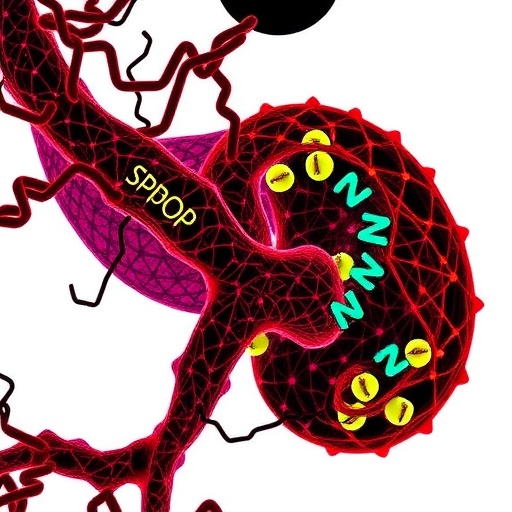
Kidney cancer may have revealed a new way to outsmart one of modern oncology’s most important drug strategies. A study by Tang, Sun, Shao and colleagues, published in Nature Communications, describes how cancer cells can become resistant to inhibitors of the mechanistic target of rapamycin, or mTOR, by rewiring the behavior of two regulatory proteins: SPOP and ZMYND8. The work places a molecular process known as phase separation at the center of treatment failure, suggesting that resistance is not driven only by mutations or changes in drug metabolism. Instead, tumor cells may reorganize the physical environment inside their nuclei, selectively excluding a protein that would otherwise help restrain malignant gene activity.
mTOR is a central signaling hub that controls cell growth, protein production, nutrient use and survival. In healthy cells, the pathway responds to signals such as growth factors and energy availability. In kidney cancer, however, abnormal activation of mTOR can help tumors grow rapidly and tolerate hostile conditions. Drugs that inhibit mTOR are designed to interrupt this growth program, and they have become an important component of treatment for advanced renal malignancies. Yet the benefits are often limited by resistance. Some tumor cells survive initial therapy, adapt to the blocked pathway and resume proliferation, leaving clinicians with a familiar problem: a treatment that works biologically but loses effectiveness as the cancer evolves.
The new study identifies SPOP-mediated ubiquitination of ZMYND8 as a key event in that adaptation. Ubiquitination is a molecular tagging process in which one protein, acting through an enzyme system, attaches the small protein ubiquitin to another protein. These tags can mark a molecule for destruction by the proteasome, alter its location within the cell or change the way it interacts with other proteins and DNA. SPOP, short for speckle-type POZ protein, functions as a substrate-recognition factor in a ubiquitin ligase complex. Its role is to identify selected proteins and help determine their cellular fate. According to the study, SPOP targets ZMYND8, changing the abundance or behavior of this chromatin-associated regulator in a way that favors survival during mTOR inhibition.
ZMYND8 is a multifunctional nuclear protein that can connect chromatin, transcriptional machinery and DNA damage-response systems. Chromatin is the highly organized material formed when DNA is wrapped around histone proteins and folded with the help of additional regulators. The arrangement of chromatin determines which genes are accessible for transcription and which remain silent. By influencing this arrangement, ZMYND8 can affect broad gene-expression programs rather than a single isolated pathway. The findings therefore suggest that mTOR inhibitor resistance may arise through an epigenetic and structural reprogramming of the cancer cell, allowing it to activate alternative survival instructions even when the main growth pathway is pharmacologically suppressed.
The most striking element of the research is the connection to biomolecular phase separation. Inside cells, many proteins and nucleic acids do not simply float in a uniform solution. They can condense into dynamic, membrane-free compartments often described as biomolecular condensates. These structures form when molecules with compatible interaction surfaces cluster together, creating concentrated environments for transcription, RNA processing, signaling or DNA repair. The process resembles the separation of oil and water, but at the molecular scale and under tightly regulated cellular conditions. Phase separation can be reversible and highly responsive, making it a powerful mechanism for rapidly organizing biochemical reactions.
The study proposes that ZMYND8 is excluded from particular phase-separated nuclear condensates in mTOR inhibitor-resistant kidney cancer cells. That exclusion is potentially decisive. If ZMYND8 cannot enter or remain within the condensates where gene regulation is organized, it may lose access to the DNA regions, cofactors or transcriptional complexes that normally support its regulatory functions. SPOP-mediated ubiquitination appears to promote this altered distribution, creating a nuclear environment in which the protein is physically separated from the molecular assemblies that would otherwise oppose resistance. In this model, the cancer cell is not merely switching genes on and off; it is changing where regulatory reactions take place.
This mechanism offers a possible explanation for why blocking mTOR alone may produce only a temporary response. When the pathway is inhibited, tumor cells experience a sudden reduction in growth-promoting signals and biosynthetic activity. Cells that can rapidly reorganize transcription and chromatin may gain a survival advantage. By modifying ZMYND8 and controlling its access to phase-separated compartments, SPOP could help establish a new gene-expression state that supports persistence. The resulting resistance program may include changes in proliferation, metabolism, stress tolerance and DNA repair, although the exact downstream genes and cellular dependencies will determine how broadly the mechanism applies across kidney cancer subtypes.
The findings also raise the possibility of a new therapeutic strategy: attack the resistance architecture rather than simply increasing the dose of the original mTOR inhibitor. One approach could involve disrupting the interaction between SPOP and ZMYND8, preventing the ubiquitination event that alters ZMYND8 behavior. Another could target the molecular interactions responsible for condensate formation or exclusion, restoring ZMYND8 to the nuclear compartments where it can exert its regulatory effects. Such strategies would require considerable caution. Phase-separated condensates are involved in normal gene control and cellular maintenance, so broadly disturbing them could damage healthy tissue. The challenge will be to identify cancer-specific interactions or condensates that can be manipulated without producing unacceptable toxicity.
The work may also influence how researchers think about drug resistance more generally. Resistance is often investigated through the lens of genetic mutations, such as alterations in drug targets or signaling proteins. Those changes remain important, but the SPOP–ZMYND8 pathway illustrates how cancer cells can exploit protein modification, chromatin organization and the physical chemistry of the nucleus without relying exclusively on a new mutation in the drug target itself. This layered form of adaptation could help explain why tumors with apparently similar genetic profiles respond differently to the same therapy. It also suggests that future treatment decisions may benefit from measuring protein localization, ubiquitination states and condensate behavior alongside DNA sequence.
For patients, the research does not yet represent a ready-made treatment, but it provides a sharper map of a problem that has limited the durability of mTOR-targeted therapy. The study’s central message is that resistance can be built through molecular geography: a protein’s position inside the cell may matter as much as its presence or absence. By linking SPOP activity, ZMYND8 ubiquitination and phase-separation exclusion, the researchers describe a mechanism that connects biochemical tagging to nuclear organization and, ultimately, tumor survival. The next step will be to determine whether this pathway can be safely manipulated in animal models and clinical samples, and whether combining mTOR inhibitors with agents aimed at the SPOP–ZMYND8 axis can prevent resistant kidney cancer cells from finding a way around treatment.
Cite Scienmag News
Nathaniel Bowman. (August 25, 2026). SPOP drives ZMYND8 ubiquitination, phase-separation loss and mTOR resistance in kidney cancer. Scienmag. https://scienmag.com/spop-drives-zmynd8-ubiquitination-phase-separation-loss-and-mtor-resistance-in-kidney-cancer/
Nathaniel Bowman. "SPOP drives ZMYND8 ubiquitination, phase-separation loss and mTOR resistance in kidney cancer." Scienmag, 25 August 2026, https://scienmag.com/spop-drives-zmynd8-ubiquitination-phase-separation-loss-and-mtor-resistance-in-kidney-cancer/. Accessed 3 September 2026.
Nathaniel Bowman. "SPOP drives ZMYND8 ubiquitination, phase-separation loss and mTOR resistance in kidney cancer." Scienmag. August 25, 2026. https://scienmag.com/spop-drives-zmynd8-ubiquitination-phase-separation-loss-and-mtor-resistance-in-kidney-cancer/


