


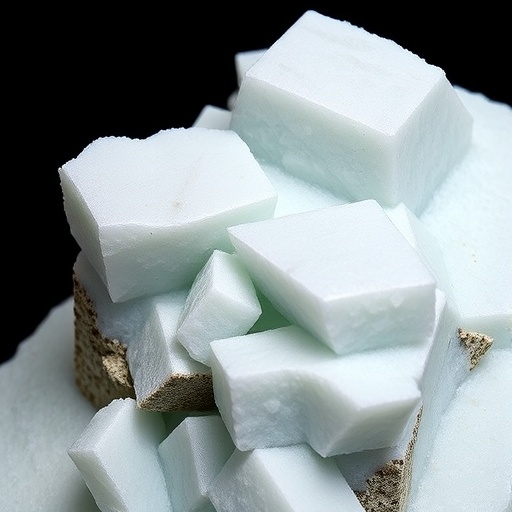
For decades, scientists have searched for the microscopic “hotspots” that make some mineral particles remarkably effective at triggering ice formation in clouds. A new study now challenges the assumption that such special locations are always necessary. Research published in Nature Communications reports that water can freeze on the (001) surface of microcline, a common potassium-rich feldspar, even when the surface shows no identifiable active sites. The finding could force a rethink of how atmospheric ice begins, with consequences for cloud formation, precipitation, climate modeling and the behavior of airborne dust.
Ice nucleation is the process by which liquid water changes into solid ice. In the atmosphere, it often begins on the surfaces of mineral dust particles lofted from deserts, agricultural land and exposed rock. These particles act as ice-nucleating particles, or INPs, allowing supercooled droplets—water that remains liquid below 0 degrees Celsius—to freeze at temperatures where pure water would often stay liquid. Once ice crystals appear, they can grow, collide with other particles and influence whether a cloud produces rain or snow. Because clouds cover much of Earth and strongly affect how sunlight and infrared radiation move through the atmosphere, even small changes in ice formation can have global significance.
Microcline is a member of the feldspar mineral family and is abundant in the continental crust. Its crystal lattice contains silicon, aluminum, oxygen and potassium arranged in a highly ordered structure. The mineral’s exposed surfaces interact with water through hydroxyl groups, charged sites, defects and microscopic changes in atomic arrangement. Previous research has often focused on identifying particularly efficient regions on mineral particles—such as steps, cracks, pits, impurities or unusually reactive chemical domains—where the first stable ice embryo might form. These regions are commonly described as active sites because they can initiate freezing more readily than the rest of the surface.
The new work centers on the microcline (001) face, a crystallographically defined surface whose atoms are arranged according to a specific plane through the mineral lattice. By examining ice formation on this surface, the researchers investigated whether freezing could be explained by a small number of exceptional locations or whether the apparently uniform surface itself could support nucleation. The study’s central conclusion, reflected in its title, is that ice nucleation can occur in the absence of detectable active sites. Rather than pointing to isolated microscopic defects as the sole cause, the observations indicate that the overall surface and the fluctuating structure of interfacial water may play a decisive role.
That distinction matters because classical descriptions of heterogeneous ice nucleation often treat the mineral as a catalyst that lowers the energetic barrier for freezing. In liquid water, molecules must spontaneously organize into an ice-like arrangement before a stable crystal can grow. Creating that first embryo costs free energy because molecules at the new ice–water boundary are arranged differently from those in the liquid. A solid surface can reduce this cost by providing a template or by changing the local energy balance. Yet the process remains probabilistic: even under identical temperature and surface conditions, freezing may occur at different times because molecular fluctuations continually create and destroy short-lived ice-like clusters.
If no single active site dominates, the freezing behavior of a mineral surface may emerge from many ordinary locations rather than a few extraordinary ones. Small variations in hydration, molecular orientation, surface charge and local lattice geometry could cause different areas to become favorable at different moments. In this picture, an apparently inactive region is not permanently incapable of nucleating ice. Instead, it may occasionally reach a favorable configuration as water molecules rearrange and the surface environment fluctuates. The result is a distributed, time-dependent nucleation process that can resemble random freezing across a broad area.
The finding also highlights why measuring ice nucleation is unusually difficult. Experiments must distinguish genuine surface-controlled freezing from effects caused by contamination, dissolved material, roughness, particle geometry or changes in cooling rate. A mineral may appear to possess highly efficient active sites simply because only a tiny fraction of its surface was observed, or because a particular preparation method created defects that were not present in natural particles. Conversely, a nominally smooth surface can still contain nanoscale chemical and structural variations that are invisible to conventional imaging. Demonstrating nucleation without identifiable active sites therefore requires careful control of the mineral surface, water chemistry and temperature history, together with statistical analysis of many freezing events.
For atmospheric science, the implications could be substantial. Climate and weather models need to estimate how many dust particles form ice at different temperatures and humidity levels. Many parameterizations assume that ice formation is governed by the number and strength of active sites on a particle. If smooth or apparently uniform surfaces can nucleate ice through collective and fluctuating behavior, then the relevant quantities may include total surface area, exposure time, water activity and the distribution of interfacial structures—not simply a fixed count of special defects. This could alter predictions of mixed-phase clouds, which contain both supercooled liquid droplets and ice crystals and are among the most difficult cloud systems to represent accurately.
The study may also help explain why laboratory measurements of mineral dust sometimes vary widely between experiments. Two samples identified as the same mineral can have different crystallographic faces, weathering histories, particle sizes and surface chemistries. Even when those properties are controlled, stochastic nucleation means that results depend on how long droplets are observed and how many surface regions are tested. A surface with no permanently “hot” spots could nevertheless produce more freezing events during a longer observation period. This time dependence offers a possible bridge between microscopic laboratory experiments and natural clouds, where particles can remain suspended and interact with supercooled droplets for seconds, minutes or much longer.
The researchers’ conclusion does not mean that defects and special sites are irrelevant. Real atmospheric dust is chemically complex, and cracks, steps, impurities and biological coatings can all influence ice formation. Instead, the microcline results suggest that active-site models should not be treated as the only possible explanation. Ice nucleation may occupy a spectrum, ranging from highly localized events controlled by a particular defect to broadly distributed nucleation governed by the collective properties of a mineral–water interface. By showing that the (001) surface of microcline can initiate ice without identifiable active sites, the study adds an important piece to the puzzle of how ordinary mineral dust helps transform clouds—and demonstrates that the first snowflake may begin not at a special flaw, but through a fleeting molecular reorganization on an apparently unremarkable surface.
Cite Scienmag News
Violet Maxwell. (August 25, 2026). Ice Formation on Microcline (001) Without Active Sites. Scienmag. https://scienmag.com/ice-formation-on-microcline-001-without-active-sites/
Violet Maxwell. "Ice Formation on Microcline (001) Without Active Sites." Scienmag, 25 August 2026, https://scienmag.com/ice-formation-on-microcline-001-without-active-sites/. Accessed 3 September 2026.
Violet Maxwell. "Ice Formation on Microcline (001) Without Active Sites." Scienmag. August 25, 2026. https://scienmag.com/ice-formation-on-microcline-001-without-active-sites/


