


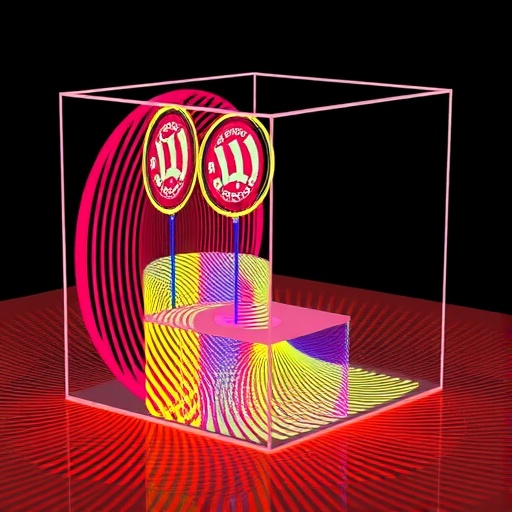
Diffusion usually appears to be one of nature’s most impartial processes: particles wander randomly, and over time their motion spreads them through available space without favoring one direction. A new study from researchers at Waseda University and collaborating institutions suggests that magnetic skyrmions can break this apparent symmetry. In computer simulations and theoretical analysis, the team found that skyrmions—tiny, particle-like whirlpools in magnetic order—can move more easily from one chamber to another through an off-center gate than in the reverse direction. The effect does not require an external ratchet, a conventional current-driven force, or a permanently imposed directional bias. Instead, it emerges from the combination of thermal randomness, repulsive interactions, the geometry of the environment, and the unusual topology of the skyrmions themselves. The finding, published in npj Spintronics, points toward a new way to control information using structures that are both stochastic and deterministic.
Skyrmions are localized patterns of magnetization in which atomic spins twist continuously around a central core. Their configuration is characterized by a topological quantity known as the skyrmion number, which distinguishes the texture from ordinary magnetic fluctuations and helps stabilize it against small perturbations. Although skyrmions are extended spin structures rather than conventional material particles, they can behave like mobile quasiparticles. In ultrathin magnetic films and multilayer heterostructures, they may be driven by electric currents, magnetic fields, or thermal fluctuations. Their motion is governed by equations that include not only ordinary damping and forces but also a transverse, topology-dependent response often associated with the skyrmion Hall effect. Under confinement, this unusual dynamics can make a skyrmion glide along a boundary or circle near a wall, producing what researchers call Brownian gyromotion.
To investigate how this behavior changes in a complex setting, the researchers constructed a theoretical model of multiple Néel-type skyrmions confined inside a nanostructured magnetic film. The simulated environment contained two chambers connected by a narrow opening, or gate, positioned away from the central axis. The skyrmions were allowed to move thermally, meaning that random fluctuations continually altered their trajectories. At the same time, the skyrmions repelled one another, as expected for magnetic textures with overlapping interaction fields. The team then compared the movement of skyrmions initially placed in the left chamber with the movement of those initially placed in the right chamber. Within a finite observation period, more skyrmions crossed in one direction than the other. The asymmetry was especially clear when the gate width was comparable to the diameter of an individual skyrmion.
The result might initially seem to be a simple consequence of the gate’s off-center shape. However, the simulations indicated that geometry alone was not sufficient to explain the effect. When ordinary particles encounter an asymmetric opening, their net transport may still remain balanced in thermal equilibrium unless another mechanism creates a sustained nonequilibrium bias. In the skyrmion system, the missing ingredient is the topology-dependent response to boundaries. As a skyrmion approaches a chamber wall, magnetic interactions generate an effective repulsive force. Because its motion includes a transverse component, the skyrmion does not simply rebound from the wall. Instead, it can be redirected into a curved, boundary-guided orbit. The off-center gate exposes an approaching skyrmion to different wall segments depending on its direction of travel, changing the trajectory and the probability that it will align with the opening.
This interaction between wall geometry and gyromotion creates a directional imbalance in passage events. A skyrmion entering the gate from the favored side can be steered toward the opening after interacting with a particular section of the boundary, while a skyrmion approaching from the opposite side may be deflected away or become trapped in a transient orbit. The process remains stochastic: individual skyrmions do not follow identical paths, and thermal noise continues to randomize their motion. Yet, when many trajectories are averaged over time, the crossing probabilities become unequal. This is a crucial distinction from a simple mechanical funnel. The system does not force every skyrmion to move in one direction; rather, it modifies the statistical likelihood of motion by exploiting the topological dynamics of the magnetic texture. In a centered, symmetric gate, the researchers observed nearly equal diffusion from both chambers.
Interactions between skyrmions added another layer of complexity. Although the skyrmions repel one another, two of them could temporarily orbit around a shared center, forming a short-lived binary configuration before separating. Such transient pairing demonstrates that repulsive quasiparticles can still display collective rotational dynamics when their trajectories and boundary forces become coupled. The density of skyrmions also mattered. At low or moderate densities, individual skyrmions had enough space to interact with the gate and the surrounding walls, allowing the directional effect to develop. At very high densities, crowding could push skyrmions out of a chamber or redirect them before they meaningfully encountered the asymmetric opening. In that regime, increased particle number did not necessarily strengthen the signal and could instead obscure the mechanism.
The width of the gate proved equally important. If the opening was substantially wider than a skyrmion, nearly all skyrmions could pass through, eliminating a strong difference between the two directions. If the opening was too narrow, neither side offered a realistic route across the barrier. Directional diffusion appeared only within an intermediate range in which the gate was restrictive enough to discriminate between trajectories but open enough to permit passage. This parameter dependence gives the phenomenon a practical design principle. By adjusting the gate position and width relative to the skyrmion size, researchers may be able to tune the magnitude and even the operating window of the diffusion asymmetry. The result is a form of geometry-controlled transport in which the structure is engineered to work with, rather than suppress, thermal fluctuations.
The researchers say this behavior could eventually support unconventional computing architectures. In conventional digital hardware, information is encoded through well-defined voltage or current states, while random motion is generally treated as noise to be minimized. In neuromorphic and physical computing systems, however, controlled randomness can become a computational resource. A chamber containing interacting skyrmions could represent a probabilistic state, with the likelihood of transfer determined by geometry, density, temperature, and magnetic topology. Networks of such chambers might perform nonlinear transformations, generate stochastic outputs, or process information through the collective statistics of many trajectories. Because skyrmions can be manipulated in nanoscale magnetic devices and may be moved with relatively low energy, structured skyrmion environments are being considered for unconventional artificial-intelligence hardware. The present work remains theoretical, but it identifies a mechanism that could be tested in patterned magnetic films.
More broadly, the study expands the scientific picture of diffusion beyond the behavior of ordinary particles. It shows how a topological spin texture can act as a mobile object while retaining internal properties that influence its response to forces and boundaries. The same combination of topology, dissipation, geometry, and fluctuations may occur in other active or nonequilibrium systems, including driven colloids, fluid vortices, and engineered metamaterials. The authors describe their work as a step toward a research area centered on interacting magnetic textures in structured environments, rather than on isolated skyrmions or perfectly ordered skyrmion lattices. If experiments confirm the predicted asymmetric transport, nanomagnetic chambers could become programmable physical systems in which randomness is not an obstacle but a mechanism for computation, selection, and control.
News Publication Date: July 16, 2026
Web References: https://doi.org/10.1038/s44306-026-00154-y
References: Xichao Zhang, Charles Reichhardt, Cynthia J. O. Reichhardt, Qiming Shao, Rui Zhang, Yan Zhou, Yongbing Xu, and Masahito Mochizuki, “Diffusion asymmetry of repulsive skyrmions in structured environment,” npj Spintronics, DOI: 10.1038/s44306-026-00154-y.
Keywords
Magnetic skyrmions, asymmetric diffusion, Brownian gyromotion, topological magnetism, spintronics, nanomagnetic devices, stochastic computing, artificial intelligence hardware, skyrmion interactions, structured environments
Cite Scienmag News
Grant Pearson. (August 25, 2026). Simulations Reveal Asymmetric Diffusion of Magnetic Skyrmions. Scienmag. https://scienmag.com/simulations-reveal-asymmetric-diffusion-of-magnetic-skyrmions/
Grant Pearson. "Simulations Reveal Asymmetric Diffusion of Magnetic Skyrmions." Scienmag, 25 August 2026, https://scienmag.com/simulations-reveal-asymmetric-diffusion-of-magnetic-skyrmions/. Accessed 4 September 2026.
Grant Pearson. "Simulations Reveal Asymmetric Diffusion of Magnetic Skyrmions." Scienmag. August 25, 2026. https://scienmag.com/simulations-reveal-asymmetric-diffusion-of-magnetic-skyrmions/


