


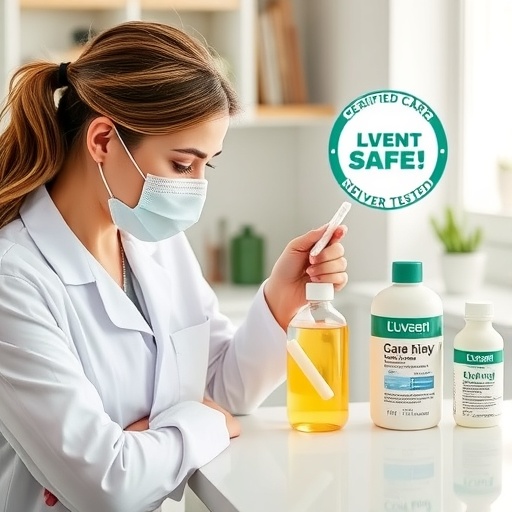
A new peer-reviewed analysis is challenging one of the most trusted assumptions in the rapidly expanding market for “clean,” “safe,” and environmentally responsible personal care products: that a certification seal means the product inside the package has been independently tested. According to the review, none of the certification and ingredient-screening programs examined routinely requires laboratory analysis of finished products. Instead, these programs generally evaluate ingredient lists, supplier records, manufacturing documents, and declarations provided by the companies seeking certification. That system can determine what manufacturers intended to include in a formulation, but it may not reveal what actually entered the bottle during production, storage, transport, or packaging.
The findings are especially significant because they arrive alongside a companion study that detected unlabeled chemicals in nearly all of 113 personal care and cleaning products purchased for testing. Most of the products contained at least one chemical that was not listed on the label and that had known or suspected health hazards. In roughly one-quarter of the products, the findings directly conflicted with marketing claims. Products advertised as free of particular chemical groups were not always free of them; some products promoted as “phthalate-free,” for example, contained detectable phthalates. Together, the studies expose a gap between chemical safety systems based on paperwork and the complex chemical reality of finished consumer products.
“Certification programs check the recipe. Nobody checks the cake,” said Johanna R. Rochester, PhD, lead author of the review and senior scientist at the Million Marker Research Institute. “What a company means to put in a product and what ends up in the bottle are two different things, and no one is checking the difference.” The distinction matters because manufacturing can introduce substances that were never deliberately added. Contaminants may come from raw materials, processing equipment, reaction byproducts, solvents, preservatives, packaging, or degradation during storage. Some can be present at very low concentrations yet remain relevant if a product is used repeatedly, applied to large areas of skin, inhaled as a spray, or used by vulnerable populations.
The researchers reviewed 18 programs operating in United States and European markets. Their analysis included third-party certifications such as MADE SAFE, Environmental Working Group, Cradle to Cradle, COSMOS, the EU Ecolabel, and EPA Safer Choice. It also covered retailer standards, including Clean at Sephora and Target Clean, as well as consumer-facing scoring applications such as Yuka and Think Dirty. Sixteen programs were designed primarily to assess chemical hazards and were compared directly. None required routine analytical testing of the finished product as a condition of evaluation, and none used non-targeted analysis, a laboratory approach capable of scanning for thousands of chemical signals without limiting the search to a predetermined list.
That technical limitation is central to the researchers’ argument. Targeted testing is designed to look for specific substances selected in advance, such as lead, formaldehyde, phthalates, or a particular solvent. It can be highly sensitive and useful when a known contaminant is suspected, but it cannot reliably detect an unexpected compound that was not included in the testing plan. Non-targeted analysis uses techniques such as high-resolution mass spectrometry and advanced chromatography to separate and identify a broad range of chemical compounds in a sample. Scientists can compare the resulting molecular signals with reference databases, then perform targeted follow-up tests to confirm the identity and concentration of substances that may pose a health concern.
The review found that six programs addressed contaminants or impurities as a defined category, but generally did so through restrictions on ingredients, manufacturing requirements, supplier documentation, or other paperwork rather than direct measurement of products. A small number of programs may require targeted testing for particular substances under specific circumstances. Such measures can reduce known risks, but they still depend on anticipating the chemical problem before testing begins. They also leave open the possibility that a product contains an unexpected contaminant, an impurity from a raw material, or a breakdown product created after the formulation leaves the factory.
Government regulation follows a similar pattern, the authors reported. In the United States, federal requirements, state laws, and newer provisions under the 2022 Modernization of Cosmetics Regulation Act emphasize ingredient restrictions, disclosure, safety records, and manufacturer responsibilities rather than routine laboratory testing of every finished cosmetic product. More than a dozen states have adopted additional requirements, and a few impose concentration limits for particular contaminants. New York and Vermont, for example, set limits for 1,4-dioxane, a manufacturing byproduct that can occur in certain ingredients. The European Union framework requires a premarket safety assessment and a legally accountable person for each product, offering stronger formal oversight than the U.S. system, but it too is largely centered on known and declared substances.
The researchers are not calling for ingredient-based safety assessments or certification programs to be abandoned. Instead, they propose adding analytical testing as a second layer of protection. Voluntary programs could begin with products likely to create higher exposure or greater vulnerability, including baby products, products used during pregnancy, leave-on formulations such as sunscreens and fragrances, and products applied to sensitive areas, including feminine washes and menstrual products. Non-targeted screening could be used periodically or on selected production batches, while targeted testing could confirm and measure any chemicals identified during the broader scan. The goal would be to connect hazard-based assessment, which asks whether a chemical can cause harm, with exposure-based evidence about how much of that chemical is actually present and how people use the product.
There is also a financial incentive for companies and certifiers to close the gap. Between 2011 and 2023, 334 skin care products were recalled in the United States, representing more than 77 million units. Recalls can result in lost inventory, regulatory action, litigation, reputational damage, and a collapse of consumer confidence in certification claims. “Shoppers read the label, they look for the seal, and they still can’t know what’s in the bottle,” said Jenna Hua, PhD, MPH, senior author and founder of the Million Marker Research Institute. “Right now the only way to know what’s in a product is to send it to a lab yourself. That’s an unfair thing to ask of a consumer, but it’s a reasonable thing to ask of a certifier.” The analysis suggests that the next generation of product safety seals may need to verify not only the recipe, but also the chemical contents of the finished product.
News Publication Date: 25-Aug-2026
Web References: https://doi.org/10.1021/envhealth.6c00181
Cite Scienmag News
Ophelia Keating. (August 25, 2026). Certified safe, never tested: Personal care certifications don’t lab-test finished products. Scienmag. https://scienmag.com/certified-safe-never-tested-personal-care-certifications-dont-lab-test-finished-products/
Ophelia Keating. "Certified safe, never tested: Personal care certifications don’t lab-test finished products." Scienmag, 25 August 2026, https://scienmag.com/certified-safe-never-tested-personal-care-certifications-dont-lab-test-finished-products/. Accessed 3 September 2026.
Ophelia Keating. "Certified safe, never tested: Personal care certifications don’t lab-test finished products." Scienmag. August 25, 2026. https://scienmag.com/certified-safe-never-tested-personal-care-certifications-dont-lab-test-finished-products/


