


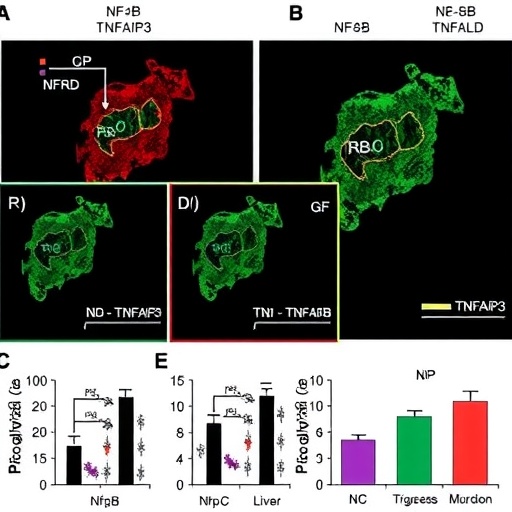
A molecular feedback system best known for restraining inflammation may also protect the liver from metabolic overload, according to a new study published in Cell Death Discovery. Researchers led by Sun, Li, Yao and colleagues report that the NF-κB–TNFAIP3 axis reduces metabolic dysfunction-associated steatotic liver disease, or MASLD, by stimulating autophagy in hepatocytes, the principal functional cells of the liver. The findings place a familiar inflammatory signaling pathway at the center of a more complex biological response—one that may help liver cells process excess fat before it triggers widespread injury.
MASLD has become one of the most common chronic liver disorders worldwide, paralleling the global rise in obesity, insulin resistance and type 2 diabetes. The condition begins when hepatocytes accumulate excessive triglycerides and other lipid species. In many people, simple steatosis remains relatively stable, but in others it progresses to metabolic dysfunction-associated steatohepatitis, fibrosis, cirrhosis and, eventually, liver cancer. The disease is not caused solely by the amount of fat stored in the liver. Lipid composition, mitochondrial stress, inflammatory signaling, oxidative damage and impaired cellular waste disposal all influence whether the organ adapts or deteriorates.
Autophagy is one of the liver’s principal systems for maintaining that balance. Through this intracellular recycling pathway, damaged proteins, defective organelles and lipid droplets are enclosed in double-membrane structures called autophagosomes. These structures subsequently fuse with lysosomes, where their contents are degraded and recycled. A specialized form known as lipophagy allows cells to mobilize stored lipids and deliver them for energy production. When autophagy is impaired, damaged mitochondria and toxic lipid intermediates can accumulate, intensifying oxidative stress and inflammatory injury. Activating autophagy, however, is not automatically beneficial; the pathway must operate through a complete and coordinated process known as autophagic flux.
The new work focuses on nuclear factor kappa B, or NF-κB, a family of transcription factors that regulates genes involved in immunity, inflammation, cell survival and stress adaptation. NF-κB is often portrayed as a driver of chronic inflammatory disease because excessive or persistent activation can induce cytokines and other mediators that damage tissues. In the liver, metabolic stress can stimulate NF-κB through signals associated with free fatty acids, reactive oxygen species, endotoxins and inflammatory cytokines. Yet NF-κB activity is not uniformly destructive. Its effects depend on the intensity, duration and cellular context of activation, as well as on the regulatory genes it induces.
One of those genes is TNFAIP3, which encodes tumor necrosis factor alpha-induced protein 3, commonly called A20. A20 is a critical negative regulator of NF-κB signaling. It functions as a molecular brake by modifying signaling proteins involved in the pathway and helping terminate inflammatory responses after an initial stimulus. This feedback arrangement allows cells to respond rapidly to danger without remaining permanently locked in an inflammatory state. Sun and colleagues describe evidence that the NF-κB–TNFAIP3 relationship has a second consequence in hepatocytes: it supports the activation of autophagy and thereby helps counter the metabolic stress associated with MASLD.
The significance of this mechanism lies in the connection between inflammation and intracellular housekeeping. NF-κB activation can change the expression of many genes, while TNFAIP3 can reshape the duration and strength of that response. According to the study, this signaling axis promotes an autophagic program in liver cells, increasing their capacity to remove or recycle harmful cellular material. By improving the handling of lipid droplets and damaged organelles, the pathway may reduce the buildup of lipotoxic molecules—fat-derived compounds that interfere with membranes, mitochondria and metabolic enzymes. The result is a shift from destructive cellular stress toward adaptation and recovery.
The researchers’ findings also highlight why MASLD cannot be understood as a simple storage disorder. Hepatocytes are highly metabolically active, and excessive nutrients force them to balance lipid synthesis, oxidation, export and degradation. When that balance fails, enlarged lipid droplets can coexist with dysfunctional mitochondria and endoplasmic reticulum stress. These conditions activate inflammatory pathways, but inflammatory signaling may simultaneously induce protective feedback mechanisms. The study presents TNFAIP3 as an important component of that feedback, linking a transcriptional response to the physical clearance of cellular waste through autophagy.
This interpretation may help explain why broadly suppressing inflammation is not always an ideal strategy for treating metabolic liver disease. Inflammation can drive fibrosis and tissue injury, but some inflammatory signals also initiate protective programs that preserve cell viability. A therapy that blocks NF-κB indiscriminately could therefore eliminate both harmful and beneficial outputs. Targeting the TNFAIP3-centered regulatory branch, or selectively enhancing its ability to support autophagy, might offer a more precise approach. Such a strategy would aim to preserve the liver’s adaptive response while limiting the prolonged inflammatory activity that contributes to disease progression.
The study also raises important questions about therapeutic translation. Any treatment designed to activate autophagy would need to establish that it increases productive autophagic flux rather than merely causing autophagosomes to accumulate because lysosomal degradation is blocked. It would also need to account for the fact that NF-κB and TNFAIP3 operate in many tissues, including immune cells, adipose tissue and the intestine. Manipulating this system could influence host defense, tumor biology and systemic metabolism. In addition, MASLD is biologically diverse: the same molecular intervention may not have identical effects in patients with obesity, diabetes, genetic susceptibility, alcohol exposure or advanced fibrosis.
For now, the findings provide a mechanistic framework rather than a ready-to-use treatment. They suggest that hepatocytes possess an endogenous defense circuit in which stress-responsive NF-κB signaling induces TNFAIP3, and TNFAIP3 helps direct the cells toward autophagic maintenance. Understanding how this circuit changes across disease stages could reveal why some fatty livers remain relatively benign while others progress to inflammatory steatohepatitis and scarring. The work ultimately reframes the NF-κB–TNFAIP3 axis as more than an inflammation switch: it may be part of the liver’s quality-control machinery, helping overloaded cells recycle damage before metabolic stress becomes irreversible disease.
Cite Scienmag News
Ophelia Keating. (August 25, 2026). NF-κB–TNFAIP3 Pathway Alleviates MASLD by Activating Autophagy in Liver Cells. Scienmag. https://scienmag.com/nf-%ce%bab-tnfaip3-pathway-alleviates-masld-by-activating-autophagy-in-liver-cells/
Ophelia Keating. "NF-κB–TNFAIP3 Pathway Alleviates MASLD by Activating Autophagy in Liver Cells." Scienmag, 25 August 2026, https://scienmag.com/nf-%ce%bab-tnfaip3-pathway-alleviates-masld-by-activating-autophagy-in-liver-cells/. Accessed 4 September 2026.
Ophelia Keating. "NF-κB–TNFAIP3 Pathway Alleviates MASLD by Activating Autophagy in Liver Cells." Scienmag. August 25, 2026. https://scienmag.com/nf-%ce%bab-tnfaip3-pathway-alleviates-masld-by-activating-autophagy-in-liver-cells/


