


The idea that every adult needs exactly eight hours of sleep has become one of modern wellness culture’s most durable assumptions. It appears in medical advice, fitness trackers, school guidance and countless health headlines. But a new peer-reviewed narrative review in Brain Medicine argues that the eight-hour rule was never established as a universal biological requirement. By bringing together anthropological fieldwork, historical documents, comparative animal research, genetics and sleep neuroscience, the authors suggest that sleep health depends less on a single number than on when sleep occurs, how consistently it is maintained and how closely it aligns with the body’s internal clock.
The review is not a clinical trial and does not present new measurements from human participants or newly sequenced genomes. Instead, it examines findings that have often been discussed separately. The authors compare sleep patterns in three hunter-gatherer societies living without widespread electric lighting—the Hadza of Tanzania, the San of Namibia and the Tsimane of Bolivia—with historical accounts of European sleep, genetic studies of naturally short sleepers, research in cave-dwelling fish and evidence linking sleep to urban environments. Across these very different sources, one conclusion becomes increasingly difficult to ignore: industrialization appears to have changed the timing and stability of sleep more consistently than its total duration.
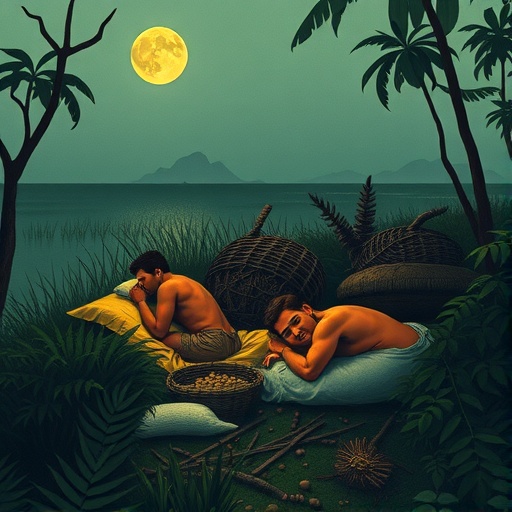
Field studies of the Hadza, San and Tsimane have reported average nightly sleep durations ranging from approximately 6.4 to 7.1 hours. These figures do not exceed the sleep duration commonly observed in industrialized populations, despite the groups’ much lower exposure to electric light and digital technology. Their sleep tends to follow the natural light–dark cycle, beginning later than sunset and ending near dawn rather than immediately after darkness. The review also finds no consistent evidence that these societies regularly practiced the highly structured “first sleep” and “second sleep” pattern often presented as a universal ancestral tradition. Their sleep was generally consolidated, although local climate, social activity, temperature and seasonal conditions influenced its timing.
The historical origins of the eight-hour standard are equally uncertain. During the nineteenth century, the slogan “eight hours for work, eight hours for rest, eight hours for sleep” became an influential social ideal. According to the review, however, this formula was a prescription for organizing daily life rather than the result of systematic sleep research. A frequently cited 1913 Stanford survey, sometimes used to suggest that people once slept about nine hours per night, examined children between eight and seventeen years old rather than a representative adult population. Over time, a convenient social convention acquired the authority of a clinical benchmark, even though the behavior of ordinary adult sleepers had not been measured in the way the modern claim implies.
The review also revisits the popular theory that pre-industrial Europeans routinely slept in two blocks separated by a period of nighttime wakefulness. Historian Roger Ekirch helped popularize this interpretation through evidence from court records, letters and literary sources describing “first sleep.” Yet a later examination of the same material argues that the phrase could have had several meanings, including an initial uninterrupted period of sleep, the deepest portion of the night or sleep occurring during the first part of a night shift. Research into Roman domestic life has likewise found little evidence for a standardized, society-wide system of segmented sleep. Experimental studies that induced extended darkness and inactivity in windowless rooms have also been criticized as poor models of candlelit evenings shaped by household work, social interaction and firelight.
Rather than replacing one universal sleep story with another, the authors emphasize biological flexibility. Sleep architecture varies across species according to ecology, metabolic demands and the risk of predation. Lions can sleep for long periods in relatively secure environments, while vulnerable prey animals often sleep in short, frequent bouts. Whales, seals and several bird species use unihemispheric slow-wave sleep, allowing one brain hemisphere to rest while the other remains sufficiently active for breathing, movement or environmental monitoring. Even measurements within a single species can change dramatically with context. Wild three-toed sloths have been recorded sleeping roughly nine to ten hours per day, far below the fifteen to twenty hours sometimes reported in captivity, demonstrating how strongly surroundings can affect apparent sleep need.
Genetic evidence further challenges the idea that a short sleep duration is automatically pathological. The review highlights DEC2, also known as BHLHE41, a transcriptional repressor identified in a family whose members naturally slept about six hours per night without the cognitive and physical signs typically associated with sleep deprivation. The P384R variant was later introduced into mice. Those animals slept less during both rapid-eye-movement and non-rapid-eye-movement phases, yet showed no obvious impairment in behavioral, motor or cognitive testing. The authors argue that familial short sleep associated with a validated genetic variant should be recognized as a non-pathological phenotype. In practical terms, not every person who sleeps fewer than seven or eight hours requires medical correction, particularly when short sleep is lifelong, stable and unaccompanied by daytime dysfunction.
One of the review’s most technically striking themes is the role of hypocretin, also called orexin, a neuropeptide system that stabilizes wakefulness. Hypocretin-producing neurons in the lateral hypothalamus project to several monoaminergic and cholinergic regions involved in arousal. When these neurons or their signaling pathways fail, people can develop narcolepsy with cataplexy, a condition characterized by overwhelming sleepiness and sudden loss of muscle tone. Similar symptoms occur in dogs carrying loss-of-function mutations in the hypocretin receptor 2 gene, while orexin-deficient mice display fragmented wakefulness and sleep. The same system connects apparently unrelated findings: the DEC2 short-sleep variant increases orexin expression in transgenic mice, and cave populations of the Mexican tetra, Astyanax mexicanus, have independently evolved reduced sleep alongside enhanced hypocretin signaling. Dual orexin receptor antagonists, which reduce wake-promoting activity, are now used clinically to treat insomnia.
The evolutionary trail may extend deeper than animal behavior. More than one hundred genes with sequence homology to known metazoan sleep-regulating genes have been identified in the single-celled green alga Chlamydomonas reinhardtii. Evidence from extremophilic bacteria and reconstructions of the Last Universal Common Ancestor also points to ancient molecular components that may have been co-opted into later biological timing and regulatory systems. The authors are careful not to claim that algae or bacteria sleep. Genetic homology indicates that molecular machinery is conserved; it does not demonstrate the presence of sleep as a behavioral state. That distinction matters because the review’s central argument is not that sleep has remained unchanged throughout evolution, but that the mechanisms governing cycles of activity, rest and environmental synchronization have deep biological roots.
The modern urban environment introduces another layer of inequality. Neighborhood disadvantage is associated with poorer sleep efficiency, more nighttime wakefulness and shorter sleep in children, even after individual characteristics are considered. In low-income and racially segregated areas, residents are more likely to experience traffic noise, artificial light, heat and inadequate housing conditions. A housing-upgrading program in Buenos Aires that moved residents from makeshift dwellings into prefabricated modular units produced measurable improvements in subjective sleep quality, suggesting that sleep can respond to changes in the physical environment rather than merely to personal habits. Climate change may intensify these disparities. Under a high-emissions scenario with no additional behavioral or technological adaptation, projections cited by the authors indicate that warming could add six to fourteen nights of insufficient sleep per 100 people annually in the United States between 2050 and 2099, with the greatest burden falling on warmer regions and lower-income populations. The review therefore treats building standards, lighting policy, noise control and heat mitigation as potential sleep interventions.
The authors acknowledge that their synthesis has important limits. It is a narrative review, not a systematic review or meta-analysis, and the selection of studies reflects their judgment about which sources connect large-scale evolutionary and social questions with individual sleep biology. Consumer wearable studies may overrepresent people who can afford and regularly use such devices, leaving informal settlements and many low- and middle-income communities poorly measured. A study of segmented sleepers in Oman found elevated oxidative-stress biomarkers, but its cross-sectional design and predominantly young sample cannot establish that split sleep caused the biological differences. Most importantly, the literature has not adequately answered whether seven or eight hours of sleep divided into two reliably timed periods provides the same health benefits as seven or eight consolidated hours. The review’s practical message is consequently measured rather than sensational: sleep assessment should consider duration together with timing, regularity and circadian alignment. The eight-hour night may be beneficial for many people, but it is not a complete definition of healthy sleep—and may never have been a universal biological law.
News Publication Date: 25 August 2026
Web References: https://doi.org/10.61373/bm026w.0060
References: Pandi-Perumal SR, Saravanan KM, Spence DW, Alsaif SS, Jahrami H, BaHammam AS, et al. “The new science of sleep: Insights from pre-industrial societies and phylogenomics.” Brain Medicine, 2026. DOI: 10.61373/bm026w.0060.
Cite Scienmag News
Drew Townsend. (August 25, 2026). Hunter-gatherers sleep as long as modern humans, but at different times. Scienmag. https://scienmag.com/hunter-gatherers-sleep-as-long-as-modern-humans-but-at-different-times/
Drew Townsend. "Hunter-gatherers sleep as long as modern humans, but at different times." Scienmag, 25 August 2026, https://scienmag.com/hunter-gatherers-sleep-as-long-as-modern-humans-but-at-different-times/. Accessed 5 September 2026.
Drew Townsend. "Hunter-gatherers sleep as long as modern humans, but at different times." Scienmag. August 25, 2026. https://scienmag.com/hunter-gatherers-sleep-as-long-as-modern-humans-but-at-different-times/


