


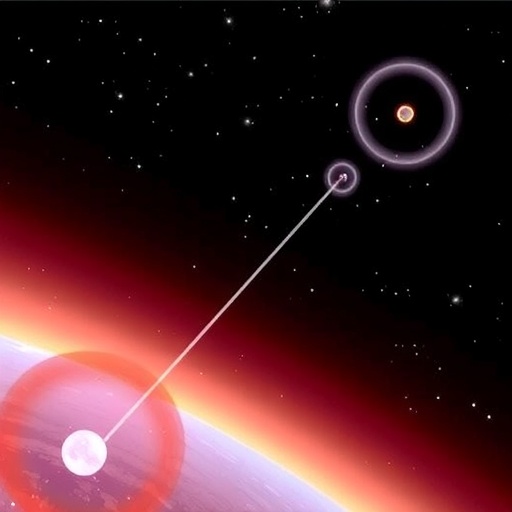
A new deep-learning system could make it far easier to detect one of the ionosphere’s most disruptive—and elusive—phenomena: plasma bubbles. These enormous pockets of depleted plasma form after sunset above equatorial and low-latitude regions, where they can distort or interrupt radio signals used by aircraft, navigation systems, satellites, and high-frequency communications. The model, called IncResUnet, analyzes ion density measurements and identifies the distinctive signatures of plasma bubbles without relying on a single fixed statistical threshold. In tests, it detected events with remarkable sensitivity and maintained much of its performance even when transferred between different satellites, suggesting that artificial intelligence could become a valuable new tool for space-weather monitoring.
Plasma bubbles are not empty cavities in space. They are regions where the concentration of charged particles in the ionosphere drops sharply relative to the surrounding plasma. These structures can extend from a few kilometers to hundreds of kilometers and may develop rapidly, merge, or appear as a sequence of connected depletion regions. When radio waves pass through them, the uneven plasma distribution can cause scintillation—a rapid fluctuation in signal intensity and phase. The resulting interference can degrade satellite navigation, disrupt communications, and complicate the operation of technologies that depend on reliable links through the ionosphere.
For decades, researchers have commonly searched for plasma bubbles by applying statistical rules to satellite measurements. A typical method removes a slowly varying background trend from a short segment of ion density data and then flags an event when the remaining fluctuation exceeds a predefined threshold. While straightforward, this approach assumes that plasma bubbles have reasonably consistent shapes and amplitudes. In reality, their appearance changes with solar activity, season, local time, latitude, and atmospheric conditions. During periods of low solar activity, traditional techniques can miss as many as 40 percent of events, according to the study. A threshold that is sensitive enough to capture weak bubbles may also produce a flood of false alarms when the background ionosphere becomes noisy.
The research team from Huazhong Agricultural University addressed this problem by treating bubble detection as a waveform-recognition task. Their model was trained on ion density observations collected by the FORMOSAT-1 satellite between 1999 and 2004, together with results from conventional detection algorithms and expert manual annotations. The resulting dataset contained 13,675 labeled plasma bubble events. Instead of asking whether a single measurement crossed a fixed boundary, IncResUnet learned the broader temporal pattern of a density depletion, including how quickly it begins, how long it lasts, and how its shape develops across neighboring measurements.
At the core of the system is the U-Net architecture, a neural-network design widely used for image segmentation and other problems requiring precise boundary detection. IncResUnet adapts that framework to one-dimensional ion density time series. Its encoder progressively compresses the input while extracting increasingly abstract features, and its decoder reconstructs the signal at its original resolution so that the beginning and end of each event can be located. The model’s distinctive feature is a series of Inception-residual modules. Parallel one-dimensional convolutional kernels of different sizes examine short- and long-duration variations simultaneously, while residual connections allow the network to preserve useful information and reduce the risk of vanishing gradients during training.
The training strategy was designed to test whether the system could recognize events across different years rather than simply memorize a particular dataset. Measurements from 2001 to 2003 were used for training, 1999 data for validation, and observations from 2000 and 2004 for testing. Because plasma bubbles occupy only a small portion of the total data, random undersampling was used to prevent the model from becoming biased toward the much more common non-event samples. The researchers also introduced explicit criteria for defining a bubble: a density deviation greater than twice the standard deviation of the background trend, an amplitude of at least 0.2, a duration of at least five seconds, and a transverse scale no larger than 500 kilometers.
After IncResUnet generates its predictions, a post-processing stage removes detections shorter than five seconds, which are treated as noise. Events separated by less than one minute are merged, allowing the system to represent a larger plasma-bubble structure rather than breaking it into multiple fragments. This refinement is important because the ionosphere often contains complex, connected depletion patterns. A detector that identifies every local dip independently could overestimate the number of events or misrepresent their physical extent. By combining neural-network classification with duration and temporal-continuity rules, the researchers aimed to balance sensitivity with physically meaningful event boundaries.
On the FORMOSAT-1 test data, IncResUnet achieved an F1-score of 0.914, a recall of 0.958, and a precision of 0.874. The F1-score combines recall and precision into a single measure, while recall indicates how many real events were successfully found and precision reflects how many reported events were genuine. On a second test period, the model again reached an F1-score of 0.914, with a recall of 0.924 and precision of 0.905. It outperformed the traditional threshold method, as well as several alternative machine-learning and neural-network systems, including ResNet-18, long short-term memory networks, standard U-Net, U-Net++, and Attention U-Net. The results indicate that multi-scale temporal features are particularly important for recognizing bubbles with widely varying durations.
The researchers then tested whether the model could work beyond the satellite data used for training. When IncResUnet, trained on FORMOSAT-1 observations, was applied directly to measurements from the C/NOFS satellite, its F1-score was 0.804. A small amount of additional training on C/NOFS data increased that score to 0.859, while recall reached 98.8 percent. The model also detected all 36 events in a test involving COSMIC-2 observations. These results point to both the promise and the challenge of cross-satellite deployment: the system can transfer knowledge between instruments, but differences in sensor characteristics, sampling conditions, and data distributions can reduce accuracy. The study identifies this distribution shift as the main reason for performance differences between satellite missions.
IncResUnet does not eliminate the need for expert analysis, but it could transform how researchers build long-term catalogs of ionospheric disturbances. Automated detection would allow scientists to process far more satellite data than manual inspection permits, improving studies of how plasma bubbles respond to solar storms, atmospheric tides, seasonal cycles, and changing geomagnetic conditions. For operational space-weather services, rapid identification could provide an earlier warning of conditions likely to affect navigation and communications. The work, published in Space: Science & Technology, represents a systematic demonstration that deep learning can learn the time-series fingerprints of plasma depletion. As satellite observations continue to expand, models capable of adapting across missions may become central to monitoring the restless, signal-disrupting environment at the edge of space.
News Publication Date: 22 July 2026
Web References: https://doi.org/10.34133/space.0492
References: Space: Science & Technology, DOI: 10.34133/space.0492
Cite Scienmag News
Blake Davidson. (August 23, 2026). IncResUnet Automatically Detects Ionospheric Plasma Bubbles. Scienmag. https://scienmag.com/incresunet-automatically-detects-ionospheric-plasma-bubbles/
Blake Davidson. "IncResUnet Automatically Detects Ionospheric Plasma Bubbles." Scienmag, 23 August 2026, https://scienmag.com/incresunet-automatically-detects-ionospheric-plasma-bubbles/. Accessed 4 September 2026.
Blake Davidson. "IncResUnet Automatically Detects Ionospheric Plasma Bubbles." Scienmag. August 23, 2026. https://scienmag.com/incresunet-automatically-detects-ionospheric-plasma-bubbles/


