


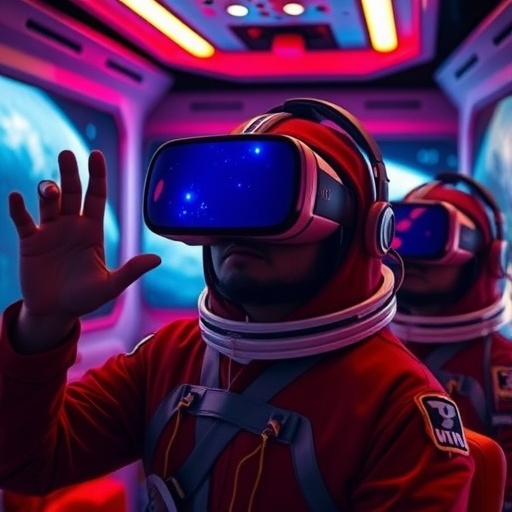
As humanity prepares for the possibility of extended missions beyond Earth, researchers are investigating an unusual but potentially powerful form of astronaut support: bringing the sights, smells and emotional cues of nature into space. A team at Texas A&M University has tested a multisensory virtual reality system designed to help people maintain psychological well-being while living in confined, isolated environments. In a study funded by NASA, sailors aboard a U.S. Navy ship experienced simulated outdoor environments, including beaches, parks and forests, while a compact scent generator released odors synchronized with what they were seeing. The results suggest that combining visual immersion with carefully timed smells may reduce negative emotions and increase positive ones immediately after use, offering a possible tool for future crews traveling far from Earth.
The research addresses one of the most persistent challenges of interplanetary exploration: astronauts will not simply be working in a spacecraft; they will be living inside one for months or years. A mission to Mars, for example, would involve long periods of isolation, restricted movement, repetitive surroundings and delayed communication with family, friends and mission-control psychologists. On the International Space Station, astronauts can communicate with Earth in near real time and receive frequent supplies, personal items and care packages. Those options would be severely limited during a deep-space journey because radio signals take minutes to travel between planets and resupply missions would be impossible. As a result, NASA has increasingly focused on technologies that can provide psychological support without requiring physical contact with Earth.
Dr. Ana Diaz Artiles, an associate professor in Texas A&M’s Department of Aerospace Engineering, led the study with a team that examined how virtual environments could simulate experiences otherwise unavailable to people living in enclosed habitats. Participants wore HTC Vive Pro Eye headsets, which use high-resolution stereoscopic displays and motion tracking to create the perception of being inside a digitally generated location. The system allowed subjects to look around and explore scenes such as a walk along a beach or a stroll through a park. Rather than treating virtual reality as a purely visual medium, however, the researchers added a second sensory channel. A compact scent generator, preloaded with selected odors, delivered smells at specific points in each simulation, linking the artificial environment to a physical chemical stimulus.
That synchronization was central to the experiment. When participants viewed a forest, for example, the system could release scents associated with soil, vegetation or other natural settings. The goal was not simply to make the headset more entertaining, but to strengthen the brain’s sense of presence—the feeling that a person is occupying a place rather than merely watching a screen. Smell is particularly relevant because the olfactory system is closely connected with brain regions involved in emotion and memory. Familiar scents can evoke vivid autobiographical associations, while environmental odors may help make a simulated setting feel coherent and believable. By coordinating visual information with scent, the researchers sought to create an experience that was more psychologically convincing than conventional screen-based relaxation tools.
The team spent four years developing the combined technology and preparing it for testing in an operationally relevant setting. Instead of conducting the work only in a laboratory, the researchers deployed it aboard a U.S. Navy ship, where participants lived under conditions that more closely resembled the restrictions of a future spacecraft. The sailors were confined to the vessel for two weeks, experiencing limited access to open outdoor spaces and the predictable routines of shipboard life. Although a ship is not a spacecraft, it provides a useful terrestrial analogue for several important stressors, including confinement, social crowding, isolation from ordinary surroundings and reduced exposure to natural environments. The setting allowed the researchers to evaluate the system under circumstances more demanding than a brief laboratory session.
The psychological reasoning behind the project is grounded in a growing body of research on the benefits of nature exposure. Natural environments have been associated with improved mood, reduced stress and restoration of attention, while access to sunlight, vegetation and open space can also influence physiological and cognitive states. Astronauts on long missions may be deprived of nearly all of these cues. Their surroundings could consist of metal walls, equipment panels, artificial lighting and a narrow range of sounds and smells. Even carefully designed spacecraft will not reproduce the changing complexity of Earth’s landscapes. “Nature has a lot of psychological and physiological benefits, it also has cognitive benefits,” said Renee Abbott, an aerospace Ph.D. student involved in the work. “What we’re trying to do is bring nature to astronauts in virtual reality.”
The initial findings showed that participants who used the virtual reality headset together with the scent generator reported fewer negative emotions and more positive emotions immediately after the experience. Those results do not establish that the system can prevent depression, anxiety or other mental-health conditions during a multiyear mission, and the study does not demonstrate long-term therapeutic effects. They do, however, indicate that multisensory virtual environments can produce a measurable short-term emotional response in an isolated population. That distinction is important for spaceflight researchers, who must evaluate not only whether a technology feels immersive but also whether it changes the user’s psychological state in a consistent and useful way. Future studies will need to determine how long the benefits last, whether repeated use remains effective and which environments or scents are most helpful for different individuals.
The researchers say that adding smell may be especially valuable because it engages a sensory system often overlooked in virtual reality design. Most commercial VR applications rely primarily on vision and sound, while touch is usually limited to handheld controllers or haptic feedback devices. The Texas A&M system instead explored how a timed chemical stimulus could reinforce the digital scene. The approach could eventually be expanded with other forms of sensory feedback, including temperature changes, airflow, vibration or tactile surfaces. A simulated walk beside the ocean might be paired with the sound of waves, a gentle breeze, a cool sensation and the scent of saltwater. Such additions would not recreate Earth in a literal sense, but they could provide astronauts with brief, structured escapes from an environment that remains physically unchanged.
The practical requirements of spaceflight will determine whether this concept can move beyond research trials. Any system used aboard a spacecraft would need to be compact, reliable and easy to clean, with minimal power consumption and tightly controlled chemical cartridges. Scent compounds would also have to meet strict safety requirements, particularly in a closed cabin where airborne substances could affect sensitive equipment or trigger allergies. The software would need to operate without dependence on high-bandwidth communication with Earth, and mission planners would need to ensure that the technology complements rather than replaces professional psychological care. Personalization may also be essential: one astronaut might find a forest calming, while another could respond more strongly to a familiar kitchen, a favorite coastline or a location connected with family memories.
Diaz Artiles believes the potential applications extend well beyond space exploration. Sailors serving on submarines and warships may experience many of the same psychological pressures as astronauts, including prolonged confinement and limited access to outdoor environments. Hospitals could also use multisensory VR to help patients who cannot leave their rooms because of illness, injury or infection-control requirements. People with limited mobility might be able to explore locations that are physically difficult or impossible to reach, while workers in offices or other stressful settings could use short virtual nature sessions as a form of recovery. The technology’s appeal lies in its ability to deliver a controlled experience without transporting the user anywhere. “It’s remarkable how immersive VR can feel, even if you know the experience is not real,” Diaz Artiles said. If larger and longer-term studies confirm the early results, a headset paired with a small scent device could become part of a broader toolkit for protecting mental health in the most isolated environments humans can enter.
News Publication Date: 30-Jun-2026
Web References: Frontiers in Psychology study; Dr. Ana Diaz Artiles profile; Texas A&M Department of Aerospace Engineering
References: Frontiers in Psychology, DOI: 10.3389/fpsyg.2026.1769314
Keywords
Virtual reality, astronaut mental health, space psychology, multisensory technology, scent generator, NASA, isolation, confinement, Mars missions, immersive environments, nature simulation, emotional well-being.
Cite Scienmag News
Glenn Wilkins. (August 20, 2026). Virtual Reality Advances Research on Spaceflight-Related Mental Health. Scienmag. https://scienmag.com/virtual-reality-advances-research-on-spaceflight-related-mental-health/
Glenn Wilkins. "Virtual Reality Advances Research on Spaceflight-Related Mental Health." Scienmag, 20 August 2026, https://scienmag.com/virtual-reality-advances-research-on-spaceflight-related-mental-health/. Accessed 3 September 2026.
Glenn Wilkins. "Virtual Reality Advances Research on Spaceflight-Related Mental Health." Scienmag. August 20, 2026. https://scienmag.com/virtual-reality-advances-research-on-spaceflight-related-mental-health/


