


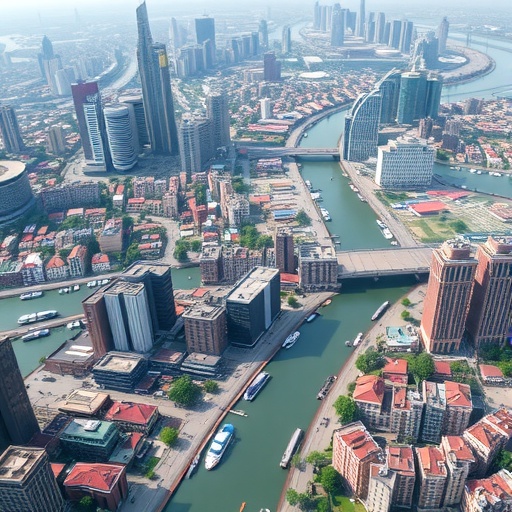
A new study published in npj Urban Sustainability identifies a powerful but often overlooked force behind the planet’s expanding urban footprint: the dispersal of people around cities. Rather than concentrating exclusively in dense metropolitan cores, populations increasingly occupy the spaces between cities, along transport corridors and at the edges of established settlements. According to researchers Francesco Orsi, D. Valbuena and A. Hopkins, this population dispersion can help explain why urban land continues to spread outward, even when the growth of central city populations appears modest.
The finding challenges one of the most common assumptions about urbanization. When people imagine a growing city, they may picture taller skylines, crowded downtown districts and denser neighborhoods. Yet urban expansion frequently happens in a different way. Housing, warehouses, roads, commercial sites and public infrastructure can spread across vast surrounding areas, creating low-density development that consumes land much faster than population numbers alone would suggest. This outward process, often described as urban sprawl, can transform agricultural fields, forests, wetlands and other open landscapes into a fragmented urban mosaic.
The study’s central idea is that population change should not be measured only within official city boundaries. Administrative borders are often artificial lines that fail to capture how people live, commute and build. A person may reside in a village outside a metropolitan boundary, work in the city, depend on its services and contribute to its economic expansion without being counted as part of the city’s core population. By examining population dispersion around cities, the researchers draw attention to the broader urban regions where land-use decisions actually take place.
Technically, population dispersion refers to how residents are distributed across geographic space rather than simply how many people live in a given urban center. A concentrated population produces a different land-use pattern from the same number of people spread across a wide region. Dispersion can increase the distance between homes, workplaces and services, raising demand for roads, parking areas, utility networks and other infrastructure. Each individual development may appear small, but together these projects can create a substantial increase in the total area classified as urban land.
This relationship matters because urban land expansion is not a purely demographic phenomenon. It is also shaped by transportation systems, housing markets, zoning rules, land prices and the availability of developable land. When population growth occurs in peripheral areas, developers may find it easier or cheaper to build on open land than to redevelop dense central districts. New roads and highways can reinforce that pattern by making distant locations more accessible, producing a feedback loop in which infrastructure encourages dispersed settlement and dispersed settlement generates further infrastructure demand.
The consequences extend far beyond the edges of a city. Low-density expansion can increase travel distances and dependence on private vehicles, contributing to energy use and greenhouse-gas emissions. It can also make public transport more difficult and expensive to operate because homes and destinations are spread across a larger area. Ecologically, the conversion of continuous landscapes into scattered buildings and roads can divide habitats, disrupt wildlife movement and increase pressure on farmland and water resources. Even when individual developments appear environmentally minor, their cumulative footprint can be significant at regional and global scales.
The researchers’ emphasis on population dispersion also offers a new way to interpret the apparent contradiction between population trends and land consumption. A city may experience slow growth, stable population or even decline in its central districts while its wider urbanized area continues to expand. This can happen when residents move outward, when new households occupy larger homes or plots, or when economic activity relocates to peripheral zones. Measuring only the population inside a municipal boundary may therefore underestimate the forces driving land conversion around the city.
For planners, the message is both urgent and practical. Strategies designed to limit urban expansion must look beyond city centers and coordinate decisions across metropolitan regions. Policies that encourage compact development, protect undeveloped land and improve public transportation can reduce the amount of land required to accommodate population growth. At the same time, simply promoting density in one location may not be enough if new roads, fragmented governance or housing pressures continue to push development outward elsewhere. The study points toward the need for planning systems that treat cities and their surrounding settlements as interconnected spatial systems.
The research also arrives at a moment when satellite imagery, global population databases and geographic information systems are making it possible to observe urban change at unprecedented scales. These tools allow scientists to compare built-up land with population distribution and to identify places where land consumption is accelerating faster than demographic growth. Such analyses can reveal patterns hidden by national statistics or local administrative categories. However, interpreting the relationship requires care: dispersion may contribute to expansion, but local policies, economic conditions and geographic constraints can determine how strongly that relationship appears in different regions.
As cities continue to grow across the world, the study by Orsi, Valbuena and Hopkins reframes urban expansion as a spatial problem as much as a population problem. The future shape of urbanization will depend not only on how many people cities contain, but also on where those people live relative to one another and to existing infrastructure. That distinction could become decisive for climate policy, biodiversity protection and the design of more efficient metropolitan regions. The research suggests that the battle against uncontrolled urban sprawl will be won—or lost—not only in downtown planning offices, but across the dispersed landscapes surrounding the world’s cities.
Cite Scienmag News
Courtney Benton. (August 19, 2026). How Population Sprawl Around Cities Drives Global Urban Land Expansion. Scienmag. https://scienmag.com/how-population-sprawl-around-cities-drives-global-urban-land-expansion/
Courtney Benton. "How Population Sprawl Around Cities Drives Global Urban Land Expansion." Scienmag, 19 August 2026, https://scienmag.com/how-population-sprawl-around-cities-drives-global-urban-land-expansion/. Accessed 3 September 2026.
Courtney Benton. "How Population Sprawl Around Cities Drives Global Urban Land Expansion." Scienmag. August 19, 2026. https://scienmag.com/how-population-sprawl-around-cities-drives-global-urban-land-expansion/


