


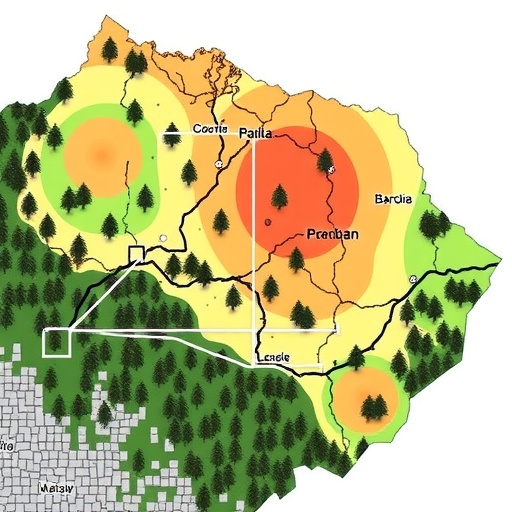
Forests are often described as if they occupy a single, uniform layer of living green above the ground. Yet beneath every woodland lies a geological foundation that can determine how much water trees can access, how long that water remains available, and how quickly a forest can recover when rainfall disappears. A study by Su, Zheng, Gou and colleagues, published in Nature Communications, shows that this hidden foundation—bedrock lithology—can strongly shape the way forests respond to drought. The finding challenges the idea that temperature, precipitation and atmospheric dryness alone are sufficient to predict which forests will survive a hotter, more erratic climate.
Drought is not simply a matter of how much rain falls from the sky. Its biological impact depends on the amount of water stored in soil and rock, the depth reached by tree roots, the speed at which water moves through fractures, and the chemical environment created as rocks weather. Two forests exposed to the same rainfall deficit can therefore experience very different levels of stress. One may continue drawing water from deep, fractured bedrock, while another may quickly exhaust a shallow soil reservoir. The new research places these geological differences at the center of forest demography—the study of how trees grow, reproduce, recruit new individuals and die.
The term lithology refers to the physical and chemical nature of bedrock, including its mineral composition, texture, porosity, hardness and tendency to fracture. These characteristics influence the formation of soil and the underground architecture of a forest ecosystem. Some rocks weather into deep, fine-textured soils capable of retaining water. Others produce thinner or coarser soils in which rainfall drains rapidly or becomes inaccessible to roots. Bedrock can also control the abundance of calcium, magnesium, potassium and other elements released during weathering. Those nutrients affect leaf production, root development and the ability of trees to maintain physiological functions during water stress.
The study’s importance lies in connecting these geological processes with demographic outcomes rather than treating drought response as a single measurement of tree productivity. A forest can appear relatively stable in its total canopy cover while undergoing profound changes beneath the surface. Mature trees may survive but grow more slowly; seedlings may fail to establish; saplings may disappear; or mortality may rise among particular species or size classes. By examining demographic responses, the researchers reveal that drought can alter the future structure of a forest long before a landscape becomes visibly brown. The geological setting helps determine which of these pathways dominates.
Water availability is especially important because trees must maintain a continuous hydraulic pathway from the soil to their leaves. During drought, water tension inside the xylem increases. If that tension becomes too great, air bubbles can form and block the transport system, a process known as hydraulic embolism. At the same time, leaves may close their stomata—the microscopic pores through which carbon dioxide enters—to reduce water loss. Stomatal closure protects the plant in the short term but limits photosynthesis and carbon gain. Bedrock that provides access to persistent underground water may reduce these pressures, allowing trees to maintain growth and recover more effectively after rainfall returns.
The geological control does not operate through water alone. Bedrock influences soil acidity, nutrient cycling and the balance between shallow and deep roots, all of which can change the costs of surviving drought. Nutrient-rich conditions may support larger root systems or faster recovery, but rapid growth can also increase water demand. Conversely, nutrient-poor sites may favor slow-growing trees with dense wood and conservative water use. In this way, lithology can filter which species establish in a forest and can determine whether drought favors deep-rooted, drought-tolerant trees over species adapted to wetter conditions. The same climate event can therefore rearrange competitive relationships differently on different geological substrates.
This finding has major implications for climate- risk forecasting. Many large-scale vegetation models estimate drought impacts using climate variables such as rainfall, temperature, vapor-pressure deficit and soil moisture. These tools are indispensable, but they may miss the underground pathways that buffer or intensify drought. If bedrock is omitted, models could overestimate vulnerability in forests with reliable access to fractured groundwater, or underestimate risk where shallow soils sit above poorly accessible rock. Incorporating geological maps, soil depth, hydrological properties and root-zone information could make predictions more spatially precise, particularly in mountainous and heterogeneous landscapes where conditions can change over short distances.
The research also offers a warning about the limits of restoration strategies based only on climate zones. Planting a tree species in an area with a suitable average temperature does not guarantee success if the local bedrock cannot support its water requirements. Conservation planners may need to identify geological refuges—sites where underground water storage and soil development reduce drought stress—as priorities for protecting old trees, seed sources and biodiversity. Forest restoration could similarly benefit from matching species to the hydraulic and chemical properties of the substrate beneath them. In some places, preserving natural regeneration may be more effective than planting, because surviving local trees already reflect generations of adaptation to the site’s geology.
For forest managers, the message is both encouraging and sobering. Encouragingly, not every forest will respond to intensifying drought in the same way, and some landscapes may possess natural geological resilience. Soberingly, that resilience is not limitless. Repeated drought can deplete deep water reserves, weaken carbon balance and increase vulnerability to insects, pathogens and wildfire. A forest that survives one dry year may still experience a delayed rise in mortality or a collapse in recruitment several seasons later. Monitoring programs that record only canopy greenness may miss these delayed demographic signals. Long-term measurements of tree growth, seedling establishment, species composition and mortality are essential for detecting whether a forest is recovering or quietly losing its capacity to regenerate.
The study ultimately reframes forests as partnerships between biology and geology. Climate determines the atmospheric demand for water, but bedrock helps determine what water is stored belowground, how accessible it is and what kinds of plants can use it. As drought becomes more frequent and severe, understanding that partnership will be crucial for predicting forest futures. The trees visible from above may look similar, but their prospects can be radically different beneath the soil. By showing that lithology helps govern forest demographic responses, the researchers add a powerful geological dimension to the science of climate resilience—and provide conservationists with a more realistic map of where forests may endure, transform or fail.
Cite Scienmag News
Violet Maxwell. (August 19, 2026). Bedrock Type Shapes Forest Population Responses to Drought. Scienmag. https://scienmag.com/bedrock-type-shapes-forest-population-responses-to-drought/
Violet Maxwell. "Bedrock Type Shapes Forest Population Responses to Drought." Scienmag, 19 August 2026, https://scienmag.com/bedrock-type-shapes-forest-population-responses-to-drought/. Accessed 4 September 2026.
Violet Maxwell. "Bedrock Type Shapes Forest Population Responses to Drought." Scienmag. August 19, 2026. https://scienmag.com/bedrock-type-shapes-forest-population-responses-to-drought/


