


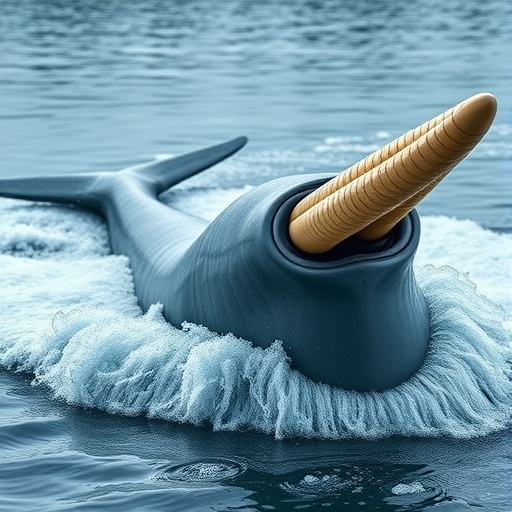
For centuries, the narwhal’s long, ivory-colored tusk was treated as evidence of magic. In medieval Europe, these extraordinary teeth were sold as unicorn horns and were believed to neutralize poison, cure disease, and possess supernatural powers. Modern science has removed the mythological mystery, but the tusk has retained a remarkable biological puzzle: how does a tooth more than two meters long develop its distinctive, left-handed twist? An international research team led by Aarhus University has now provided the most detailed answer yet. Using powerful X-ray techniques, the scientists discovered that the narwhal tusk is built from two opposing internal twists rather than a single spiral. The finding reveals a sophisticated structural design that may help the tooth resist the extreme bending and torsional forces it experiences throughout the animal’s life.
The narwhal tusk is actually the animal’s left canine tooth. It grows through the upper jaw and lip, sometimes reaching more than two meters in length. Although it appears solid and smooth from a distance, the tusk is a highly organized biological composite. Unlike human teeth, it has no enamel. Its core is made of dentin, a mineralized tissue that provides strength and toughness, while the outer layer consists of cementum. Within both tissues are microscopic mineralized collagen fibrils. These fibrils are formed from collagen, a flexible protein, reinforced with nanoscale mineral crystals. Their orientation determines how forces move through the tooth, much as the arrangement of fibers determines the strength of engineered materials such as carbon-fiber composites or reinforced concrete.
The characteristic twist of the tusk has long suggested that its microscopic components must also be arranged in a directional pattern. Yet mapping that organization throughout a large, curved tooth has been extremely difficult. Conventional microscopy can reveal tiny regions in great detail, but it cannot easily show how structures are connected across the entire interior. The research team therefore combined several advanced X-ray imaging approaches, including a technique known as small-angle X-ray scattering tensor tomography, or SAXS tensor tomography. Instead of simply producing an image of the tooth’s shape, this method analyzes how X-rays scatter when they encounter nanoscale structures. Because elongated mineralized collagen fibrils scatter X-rays differently depending on their orientation, the technique can reconstruct their three-dimensional alignment throughout the sample.
The experiments required access to some of the world’s most powerful synchrotron facilities. The researchers used the MAX IV Laboratory in Sweden, the Swiss Light Source in Switzerland, and the European Synchrotron Radiation Facility in France. Synchrotrons accelerate electrons to nearly the speed of light and force them around enormous storage rings, generating intensely bright X-ray beams. These beams can probe biological materials across multiple length scales, from the overall architecture of a tooth to the nanoscale organization of its mineralized fibers. By combining data from the three facilities, the scientists were able to examine the narwhal tusk’s internal structure in three dimensions with a level of detail that had not previously been possible.
The resulting maps showed that the fibrils are primarily aligned with the long axis of the tusk, but they do not run perfectly straight. Instead, they deviate by small, systematic angles as they extend through the tooth. Those deviations accumulate into a large-scale helical pattern. The outer cementum follows a left-handed twist, matching the direction visible on the surface of the tusk. Inside the dentin, however, the fibrils twist in the opposite, right-handed direction. The two patterns meet at the boundary between dentin and cementum, creating what the researchers describe as a biological double-helix architecture. The tusk’s famous external spiral is therefore only one part of a deeper structural arrangement that extends from the nanoscale to the full length of the tooth.
This opposing geometry may explain why the tusk can remain long, slender, and remarkably durable despite being exposed to repeated mechanical stress. A straight rod and a single spiral can each be vulnerable to particular combinations of bending and twisting. In contrast, two counter-rotating structures may distribute mechanical loads more evenly and reduce the risk that cracks will travel through the material in a single direction. At the interface between dentin and cementum, the opposing fibril orientations may also help stabilize the tooth, much like interlocking layers in a high-performance composite. The researchers suggest that the architecture provides greater resistance to bending and torsion than either a purely straight arrangement or a single-direction spiral would offer.
The discovery also challenges the idea that the tusk’s structure is a simple consequence of its growth. The scientists found that the double-twist organization persists through the tooth’s annual growth layers. These layers resemble tree rings, recording successive periods of mineral deposition as the narwhal ages. Although the tooth continues to grow and its internal history accumulates, the opposing arrangement remains stable across the layers. That persistence suggests that the geometry is not a random result of local growth conditions. Instead, it is likely controlled by a genetically programmed developmental process that directs how cells deposit collagen and mineral throughout the tooth. Because narwhals can live for approximately 80 years, the tusk may preserve this structural pattern across most of an individual’s lifetime.
The findings may also transform the way researchers view the tusk as an environmental archive. The hard tissues of long-lived marine mammals can record changing conditions in the ocean as they form. Variations in chemistry, mineral composition, and growth may preserve information about temperature, salinity, diet, pollution, and other environmental factors. The research team is now investigating whether narwhal tusks can reveal how rapidly changing conditions in the North Atlantic have affected the animals over time. Such work could turn a famously mysterious tooth into a chronological record of Arctic environmental change, allowing scientists to study past conditions that were never directly measured.
The biological purpose of the tusk itself remains less certain than its internal structure. Most researchers believe it functions primarily as a sexual signal because tusks are found mainly in males, although a small percentage of females also develop them and some males do not. Other proposals have suggested that the tusk might detect changes in the surrounding water, serve as a hunting instrument, or be used during fights between males. Narwhals have occasionally been observed with broken tusk fragments embedded in their bodies, but there is no conclusive evidence that combat is its normal function. Whatever its behavioral role, the new research shows that the tusk is far more than a simple elongated tooth. Its opposing helical design is a highly engineered natural material, built through biological processes that could inspire new composites for medicine, construction, and other technologies. The medieval unicorn horn was imaginary, but the real narwhal tusk may be even more astonishing.
News Publication Date: 18-Aug-2026
Web References: https://doi.org/10.1038/s41467-026-75689-z
References: Nature Communications, DOI: 10.1038/s41467-026-75689-z
Cite Scienmag News
Drew Townsend. (August 18, 2026). Scientists unravel the mystery behind narwhals’ uniquely twisted tusks. Scienmag. https://scienmag.com/scientists-unravel-the-mystery-behind-narwhals-uniquely-twisted-tusks/
Drew Townsend. "Scientists unravel the mystery behind narwhals’ uniquely twisted tusks." Scienmag, 18 August 2026, https://scienmag.com/scientists-unravel-the-mystery-behind-narwhals-uniquely-twisted-tusks/. Accessed 3 September 2026.
Drew Townsend. "Scientists unravel the mystery behind narwhals’ uniquely twisted tusks." Scienmag. August 18, 2026. https://scienmag.com/scientists-unravel-the-mystery-behind-narwhals-uniquely-twisted-tusks/


