


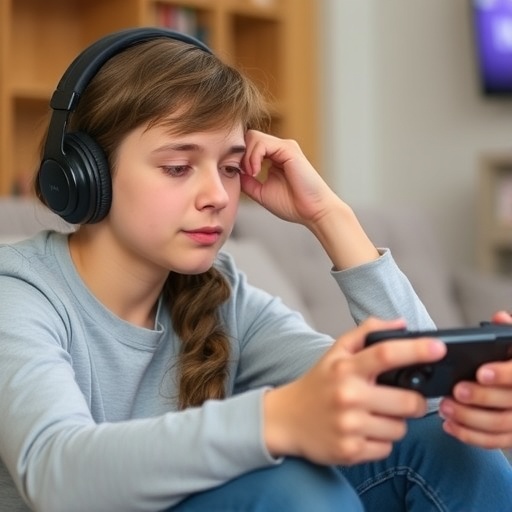
A video game created to teach teenagers how to recognize depression, respond to substance-use risks and seek help has produced measurable mental-health benefits that persisted for a year after play ended. In a randomized clinical trial involving 532 high school students, those who played the digital behavioral-health game PlaySmart reported significantly fewer depressive symptoms than students assigned to commercial role-playing games without therapeutic content. The reduction, measured using the Patient Health Questionnaire-8, or PHQ-8, matched or exceeded effects commonly reported for broad school-based prevention programs. The findings, published in JAMA Network Open, suggest that carefully designed games could become an accessible tool for adolescent mental-health promotion, particularly for young people who do not receive conventional counseling.
The trial was conducted with students aged 16 to 19 recruited through school-based health programs in Connecticut. Researchers assigned 269 participants to PlaySmart and 263 to an active control group that played commercially available role-playing games. Unlike a passive comparison group that might receive no activity at all, the use of commercial games as an active control allowed investigators to test whether any benefits were associated specifically with PlaySmart’s behavioral-health content rather than with screen time, social engagement or the general experience of playing a game. Participants in the PlaySmart group played for approximately one hour after school each week, for as many as six weeks. Both groups were then followed for 12 months.
PlaySmart is structured as an interactive narrative in which the player becomes the central character and makes decisions in situations modeled on real experiences reported by teenagers and other stakeholders. The scenarios require players to interpret social and emotional cues, identify warning signs of depression and decide whether to involve a trusted adult or seek professional support. Some choices lead to more favorable outcomes for the player and other characters, while less constructive decisions produce negative consequences. The game also allows participants to revisit earlier choices and explore alternative outcomes, a feature that transforms gameplay into a form of guided reflection. Rather than simply presenting information about mental illness, the design asks players to apply that information in emotionally recognizable situations.
This approach is based on principles from behavioral learning and cognitive science. Players receive immediate feedback about the consequences of their decisions, allowing abstract concepts such as stigma, avoidance and help-seeking to become part of a simulated experience. Replaying scenarios may also encourage what researchers describe as counterfactual thinking: examining what happened and considering how a different action might have changed the outcome. In theory, this combination of narrative transportation, rehearsal and feedback can improve mental-health literacy while reducing uncertainty about how to respond when a friend shows signs of depression. Because PlaySmart is self-guided, students can engage with the material without disclosing personal symptoms to a teacher, clinician or researcher during the intervention itself.
At the one-year follow-up, students who played PlaySmart had PHQ-8 scores that were 1.12 points lower than those of students in the commercial-game control group. The PHQ-8 is an eight-item self-report instrument derived from the diagnostic criteria for major depressive disorder. Each item reflects the frequency of a symptom during the previous two weeks, with total scores ranging from 0 to 24; higher scores indicate more severe symptoms. The trial was not designed to establish that PlaySmart treats clinical depression in the same way as psychotherapy or medication, and the reported outcome was a difference in symptom scores rather than a universal remission of depression. Nevertheless, the size and durability of the change are notable because prevention programs delivered broadly to school populations often produce relatively small effects.
Researchers compared the result with evidence from earlier depression-prevention studies. Programs based on classroom instruction or small, organized discussions with teachers can improve knowledge and reduce symptoms, but their average effects frequently weaken over time. A comprehensive 2024 analysis of short-term school interventions found that the typical reduction in depression scores after one year was approximately 0.1 points, while larger early improvements often failed to persist beyond six months. By contrast, the PlaySmart group’s 1.12-point advantage remained evident 12 months after the gameplay period ended. The investigators say the effect was at the upper end of the range reported for universal and targeted prevention interventions, although comparisons across studies should be interpreted cautiously because participant populations, control conditions and measurement procedures can differ.
The trial also found that participants developed a more positive attitude toward seeking psychological care after only six weeks of gameplay. That finding addresses one of the central barriers in adolescent mental health: many young people who could benefit from services never reach them because of stigma, limited availability, cost, transportation challenges or an inability to recognize that their symptoms warrant attention. A game cannot replace crisis services, clinical assessment or evidence-based treatment for major depression, but it may help close the gap between noticing a problem and taking the first step toward support. Its digital format could allow schools and youth organizations to offer the intervention without requiring a clinician to be present during every session, an important consideration in communities with limited behavioral-health resources.
The researchers reported that exploratory analyses did not identify significant differences in the game’s effect according to sex, race, grade level, food insecurity or family history of substance use. Approximately 53 percent of participants were male, about 45 percent were Black and 38 percent were Hispanic. The study population was selected for elevated risk: students were eligible if they had reported vaping or using alcohol, cannabis or nonopioid drugs within the previous 30 days, or if they had heightened symptoms of depression. Participants with a history of opioid misuse were excluded. Because the sample came from school-based health programs in one state and the intervention was tested among older adolescents, further research will be needed to determine whether the results generalize to younger students, other regions and teenagers with diagnosed depressive disorders.
PlaySmart was developed in the play2PREVENT Lab led by Lynn Fiellin, a professor of biomedical data science and medicine at Dartmouth’s Geisel School of Medicine. Its origins lie in the National Institutes of Health Helping to End Addiction Long-term, or HEAL, initiative, which selected the project as one of 10 national efforts to develop and test new approaches to opioid-misuse prevention. A related study published in Nature Health reported that students who played PlaySmart retained greater awareness of the harms associated with opioid abuse after gameplay ended. The Dartmouth team says the new JAMA Network Open report is the second in a planned series of analyses from the same clinical trial, examining different mental-health and prevention outcomes.
The findings arrive as schools search for interventions that can be delivered at scale without adding pressure to already limited counseling services. PlaySmart is currently deployed as a universal prevention program, and five games developed by Fiellin’s group have been implemented in school districts and other youth-serving organizations through Playbl, a company independent of the Dartmouth laboratory. The study’s randomized design, active commercial-game control and 12-month follow-up strengthen the evidence that the benefits were linked to the game’s behavioral-health content. Even so, the results should be understood as evidence for prevention and mental-health promotion, not as proof that gameplay alone can cure depression. The broader significance is that an activity adults often associate with distraction or entertainment may, when engineered with clinical and educational principles, become a practical channel for helping teenagers recognize distress, make safer decisions and connect with care before problems escalate.
News Publication Date: 17-Aug-2026
Web References: JAMA Network Open article; play2PREVENT Lab; PlaySmart
References: Fiellin L.E., Barry C., Boomer T., Haile K. and Xie H., “A Digital Behavioral Health Game for Adolescent Mental Health,” JAMA Network Open, DOI: 10.1001/jamanetworkopen.2026.29173. Related study led by Tyra Pendergrass Boomer, Nature Health, DOI: 10.1038/s44360-025-00010-z.
Cite Scienmag News
Glenn Wilkins. (August 17, 2026). Prevention-focused video games may reduce depression among teenagers, study finds. Scienmag. https://scienmag.com/prevention-focused-video-games-may-reduce-depression-among-teenagers-study-finds/
Glenn Wilkins. "Prevention-focused video games may reduce depression among teenagers, study finds." Scienmag, 17 August 2026, https://scienmag.com/prevention-focused-video-games-may-reduce-depression-among-teenagers-study-finds/. Accessed 3 September 2026.
Glenn Wilkins. "Prevention-focused video games may reduce depression among teenagers, study finds." Scienmag. August 17, 2026. https://scienmag.com/prevention-focused-video-games-may-reduce-depression-among-teenagers-study-finds/


