


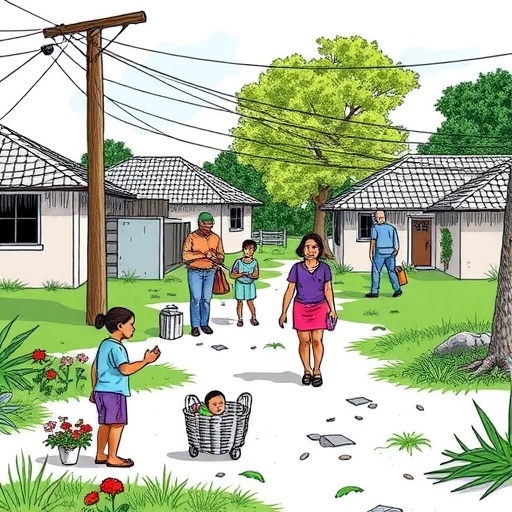
For decades, migration has often been explained as a response to poverty, conflict, climate hazards, or the search for jobs. A new study offers a different lens: people also move because the places where they live do not provide adequate access to the opportunities, services, and infrastructure required by their changing needs. Published in Communications Earth & Environment, the research argues that “accessibility” should be treated not as a fixed feature of geography, but as a dynamic measure of whether people can realistically reach the resources that sustain a healthy and dignified life. As human needs evolve, the study suggests, accessibility can influence where populations concentrate, how cities grow, and whether sustainable development benefits everyone or only those already positioned to take advantage of it.
The idea is deceptively simple. A hospital may be located only a few kilometers from a community, yet remain effectively inaccessible if public transport is unreliable, roads are unsafe, travel costs are unaffordable, or people cannot obtain care when they arrive. The same principle applies to schools, employment, food markets, clean energy, digital networks, and social services. In technical terms, accessibility is not merely the physical distance between a person and a destination. It is a composite relationship involving travel time, transportation availability, economic cost, infrastructure quality, personal mobility, and the suitability of the service itself. By placing these factors at the center of migration analysis, Zhou, Huang, Zhong and colleagues connect everyday decisions with the larger systems shaping sustainable development.
This perspective challenges the traditional assumption that migration is primarily a one-time response to external pressure. Instead, movement can become an ongoing adjustment process. A household may relocate to find work, then move again when children need better schools, older family members require healthcare, or extreme weather makes the local environment less secure. Even people who do not cross national borders may migrate between rural areas, small towns, suburbs, and metropolitan centers as their priorities change. The researchers describe this process as need-responsive accessibility: the ability of a place to satisfy the needs people have at a particular stage of life. Because those needs are not static, the geography of migration is constantly being reshaped.
The concept also helps explain why economic growth does not automatically produce equitable development. A region can build new roads, railways, or digital infrastructure and still leave large groups behind if the benefits are distributed unevenly. A high-speed transport corridor may shorten travel times for affluent commuters while bypassing low-income settlements. A new hospital may improve regional statistics while remaining unreachable for people without vehicles or reliable public transit. Accessibility therefore has both a spatial and a social dimension. Researchers and planners must ask not only whether a service exists, but who can use it, how often, at what cost, and with what degree of security. These questions are crucial for measuring whether sustainable development is genuinely inclusive.
The study’s implications extend to climate adaptation. Rising temperatures, floods, droughts, wildfires, and coastal hazards can reduce accessibility long before they force a population to abandon an area entirely. Roads may become impassable, agricultural income may decline, energy systems may fail, and essential services may be stretched beyond capacity. At the same time, climate-safe destinations may become more attractive, creating new flows of migration and increasing pressure on housing, transport, water, and public institutions. If planners focus only on the number of people moving, they may miss the gradual erosion of access that precedes displacement. Tracking accessibility can provide an earlier warning system by revealing where residents are losing practical connections to the resources they need.
The framework is particularly relevant to the future of cities. Urban areas often promise greater access to jobs, education, healthcare, culture, and technology, which helps explain why they continue to attract migrants. But rapid urban growth can produce a paradox: the same influx that expands economic opportunity can also drive up housing costs, lengthen commutes, overload public services, and push vulnerable residents toward peripheral areas with weaker connections. In that sense, migration does not simply respond to urban accessibility; it actively transforms it. New arrivals can stimulate investment and innovation, yet poorly managed growth can create accessibility gaps that reproduce inequality. Sustainable urban planning must therefore anticipate how population movement changes the distribution of opportunity over time.
A major strength of the study’s approach is its emphasis on human needs rather than on population movement alone. Conventional migration maps often represent flows as arrows between administrative regions, giving the impression that movement is a clear and measurable event. But migration decisions are shaped by complex trade-offs that are difficult to capture in a single arrow. People may remain in place despite declining opportunities because they have family ties, cultural connections, or limited financial resources. Others may move not because their original home has become unlivable, but because another location offers a better combination of services and possibilities. A need-based accessibility framework can incorporate these differences by examining the relationship between individual or household requirements and the environments capable of meeting them.
The findings carry a powerful message for governments: improving accessibility may be as important as managing migration itself. Policies that expand affordable public transportation, strengthen local healthcare, improve schools, support digital connectivity, and protect access to housing can reduce the pressure that drives involuntary movement. At the same time, investment should not be concentrated only in already prosperous destinations. Strengthening accessibility in smaller towns and rural regions can diversify economic opportunity and reduce the need for long-distance relocation, while carefully planned links between regions can allow people to move by choice rather than necessity. The goal is not to stop migration, which is a normal feature of human societies, but to ensure that movement is safer, more equitable, and less determined by deprivation.
As global populations age, technologies change, and climate risks intensify, the needs that shape migration will become even more fluid. A location considered attractive today may struggle tomorrow if it cannot provide affordable housing, resilient infrastructure, clean water, or reliable healthcare. The research by Zhou and colleagues presents accessibility as a moving target—and migration as one of the ways societies respond when that target shifts. Its broader lesson is that sustainable development cannot be judged solely by economic output, construction totals, or aggregate access indicators. It must be evaluated through the lived ability of different people to reach the opportunities and services that matter to them. In a world where human needs are evolving faster than many systems are adapting, understanding who can access what—and where—could become one of the most important tools for building a fairer future.
Cite Scienmag News
Sloane Callahan. (August 15, 2026). Need-responsive access advances equitable sustainability and reshapes migration around evolving human needs. Scienmag. https://scienmag.com/need-responsive-access-advances-equitable-sustainability-and-reshapes-migration-around-evolving-human-needs/
Sloane Callahan. "Need-responsive access advances equitable sustainability and reshapes migration around evolving human needs." Scienmag, 15 August 2026, https://scienmag.com/need-responsive-access-advances-equitable-sustainability-and-reshapes-migration-around-evolving-human-needs/. Accessed 4 September 2026.
Sloane Callahan. "Need-responsive access advances equitable sustainability and reshapes migration around evolving human needs." Scienmag. August 15, 2026. https://scienmag.com/need-responsive-access-advances-equitable-sustainability-and-reshapes-migration-around-evolving-human-needs/


