


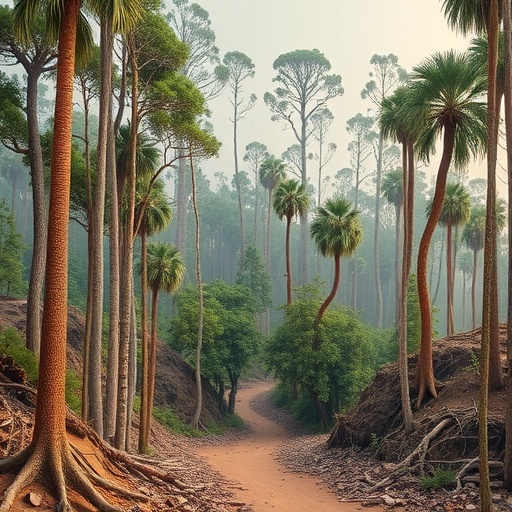
Los Angeles, California—The forests that covered Wyoming 56 million years ago may offer one of the clearest warnings yet about how today’s accelerating carbon emissions could reshape Earth’s ecosystems. In a study published in Science, researchers reconstructed the structure of ancient forest canopies during the Paleocene-Eocene Thermal Maximum (PETM), a period of abrupt global warming triggered by a massive release of carbon dioxide and other carbon compounds into the atmosphere. Their findings indicate that forests became substantially more open as temperatures rose, rainfall declined, and trees died—an ancient transformation that resembles the browning and structural decline now emerging in forests around the world.
The study is the first to use fossilized leaf cells to estimate the Leaf Area Index, or LAI, of a forest from deep time. LAI measures the total leaf area above a given unit of ground and is widely used to describe canopy density. A high LAI indicates a multilayered forest with abundant foliage, while a low LAI corresponds to a more open woodland or sparse vegetation. Modern satellites track changes in global LAI, but until now, researchers lacked a comparable quantitative method for reconstructing canopy structure across geological timescales. By extracting information from microscopic leaf fragments preserved in ancient soils, the team created a new window into how forests responded to an extreme carbon-driven climate event.
The PETM began approximately 56 million years ago and lasted for tens of thousands of years, although the initial carbon release occurred rapidly by geological standards. Atmospheric temperatures increased sharply, high-latitude regions became unusually warm, and rainfall patterns shifted across continents. The new analysis suggests that these changes did not simply alter the species composition of forests; they transformed the physical architecture of entire landscapes. As vegetation migrated toward cooler regions, canopy cover declined, erosion intensified, and the terrestrial water cycle was disrupted. The result was what the researchers describe as a widespread “browning” of Earth’s landscapes, with fewer large trees and more open forest structure.
The research team developed its fossil-canopy reconstruction by studying modern forests in South and Central America. In each contemporary ecosystem, the researchers photographed the canopy from below using a fisheye lens pointed upward. These images allowed them to calculate LAI by measuring how much of the sky was blocked by leaves and branches. At the same time, they collected soil samples beneath the photographed canopies and isolated fragments of leaf cuticle—the durable, waxy outer layer of leaves that can survive after other plant tissues decay. By comparing the microscopic anatomy of the modern cuticle fragments with the measured LAI values above them, the scientists established a calibration model that could later be applied to fossil material.
The key biological signal came from the shape of epidermal cells, the microscopic units forming the outer surface of a leaf. Leaves growing in bright, exposed positions near the tops of trees tend to develop relatively broad epidermal cells. Leaves growing in the shade of a dense canopy respond differently: their cells become longer and more slender, increasing their aspect ratio as the plant adjusts to limited sunlight. Although the leaves eventually fall and break apart in the soil, the shapes of these cells can remain preserved in cuticle fragments. By measuring thousands of fossilized cells and applying the modern calibration, the researchers could estimate how dense the ancient canopy had been when those leaves were alive.
The fossil evidence came from Wyoming’s Hanna Basin, a coal-forming region containing organic-rich rocks that preserve plant material from before, during, and after the PETM. The basin’s lignites and coals retain leaf fragments that are rare or poorly preserved in many other sites containing the same climate interval. More than a decade of fieldwork produced hundreds of samples from the basin, documenting forests that were dramatically different from the sagebrush-dominated landscape found in Wyoming today. Ancient dawn redwoods, sycamores, alders, palms, and other subtropical and tropical plants formed a complex vegetation system around lakes, wetlands, and floodplains.
When the team compared canopy estimates across the PETM interval, the pattern was pronounced: forest LAI fell, indicating a more open canopy with less foliage overhead. The decline implies that forests contained fewer large trees or experienced greater spacing between trees, or both. Such structural changes would have affected far more than the plants themselves. Open canopies allow more sunlight to reach the ground, increase evaporation from soils, and expose organic matter to heat and drying. They can also accelerate surface runoff and erosion, alter nutrient transport, and reduce the capacity of forests to recycle water into the atmosphere through transpiration. The decline in canopy density therefore represents a broad ecosystem shift rather than a simple change in tree abundance.
The ancient findings carry an urgent modern implication because contemporary carbon emissions are occurring at a rate far beyond the natural carbon release associated with the PETM. Human activities are raising atmospheric carbon dioxide roughly an order of magnitude faster than the ancient episode, while forests are simultaneously being exposed to warming temperatures, drought, wildfire, insects, pathogens, habitat fragmentation, and land-use change. Carbon dioxide can initially stimulate plant growth, a phenomenon reflected in decades of global “greening” detected by satellites. Yet as temperatures rise and water stress intensifies, that fertilization effect can be overwhelmed. In many regions, forest productivity is now weakening, tree mortality is increasing, and landscapes are beginning to brown.
“Earth has been on a greening trajectory because of anthropogenic carbon dioxide emissions that have fertilized plants,” said lead author Regan Dunn, a paleobotanist and associate curator at the Natural History Museum of Los Angeles County. “But as Earth has heated up because of those emissions, this greening trend is reversing, and many parts of Earth are now browning.” The PETM record suggests that forests can cross a threshold at which additional heat and drying cause their structure and function to deteriorate. Co-author Ellen D. Currano of the University of Wyoming said the ancient evidence shows that excessive carbon dioxide, accompanied by warming and drying, can reduce plant growth, biomass, and productivity while changing climate, nutrient cycling, weathering, and the habitats available to animals.
The researchers emphasize that the PETM is not a perfect duplicate of the present. The ancient world had different continents, ecosystems, atmospheric conditions, and rates of environmental change, while today’s forests face direct human destruction in addition to climate stress. Nevertheless, the fossil canopy provides a rare empirical test of how forests respond when carbon levels rise and temperatures increase across a sustained interval. Trees currently remove hundreds of millions of tons of carbon from the atmosphere each day, but that service depends on healthy, functioning forests. If warming and drought continue to reduce canopy cover, forests may absorb less carbon precisely when society most needs them to do so. The ancient Wyoming record thus turns microscopic fragments of leaf tissue into a warning visible at planetary scale: protecting and restoring forests may be essential to preventing a climate feedback in which damaged ecosystems release carbon and lose their ability to buffer further warming.
News Publication Date: 13-Aug-2026
Web References: https://www.science.org/doi/10.1126/science.aec4776
References: Science; DOI: 10.1126/science.aec4776
Cite Scienmag News
Gavin Prescott. (August 13, 2026). Paleontologists reconstruct 56-million-year-old forests, revealing eerie parallels to today’s warming world. Scienmag. https://scienmag.com/paleontologists-reconstruct-56-million-year-old-forests-revealing-eerie-parallels-to-todays-warming-world/
Gavin Prescott. "Paleontologists reconstruct 56-million-year-old forests, revealing eerie parallels to today’s warming world." Scienmag, 13 August 2026, https://scienmag.com/paleontologists-reconstruct-56-million-year-old-forests-revealing-eerie-parallels-to-todays-warming-world/. Accessed 3 September 2026.
Gavin Prescott. "Paleontologists reconstruct 56-million-year-old forests, revealing eerie parallels to today’s warming world." Scienmag. August 13, 2026. https://scienmag.com/paleontologists-reconstruct-56-million-year-old-forests-revealing-eerie-parallels-to-todays-warming-world/


