


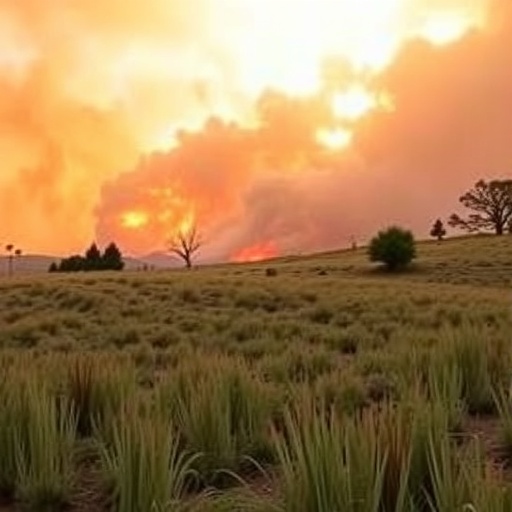
Lyda Hill Philanthropies has awarded $2.7 million to the Cary Institute of Ecosystem Studies to expand wildfire research across the western United States, with a major new focus on the rapidly burning grasslands and shrublands of west Texas. The two-year grant will support the Western Fire & Forest Resilience Collaborative, or WFFRC, a research network led by Cary Institute scientist Winslow Hansen. The program will also investigate how wildfire and forest management influence water resources in Colorado, linking fire ecology to one of the West’s most urgent resource challenges.
The funding extends a 2024 investment from Lyda Hill Philanthropies and builds on seed support from the Gordon and Betty Moore Foundation. WFFRC was created to bring scientists and land managers into the same decision-making process, ensuring that research is designed around practical needs such as prescribed fire, wildfire preparedness, ecosystem recovery, and climate adaptation. Rather than treating fire as a single, uniform phenomenon, the collaborative studies how fire behaves in different landscapes and how management strategies can be tailored to local ecological conditions.
Until now, much of WFFRC’s work has concentrated on western forests, where wildfire activity has been strongly affected by warmer and drier conditions, accumulated fuels, and a century of fire suppression. The new grant recognizes that grassland and shrubland fires follow different physical and ecological rules. These fires can move extremely quickly across continuous vegetation, often leaving land managers with little time to respond. Their behavior is also shaped by human-caused ignitions, expanding development, and the spread of invasive grasses that can create dense, highly flammable fuel beds.
The urgency of the expansion is underscored by recent WFFRC research published in the journal Science. Researchers found that the fastest-moving fires were also among the most destructive, and that 90 percent of the 20 fastest fires recorded in the United States between 2001 and 2020 occurred in grasslands or shrublands. Texas accounted for 20 percent of those fires. Rapid fire growth can overwhelm conventional response systems, threaten communities and livestock, disrupt transportation, and transform ecosystems before suppression crews can establish effective control lines.
“Most fire science has been built around forests,” Hansen said. “But fires in grasslands and shrublands operate differently.” In forests, models often emphasize tree mortality, canopy structure, fuel accumulation, and fire intensity beneath or within vegetation layers. In grasslands, the key variables may instead include fine-fuel continuity, fuel moisture, wind speed, vegetation height, terrain, and the timing of ignition. WFFRC researchers will adapt fire-behavior models so they can represent these distinct interactions and forecast how vegetation and fire risk may change under different climate scenarios.
A central element of the project will be direct collaboration with Texas land managers. Government agencies, conservation organizations, ranchers, and private landowners will help identify the questions most important for on-the-ground decisions. That partnership could guide research into where prescribed burning is most effective, how invasive grasses alter fire risk, and which landscapes are most vulnerable to large, fast-moving events. Prescribed fire, when carefully planned and conducted under suitable weather and fuel conditions, can reduce accumulated vegetation and interrupt the continuity that allows fires to spread rapidly.
The collaborative will also use satellite observations to monitor fire behavior and ecosystem recovery. Remote-sensing instruments can track burn scars, vegetation condition, surface moisture, and changes in plant productivity across areas too large or hazardous for frequent ground surveys. Near-real-time satellite data may help emergency managers follow the evolution of active fires, while longer-term observations can reveal whether native grasslands and shrublands recover, shift toward invasive species, or become more vulnerable to repeated burning. These measurements will support both immediate response and long-range adaptation planning.
In Colorado, the grant will extend WFFRC’s work into the connection between forests, wildfire, and water. Researchers will use remote sensing and artificial intelligence to examine how forest composition and structure affect evapotranspiration, snow persistence, and other components of the water cycle in the Colorado River Basin. Evapotranspiration—the transfer of water from soil and vegetation to the atmosphere—can influence how much moisture remains available for rivers and reservoirs. Forest structure also affects how snow accumulates, melts, and reaches downstream waterways. Understanding these processes could help managers evaluate whether wildfire treatments or forest restoration projects improve or reduce water availability for communities and agriculture.
The project reflects a broader shift in wildfire science, from studying fire as an isolated disaster to viewing it as a coupled process involving climate, vegetation, human activity, water, and ecosystem recovery. As fire conditions continue to change across the West, land managers face decisions with consequences that may extend for decades. WFFRC aims to provide the models, observations, and decision-support tools needed to navigate those choices. “All of the western US will be profoundly affected by fire in one way or another over future decades,” Hansen said. “It is not a matter of if, but when.” The collaborative’s goal is to ensure that when that moment arrives, communities and ecosystems are supported by science designed for the landscapes they actually inhabit.
Web References: https://www.caryinstitute.org/ ; https://www.westernfireforest.org/ ; https://www.lydahillphilanthropies.org/ ; https://www.science.org/doi/10.1126/science.adk5737
References: Western Fire & Forest Resilience Collaborative; Cary Institute of Ecosystem Studies; Lyda Hill Philanthropies; Gordon and Betty Moore Foundation; Science research on the fastest and most destructive U.S. fires.
Cite Scienmag News
Gavin Prescott. (August 11, 2026). Wildfire Collaboration Expands Into Grasslands With $2.7 Million Lyda Hill Philanthropies Grant. Scienmag. https://scienmag.com/wildfire-collaboration-expands-into-grasslands-with-2-7-million-lyda-hill-philanthropies-grant/
Gavin Prescott. "Wildfire Collaboration Expands Into Grasslands With $2.7 Million Lyda Hill Philanthropies Grant." Scienmag, 11 August 2026, https://scienmag.com/wildfire-collaboration-expands-into-grasslands-with-2-7-million-lyda-hill-philanthropies-grant/. Accessed 4 September 2026.
Gavin Prescott. "Wildfire Collaboration Expands Into Grasslands With $2.7 Million Lyda Hill Philanthropies Grant." Scienmag. August 11, 2026. https://scienmag.com/wildfire-collaboration-expands-into-grasslands-with-2-7-million-lyda-hill-philanthropies-grant/


