


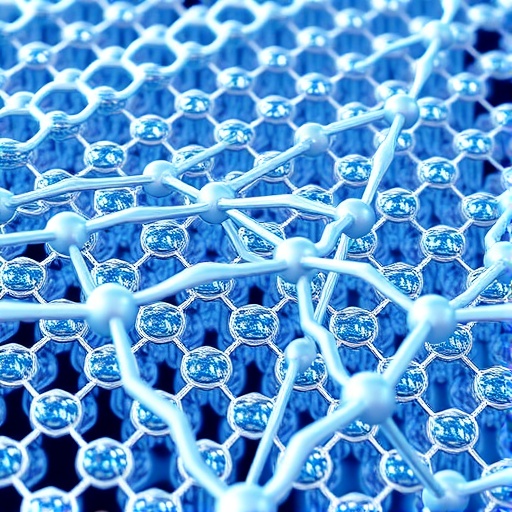
A new class of high-entropy nanoalloys could reshape the way contaminated water is treated, according to researchers who have developed an unusual crystalline form of RhCuNiInSb for converting nitrate into ammonia-derived products. The material, composed of rhodium, copper, nickel, indium and antimony, was engineered to operate efficiently even when nitrate concentrations are low—a major challenge for electrochemical water purification. The study, published in Nature Water, reports that the alloy’s distinctive atomic arrangement gives it a decisive advantage over a conventional version of the same composition.
The central innovation is not simply the alloy’s mixture of five elements, but its crystal phase. Most metallic nanoalloys adopt a face-centred cubic, or FCC, structure, in which atoms occupy the corners and centres of the faces of a cubic lattice. The researchers instead produced a 2H phase, a less common hexagonal arrangement. By controlling the kinetics of nucleation and growth during a one-pot synthesis, they were able to guide the atoms into this unconventional structure rather than allowing the material to settle into its more familiar FCC form.
High-entropy alloys are attractive because their multiple elements can generate a complex combination of active sites, electronic states and resistance to chemical degradation. Yet that same complexity makes them difficult to control. At the nanoscale, small changes in reaction conditions can determine which phase forms, how the elements are distributed and which surfaces become exposed. The team’s synthesis strategy addresses this problem by regulating how rapidly the alloy nuclei appear and how they grow, producing 2H RhCuNiInSb nanoparticles with a structure that remains distinct from the FCC counterpart.
The material was tested for electrochemical nitrate reduction, a reaction that transforms nitrate ions into ammonia. Nitrate contamination is widespread in agricultural runoff and industrial wastewater, and excessive exposure can threaten drinking-water safety and aquatic ecosystems. Converting nitrate into ammonia can also create a useful chemical feedstock, although the reaction is technically demanding. It involves multiple proton- and electron-transfer steps, and the catalyst must break strong nitrogen–oxygen bonds while preventing unwanted side reactions, including the formation of nitrite, nitrogen gas or hydrogen.
In direct comparisons, the 2H alloy demonstrated superior nitrate-reduction performance at low nitrate concentrations compared with its FCC-phase equivalent. This distinction is important because catalysts that perform well in concentrated laboratory solutions may lose efficiency when nitrate becomes dilute, as it often is after partial treatment or in real environmental samples. The researchers’ results indicate that the phase of a catalyst can be as important as its elemental composition in determining how effectively it captures and transforms molecules at the interface between a solid electrode and water.
Ex situ and in situ investigations provided clues to the origin of the improvement. The observations pointed to faster deoxygenation and hydrogenation kinetics on the 2H surface. In practical terms, nitrate appears to be converted through a more efficient sequence of oxygen removal and hydrogen addition, helping the reaction proceed toward ammonia. The experiments also revealed a distinct reaction pathway compared with the FCC material, suggesting that the crystal phase changes not only the speed of the reaction but also the identity or stability of important surface intermediates.
Theoretical calculations linked these catalytic effects to electronic changes caused by the FCC-to-2H transition. In the unconventional phase, charge is redistributed among the five constituent elements, altering how the surface interacts with adsorbed nitrate and reaction intermediates. The calculations also highlighted p–d elemental interactions, involving the p orbitals of elements such as indium and antimony and the d orbitals associated with transition metals including rhodium, copper and nickel. These interactions can tune adsorption strength, allowing intermediates to bind firmly enough to react but not so strongly that they become trapped on the catalyst.
The researchers then moved beyond small-scale electrochemical testing to examine the material in a flow-cell configuration. In this setup, simulated wastewater was continuously delivered to the electrode rather than being treated in a static laboratory vessel. A half-litre volume was reportedly converted into an ammonia-derived value-added product within 10 hours. The demonstration suggests that the catalyst can function under conditions more representative of practical water treatment, where liquid flow, changing reactant concentrations and sustained operation can all influence performance.
A longer test using real industrial and agricultural wastewater provided an additional indication of the alloy’s potential. After 20 hours of electrolysis, nitrate-nitrogen concentrations in both wastewater samples were reduced beyond the World Health Organization’s drinking-water benchmark, according to the study. The work does not by itself establish a complete commercial treatment system, since energy consumption, catalyst lifetime, product separation and operation at larger scale will require further evaluation. Nevertheless, it shows how deliberate control over crystal phase can unlock new capabilities in complex nanoalloys. By combining high-entropy chemistry with an unconventional 2H structure, the researchers have created a catalyst designed not only to contain many elements, but to make those elements work together electronically for cleaner water and chemical recovery.
Cite Scienmag News
Violet Maxwell. (August 10, 2026). Unconventional High-Entropy Nanoalloys Boost Efficient Ammonia Production from Dilute Nitrate. Scienmag. https://scienmag.com/unconventional-high-entropy-nanoalloys-boost-efficient-ammonia-production-from-dilute-nitrate/
Violet Maxwell. "Unconventional High-Entropy Nanoalloys Boost Efficient Ammonia Production from Dilute Nitrate." Scienmag, 10 August 2026, https://scienmag.com/unconventional-high-entropy-nanoalloys-boost-efficient-ammonia-production-from-dilute-nitrate/. Accessed 3 September 2026.
Violet Maxwell. "Unconventional High-Entropy Nanoalloys Boost Efficient Ammonia Production from Dilute Nitrate." Scienmag. August 10, 2026. https://scienmag.com/unconventional-high-entropy-nanoalloys-boost-efficient-ammonia-production-from-dilute-nitrate/


