


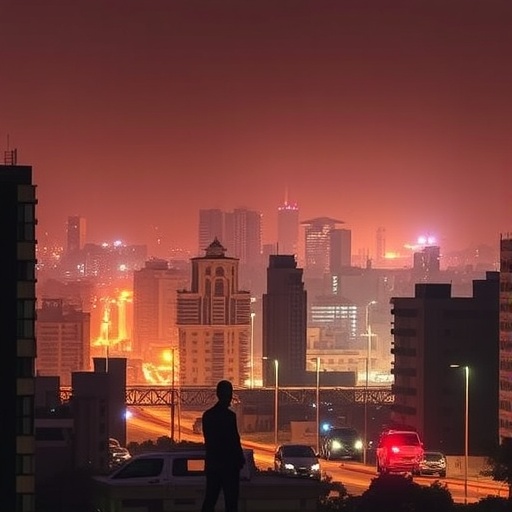
A new study of rapidly growing cities across the Arabian Peninsula has revealed a striking climate paradox: urban expansion may reduce the rate at which temperatures rise, while simultaneously exposing more people to extreme heat in absolute terms. The finding challenges the simple assumption that hotter cities are always the result of faster local warming, showing instead that population growth and expanding built environments can transform the scale of heat risk even when the pace of warming appears to moderate.
Published in Communications Earth & Environment, the study by Luo, Zimmer, Teyton and colleagues examines how urban development is reshaping heat exposure across one of the world’s fastest-changing regions. The Arabian Peninsula is already characterized by exceptionally high temperatures, arid landscapes and intense solar radiation. At the same time, cities are spreading outward, absorbing surrounding land and attracting growing populations. These overlapping trends create a complex relationship between climate warming, land-cover change and human vulnerability.
The researchers’ central conclusion is that urban expansion can moderate warming without making cities safer. In other words, the temperature increase experienced by a given urban location may become less pronounced as the city grows, yet the total number of people living under dangerous heat can rise substantially. This distinction separates two commonly confused concepts: the rate of warming and the amount of heat exposure. A slower increase in temperature does not necessarily mean a smaller public-health threat if more residents, buildings and infrastructure are placed in hot environments.
Urban growth can influence temperature through several physical mechanisms. Natural desert surfaces and newly developed urban areas do not absorb and release energy in the same way. Roads, rooftops and concrete structures can alter surface reflectivity, heat storage and air circulation. Buildings may provide shade and change wind flow, while paved surfaces can store solar energy during the day and release it after sunset. At the same time, expanding cities often replace open land with dense infrastructure, increasing the area in which people live and work under conditions of persistent heat.
The study’s result suggests that these processes can offset part of the warming signal measured over particular urban areas. Urban surfaces may modify local energy exchange, while changes in land cover and built density can affect how heat is distributed. Yet such moderation is not equivalent to cooling. Even where urban expansion reduces the rate of temperature increase, baseline temperatures may remain extremely high. A city can therefore experience a smaller upward trend while still recording heat levels that are hazardous to human health, especially during prolonged hot spells.
The most consequential change may be demographic rather than purely meteorological. As cities expand, more people occupy areas exposed to intense heat. New residential districts, industrial zones, transport corridors and commercial developments extend the footprint of human activity into landscapes where high temperatures are already normal. This creates what the researchers describe as intensified absolute heat exposure: the overall population and urban area subject to heat increase, even if the local warming trend is moderated.
That distinction has major implications for how climate risk is assessed. Temperature trends alone can conceal the growth of vulnerability. A city with a relatively modest warming rate may still face escalating risks if its population expands rapidly, if outdoor work increases, or if new neighborhoods lack shade, vegetation and efficient cooling. Heat exposure is also shaped by the duration of hot conditions, nighttime temperatures and access to cooling, although the supplied study citation does not specify the individual indicators or datasets used in the analysis.
The Arabian Peninsula provides an especially important setting for this research because urbanization is occurring alongside severe climatic stress. Major cities are expanding through large-scale construction and infrastructure projects, while their residents already rely heavily on air conditioning and engineered systems to remain safe. Rising electricity demand, water requirements and cooling needs can create additional pressure on urban services. If heat exposure grows faster than adaptation capacity, the consequences may include increased risks for outdoor workers, older adults, people with chronic illnesses and households unable to afford continuous cooling.
The findings also deliver a warning for urban planners: reducing warming intensity should not be treated as proof that development is climate-safe. Planning decisions must account for how many people will be exposed, where new construction is located and whether neighborhoods are designed to limit heat accumulation. Building orientation, reflective materials, shaded public spaces, vegetation where water supplies permit, and access to reliable cooling can all influence the human experience of extreme heat. The study’s broader message is that climate adaptation must measure not only how hot a city becomes, but how many people are placed in harm’s way.
As Arabian Peninsula cities continue to grow, the research offers a powerful reminder that climate danger is produced by the interaction between atmosphere and society. Urban expansion may dampen the apparent pace of warming in some locations, but it can also multiply the number of people living with dangerous temperatures. That paradox turns a seemingly reassuring statistic into a potential blind spot—and makes population-aware heat assessments essential for understanding the region’s future.
Cite Scienmag News
Sloane Callahan. (August 6, 2026). Urban growth slows warming but increases heat exposure across growing Arabian cities. Scienmag. https://scienmag.com/urban-growth-slows-warming-but-increases-heat-exposure-across-growing-arabian-cities/
Sloane Callahan. "Urban growth slows warming but increases heat exposure across growing Arabian cities." Scienmag, 6 August 2026, https://scienmag.com/urban-growth-slows-warming-but-increases-heat-exposure-across-growing-arabian-cities/. Accessed 4 September 2026.
Sloane Callahan. "Urban growth slows warming but increases heat exposure across growing Arabian cities." Scienmag. August 6, 2026. https://scienmag.com/urban-growth-slows-warming-but-increases-heat-exposure-across-growing-arabian-cities/


