


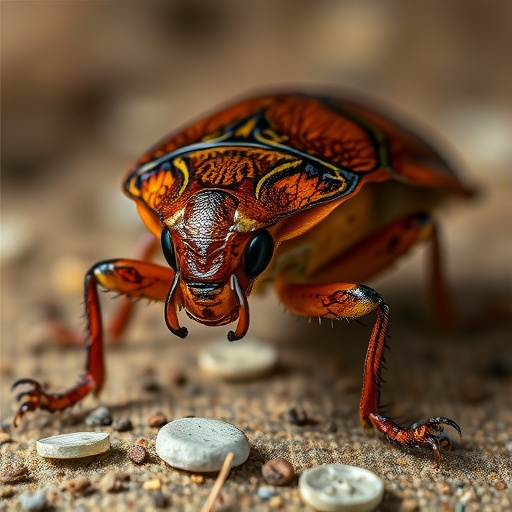
Newborn German cockroaches may be learning the identity of their social group through an unlikely source: feces. A study from North Carolina State University suggests that the insects use odors from their colony’s fecal deposits to recognize familiar groups, form early-life affiliations and remain close to the aggregation where they acquire essential nutrients and gut microbes. The discovery challenges the common image of cockroaches as purely solitary scavengers and could inspire a new generation of pest-control strategies.
German cockroaches, Blattella germanica, are born without a developed gut microbiome. Shortly after hatching, they feed on feces deposited by older members of their aggregation, a behavior known as coprophagy. This material supplies nutrients and introduces the bacterial communities that help the young insects digest food and function normally. The fecal deposits also release chemical signals that attract cockroaches to one another and help maintain the group.
Researchers investigated whether these odors merely attract cockroaches to any aggregation or whether young insects can learn to identify the particular group in which they were raised. The team manipulated the early experiences of cockroach nymphs, controlling whether they encountered feces after hatching and later altering the quality of their diets. These treatments produced groups with different fecal odor profiles, reflecting changes in both their digestive processes and microbial communities.
The scientists then collected feces from the experimental groups and presented the odors to neonate cockroaches in behavioral tests. Newly hatched insects that had not yet experienced coprophagy were broadly attracted to fecal odors from all of the groups. This response indicates an innate attraction to the feces of their own species, likely because such odors signal food, shelter and access to beneficial microorganisms.
The results changed when the cockroaches had consumed feces from their natal aggregation. Experienced nymphs showed a clear preference for the odor associated with the group they had encountered early in life, rather than displaying equal interest in unfamiliar fecal odors. Their behavior suggests that coprophagy does more than seed the gut microbiome: it exposes the developing nervous system to a chemical signature that can later be recognized as a marker of home.
The study also tested whether cockroaches could form new odor preferences through associative learning. In these experiments, researchers paired a fecal odor with glucose, a valuable food reward. After conditioning, the nymphs preferentially aggregated near the odor linked to the reward instead of choosing unfamiliar scents. This demonstrated that German cockroaches can learn relationships between chemical signals and positive outcomes, adding a flexible component to the innate attraction that brings them toward fecal deposits.
Fecal odors are chemically complex because they originate from the digestive tract and are shaped by diet, metabolism and microbial activity. Distinct cockroach aggregations living in different environments may therefore produce partially unique odor signatures. According to the researchers, this variation could allow young cockroaches to distinguish their natal group from other nearby groups. The mechanism resembles nest-mate recognition in highly social insects such as ants, bees, wasps and termites, although those species generally rely on body odors rather than fecal signals.
The findings offer a new perspective on cockroach sociality. German cockroaches are often described as subsocial because they do not build elaborate colonies or display the highly organized division of labor associated with ants and bees. Yet the ability to learn and retain group-specific odors indicates that their social behavior is more sophisticated than previously assumed. Their kin or group bonds may have evolved through a different chemical route, one centered on shared fecal material and the microbial ecosystem it carries.
The discovery could also have practical implications for pest management. Cockroach aggregations provide young insects with food, microbes and protection, reducing the likelihood that they will leave the group and encounter traps or insecticidal baits. If scientists can identify odor compounds that attract German cockroaches broadly across populations, those compounds could be incorporated into more effective monitoring devices, traps or bait formulations. Such tools might be especially valuable in residences, hospitals, restaurants and other settings where infestations are difficult to eliminate.
The researchers emphasize that the study does not mean every aggregation has a completely unique chemical identity, nor does it immediately provide a ready-to-use pest-control product. Instead, it identifies a behavioral and biological pathway that can be explored for future control methods. By combining knowledge of cockroach learning, fecal chemistry and gut microbiology, scientists may be able to design attractants that exploit the insects’ strongest social instincts while bypassing the limits of conventional traps. The study, published in Proceedings of the Royal Society B, reveals that even one of the world’s most notorious pests can learn where it belongs—and may carry that memory in its nose.
News Publication Date: 5 August 2026
Web References: https://royalsocietypublishing.org/rspb/article/293/2076/20253042/482679/Group-recognition-in-the-German-cockroach-a
References: Wada-Katsumata, A., Schal, C., Hamilton-Brown, J. A., and Kakumanu, M. L. “Group recognition in the German cockroach, a subsocial omnivore, is based on faecal odour preference that is modulated by copraphagy, diet and learning.” Proceedings of the Royal Society B. DOI: 10.1098/rspb.2025.3042
Cite Scienmag News
Morgan Morrow. (August 6, 2026). German cockroaches may be more social than scientists previously believed. Scienmag. https://scienmag.com/german-cockroaches-may-be-more-social-than-scientists-previously-believed/
Morgan Morrow. "German cockroaches may be more social than scientists previously believed." Scienmag, 6 August 2026, https://scienmag.com/german-cockroaches-may-be-more-social-than-scientists-previously-believed/. Accessed 3 September 2026.
Morgan Morrow. "German cockroaches may be more social than scientists previously believed." Scienmag. August 6, 2026. https://scienmag.com/german-cockroaches-may-be-more-social-than-scientists-previously-believed/


