


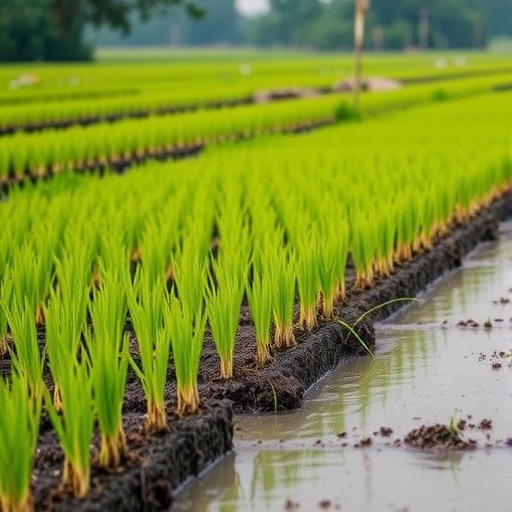
Rice fields may be quietly rewriting the rules of climate change. As global temperatures rise, flooded soils do not simply lose nitrogen faster or retain it more effectively. Instead, a new three-year field study suggests that warming triggers both processes at once: it accelerates nitrogen uptake and atmospheric losses while also pushing more nitrogen into protected soil structures where it may remain stored for longer.
The discovery could complicate how scientists and farmers calculate the future fertility and climate impact of rice paddies. Nitrogen is indispensable for plant growth and is widely supplied through fertilizer, but its movement through flooded soils is exceptionally dynamic. Microorganisms can rapidly transform nitrogen into forms that plants use, gases that escape into the atmosphere, or compounds that become attached to soil minerals and trapped inside aggregates. Understanding which pathway dominates under a warmer climate is critical for managing food production and greenhouse-gas emissions.
Researchers from South Korea investigated the issue in a three-year experiment using open-top chambers established in rice fields. The chambers reproduced present-day atmospheric conditions, a temperature increase of 2 degrees Celsius, and a future-climate treatment combining the 2-degree warming with an additional 200 parts per million of carbon dioxide. Throughout the experiment, the team tracked nitrogen uptake by rice plants, nitrous oxide emissions, soil nitrogen fractions, nitrogen isotope signatures, root-derived inputs, and microbial genes linked to biological nitrogen fixation.
The warming treatment made nitrogen move through the system more rapidly. Rice plants absorbed more nitrogen during the growing season, indicating that higher temperatures increased the availability of plant-accessible nitrogen or accelerated the transformations that produce it. At the same time, the soils emitted more nitrous oxide, a greenhouse gas with a warming potential far greater than carbon dioxide over a century. Nitrous oxide emissions represent a double problem: they intensify climate change and remove nitrogen that could otherwise support crop growth.
Yet the apparent losses did not translate into a simple decline in total soil nitrogen. In both warming treatments, the overall amount of nitrogen in the soil was maintained or increased. The explanation emerged when the researchers examined how nitrogen was distributed among different physical and chemical pools. A substantial increase occurred in nitrogen trapped within soil aggregates—clusters of mineral particles and organic matter that can physically shield their contents from microbial enzymes and other decomposing agents.
This form of protection is important because nitrogen inside aggregates is not necessarily immediately available to plants or microorganisms. The tightly packed structures can restrict access to organic compounds, slowing decomposition and reducing the rate at which nitrogen is released. In effect, warming appeared to create a paradox: it stimulated biological activity and nitrogen turnover while also encouraging some of the processed nitrogen to enter longer-lived, physically protected reservoirs.
Nitrogen associated with silt and clay particles showed isotope patterns consistent with intensified microbial processing. Isotopes are variants of the same element that differ in mass, and their relative abundance can preserve clues about the reactions nitrogen has undergone. The isotope evidence indicated that microorganisms were actively transforming nitrogen before some of it became associated with mineral surfaces. Such mineral-bound nitrogen may be less vulnerable to immediate loss than dissolved or loosely held organic forms, although its long-term stability depends on soil chemistry, flooding conditions, and future disturbance.
The microbial community also appeared to be changing. The researchers detected a significant increase in the abundance of the nifH gene, a molecular marker commonly used to identify microorganisms capable of fixing atmospheric nitrogen. Biological nitrogen fixation converts nitrogen gas from the atmosphere into forms that can enter the soil nitrogen cycle, potentially providing an additional source of nutrients when fertilizer inputs or available soil nitrogen are limited. However, the team cautions that a larger nifH gene pool does not prove that fixation rates actually increased. Confirming that process will require isotope-tracer experiments that directly measure newly fixed nitrogen.
Adding carbon dioxide to the warmed atmosphere did not consistently amplify the warming response. In one important interaction, rice plants absorbed less nitrogen under combined warming and elevated carbon dioxide than under warming alone. The researchers suggest that higher carbon dioxide can cause plants to partially close their stomata—the microscopic pores that regulate gas exchange and water loss. Reduced transpiration may limit evaporative cooling, leaving rice canopies more vulnerable to heat stress and weakening the potential growth benefits of additional carbon dioxide.
The findings point toward a more nuanced approach to rice-field management in a warming world. Maintaining moderate organic-carbon inputs could help sustain the soil structures that protect nitrogen, while carefully timed flooding may influence the microbial reactions responsible for both nitrogen retention and nitrous oxide production. Practices that preserve soil aggregates could also reduce the exposure of stabilized nitrogen to decomposition. At the same time, supporting beneficial nitrogen-fixing communities may eventually help reduce dependence on synthetic fertilizer, although that possibility remains to be tested directly. Because the experiment used only two field plots per treatment, the results are best viewed as an important signal rather than a universal prediction. Studies across different soils, rice varieties, climates, and farming systems will be needed to determine whether warming consistently produces the same trade-off: faster nitrogen cycling and greater atmospheric loss alongside increased storage in protected soil pools.
News Publication Date: 30-Jun-2026
Web References: https://doi.org/10.48130/nc-0026-0010
References: Song HJ, Seo YH, Shin HJ, Lee JJ, Ampode SJG, et al. 2026. “Warming reshapes nitrogen partitioning and stabilization pathways in flooded rice soils.” Nitrogen Cycling 2: e023. DOI: 10.48130/nc-0026-0010
Cite Scienmag News
Alan Morgan. (August 4, 2026). Rising Temperatures Alter Nitrogen Storage and Loss in Flooded Rice Soils. Scienmag. https://scienmag.com/rising-temperatures-alter-nitrogen-storage-and-loss-in-flooded-rice-soils/
Alan Morgan. "Rising Temperatures Alter Nitrogen Storage and Loss in Flooded Rice Soils." Scienmag, 4 August 2026, https://scienmag.com/rising-temperatures-alter-nitrogen-storage-and-loss-in-flooded-rice-soils/. Accessed 3 September 2026.
Alan Morgan. "Rising Temperatures Alter Nitrogen Storage and Loss in Flooded Rice Soils." Scienmag. August 4, 2026. https://scienmag.com/rising-temperatures-alter-nitrogen-storage-and-loss-in-flooded-rice-soils/


