


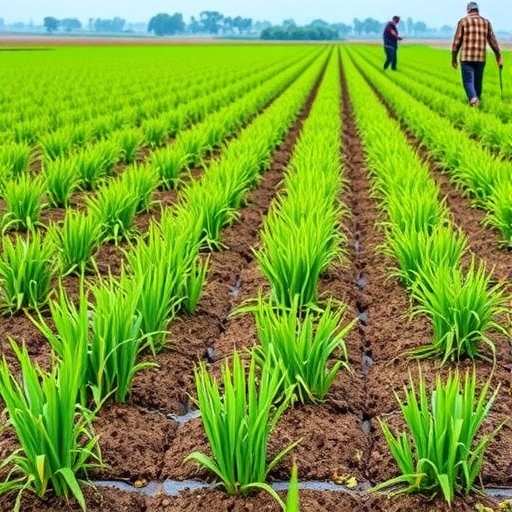
India’s crop map may be carrying an invisible environmental price tag. A new study in Nature Communications examines how restructuring the country’s nitrogen-intensive agriculture could generate benefits far beyond individual farms—while reshaping the interstate trade network that moves food across the nation. The research, led by S.S. Goyal, R. Kumar and U. Bhatia, connects two systems that are usually studied separately: the environmental consequences of nitrogen use and the economic geography of India’s food supply.
Nitrogen is essential for modern agriculture because it supports chlorophyll formation, plant growth and grain production. Synthetic fertilizers such as urea have helped India increase food output, but crops generally absorb only a fraction of the nitrogen applied to fields. The remainder can escape into the atmosphere as ammonia and nitrous oxide, leach into groundwater as nitrate, or run off into rivers and lakes. These losses contribute to air pollution, climate change, algal blooms and the degradation of freshwater ecosystems.
The study focuses on “nitrogen-based crop restructuring”—a shift in the combination and location of crops grown across India in ways that could reduce nitrogen losses while maintaining the food system’s ability to meet demand. Such restructuring is more complex than simply using less fertilizer. Different crops require different amounts of nitrogen, respond differently to soil and climate conditions, and generate varying levels of environmental impact. A change that appears beneficial within one state could create shortages, price pressures or new transport requirements elsewhere.
To capture those interactions, the research links agricultural nitrogen accounting with interstate trade-network analysis. In a trade network, states can be represented as nodes and food flows as connections between them. Some states act primarily as producers, others as major consumers, while strategically positioned regions serve as bridges connecting multiple parts of the system. Altering crop production in one location can therefore influence transport demand, regional dependence and the vulnerability of the entire network to disruption.
This network perspective is crucial for India, where food does not remain within the state in which it is grown. Rice, wheat, pulses, oilseeds, vegetables and other commodities move through extensive supply chains before reaching consumers. A nitrogen-saving crop pattern could reduce pollution at the farm level but increase the distance food must travel if production shifts away from major population centers. Conversely, a carefully designed restructuring could align crops more closely with local conditions and demand, reducing both nitrogen losses and unnecessary movement of agricultural products.
The environmental benefits considered in the study extend across several pathways. Lower nitrogen surpluses can reduce nitrous oxide emissions, a powerful greenhouse gas released by fertilized soils. Reduced ammonia volatilization can improve air quality because ammonia reacts in the atmosphere to form fine particulate matter. Limiting nitrate leaching and fertilizer runoff can protect drinking-water sources and reduce eutrophication, the nutrient-driven growth of algae that depletes oxygen in aquatic ecosystems. These effects are often described as co-benefits because a single change in crop strategy can address multiple environmental problems simultaneously.
The researchers’ approach also highlights why national averages can conceal important regional differences. A fertilizer or crop policy that performs well in one agroecological zone may be less effective in another because of variations in rainfall, soil properties, irrigation, yield potential and existing cropping patterns. The same intervention can also produce different trade consequences depending on whether a state is a major exporter, importer or transit hub. By combining environmental indicators with trade-network structure, the study aims to reveal where crop changes could deliver the greatest benefits with the fewest disruptions.
The work arrives as India faces a difficult agricultural balancing act. The country must sustain food security, support rural livelihoods and manage rising pressure on land and water, while also reducing pollution and greenhouse-gas emissions. Nitrogen fertilizer is deeply embedded in this challenge: it can raise yields and protect production, but inefficient use imposes costs that are rarely reflected in the market price of food. The study suggests that future agricultural planning may need to evaluate fertilizer efficiency, crop choice, regional specialization and food transport as parts of one connected system.
Its broader message is that environmental policy cannot stop at the farm boundary. Redesigning India’s crop structure could produce measurable gains for climate, air and water quality, but the success of such a transition would depend on how it interacts with trade flows between states. Policymakers may need to pair nitrogen-management strategies with investment in storage, transport, market access and farmer support, ensuring that environmental improvements do not undermine food availability or impose disproportionate costs on particular regions.
By placing nitrogen pollution and interstate commerce in the same analytical frame, Goyal, Kumar and Bhatia present agriculture as both an ecological system and a national network. Their findings offer a roadmap for identifying crop-production changes that can deliver multiple environmental gains while accounting for the economic connections that keep India fed. The research also points to a wider lesson for sustainable food systems worldwide: the most powerful agricultural solutions may be those that reduce pollution at its source without ignoring the journeys food must make before it reaches the plate.
Cite Scienmag News
Alan Morgan. (August 4, 2026). India’s Nitrogen Crop Restructuring Could Deliver Environmental Benefits and Reshape Interstate Trade. Scienmag. https://scienmag.com/indias-nitrogen-crop-restructuring-could-deliver-environmental-benefits-and-reshape-interstate-trade/
Alan Morgan. "India’s Nitrogen Crop Restructuring Could Deliver Environmental Benefits and Reshape Interstate Trade." Scienmag, 4 August 2026, https://scienmag.com/indias-nitrogen-crop-restructuring-could-deliver-environmental-benefits-and-reshape-interstate-trade/. Accessed 4 September 2026.
Alan Morgan. "India’s Nitrogen Crop Restructuring Could Deliver Environmental Benefits and Reshape Interstate Trade." Scienmag. August 4, 2026. https://scienmag.com/indias-nitrogen-crop-restructuring-could-deliver-environmental-benefits-and-reshape-interstate-trade/


