

Thursday, July 30, 2026
Science
No Result
View All Result
  • Login
  • HOME
  • SCIENCE NEWS
  • CONTACT US
  • HOME
  • SCIENCE NEWS
  • CONTACT US
No Result
View All Result
Scienmag
No Result
View All Result
Home Science News Marine

Simultaneous desalination and selective metal recovery enabled by potential-regulated electrochemical ion pumping

July 30, 2026
in Marine
Reading Time: 2 mins read
0
Simultaneous desalination and selective metal recovery enabled by potential-regulated electrochemical ion pumping

Simultaneous desalination and selective metal recovery enabled by potential-regulated electrochemical ion pumping

65
SHARES
587
VIEWS
Share on FacebookShare on Twitter
ADVERTISEMENT

blank

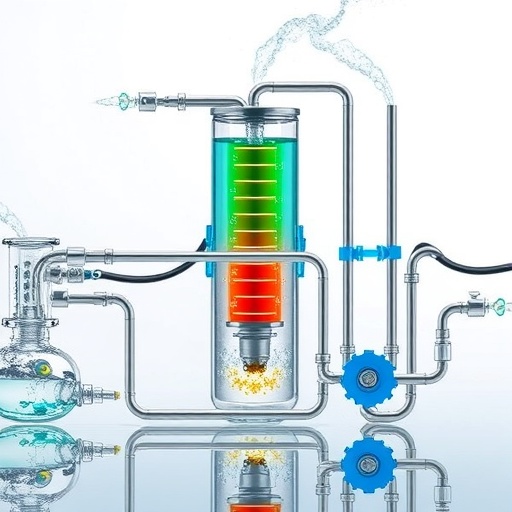
Highly saline industrial wastewaters containing heavy metals are common, yet no existing process can achieve both desalination and metal recovery in an integrated technology platform. Conventional desalination processes do not distinguish between heavy metals and background electrolyte and generate toxic brines with heavy metals, missing opportunities for resource recovery. Here we show that electrochemical ion pumping (EIP) has the unique capability to promote simultaneous desalination and metal recovery through programmable control of the electrode potential. As EIP transfers only a small amount of ions per half cycle via high-frequency circuit switching, the electrode potential can be maintained within a narrow window throughout operation, which allows redox reactions to be selectively activated or suppressed without interrupting continuous ion transport. At potentials above the Cu2+/Cu0 reduction threshold, the system desalinates only capacitively, with no metal deposition. Shifting the potential window to below this threshold triggers selective copper electrodeposition on the electrode while still performing desalination. In an asymmetric five-electrode EIP stack fed with a mixture of Cu2+, Ni2+ and Na+, positioning the potential window between the reduction potentials of Cu2+ and Ni2+ yielded selective Cu2+ capture on the electrode. These findings establish the electrode potential as a controllable operation parameter in EIP, providing an integrated platform for coupled water recycling and selective resource recovery from complex industrial brines.

Xu, L., Bello, O.A., Zaker, S.S.M.A. et al. Simultaneous desalination and selective metal recovery enabled by potential-regulated electrochemical ion pumping.
Nat Water (2026). https://doi.org/10.1038/s44221-026-00679-w

https://doi.org/10.1038/s44221-026-00679-w

Share26Tweet16
Previous Post

A ring-jig additive friction stir deposition method for efficient additive manufacturing of metal laminates

Next Post

Senotypes define the diverse landscape of senescent cells

Related Posts

In US veterans, rates of ALS associated with military branch and rank
Marine

In US veterans, rates of ALS associated with military branch and rank

July 29, 2026
Ancient turtle hunting could inform modern conservation throughout Southern Caribbean, SFU study
Marine

Ancient turtle hunting could inform modern conservation throughout Southern Caribbean, SFU study

July 29, 2026
Spectacular discovery provides insight into the internal organs of a marine reptile
Marine

Spectacular discovery provides insight into the internal organs of a marine reptile

July 29, 2026
Microorganisms actively shape the ocean floor
Marine

Microorganisms actively shape the ocean floor

July 29, 2026
Reichman University Scientists Create Biological Shield to Protect Metals from Seawater
Marine

Reichman University Scientists Create Biological Shield to Protect Metals from Seawater

July 29, 2026
Quorum sensing enables nitrite-oxidizing bacteria to fuel nitritation via altruism
Marine

Quorum sensing enables nitrite-oxidizing bacteria to fuel nitritation via altruism

July 29, 2026
Next Post
Senotypes define the diverse landscape of senescent cells

Senotypes define the diverse landscape of senescent cells

  • Mothers who receive childcare support from maternal grandparents show more

    Mothers who receive childcare support from maternal grandparents show more parental warmth, finds NTU Singapore study

    27656 shares
    Share 11059 Tweet 6912
  • University of Seville Breaks 120-Year-Old Mystery, Revises a Key Einstein Concept

    1061 shares
    Share 424 Tweet 265
  • Bee body mass, pathogens and local climate influence heat tolerance

    682 shares
    Share 273 Tweet 171
  • Researchers record first-ever images and data of a shark experiencing a boat strike

    546 shares
    Share 218 Tweet 137
  • Groundbreaking Clinical Trial Reveals Lubiprostone Enhances Kidney Function

    531 shares
    Share 212 Tweet 133
Science

Embark on a thrilling journey of discovery with Scienmag.com—your ultimate source for cutting-edge breakthroughs. Immerse yourself in a world where curiosity knows no limits and tomorrow’s possibilities become today’s reality!

RECENT NEWS

  • Complement deficiency and neonatal immunity: a serum-limited, context-dependent framework
  • Cold exposure aggravates vein occlusion through non-shivering thermogenesis-induced thrombocytopoiesis
  • Senotypes define the diverse landscape of senescent cells
  • Simultaneous desalination and selective metal recovery enabled by potential-regulated electrochemical ion pumping

Categories

  • Agriculture
  • Anthropology
  • Archaeology
  • Athmospheric
  • Biology
  • Biotechnology
  • Blog
  • Bussines
  • Cancer
  • Chemistry
  • Climate
  • Earth Science
  • Editorial Policy
  • Marine
  • Mathematics
  • Medicine
  • Pediatry
  • Policy
  • Psychology & Psychiatry
  • Science Education
  • Social Science
  • Space
  • Technology and Engineering

Subscribe to Blog via Email

Enter your email address to subscribe to this blog and receive notifications of new posts by email.

Join 5,147 other subscribers

© 2025 Scienmag - Science Magazine

Welcome Back!

Login to your account below

Forgotten Password?

Retrieve your password

Please enter your username or email address to reset your password.

Log In
No Result
View All Result
  • HOME
  • SCIENCE NEWS
  • CONTACT US

© 2025 Scienmag - Science Magazine

Discover more from Science

Subscribe now to keep reading and get access to the full archive.

Continue reading
