


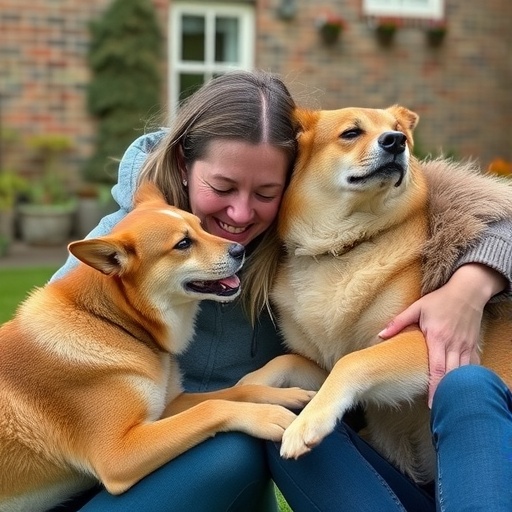

view more
Credit: RebeccasPictures, Pixabay, CC0 (
In a study of Swiss adults, women and people who spent more time with a pet or another animal they might feel close to reported feeling more attached to the animal and receiving more socio-emotional support from it. However, the study found little evidence for links between pet ownership and participants’ overall wellbeing. Rahel Marti of the University of Basel, Switzerland, and colleagues present these findings in the open access journal PLOS One on July 29, 2026.
Despite the widespread assumption that pet ownership benefits owners’ health, research on this possibility is inconclusive. Prior evidence suggests that links between health and pet ownership may involve interactions between many factors, such as animal species, owners’ sociodemographic characteristics, and particulars of the human-animal relationship.
However, few studies have examined all of these factors at once. To address that gap, Marti and colleagues analyzed survey data from 2,328 Swiss adults. They investigated whether factors such as pet ownership, regular animal contact, and attachment to an animal were statistically linked to aspects of wellbeing, such as physical health, social support, and loneliness. They also examined links between participants’ demographic characteristics and their relationships with animals.
The analysis revealed some demographic links; for instance, women, participants who spent more time with an animal, and those interacting with dogs tended to feel more attached to the animal and more socio-emotionally supported by it.
The researchers found no overarching association between participants’ health and pet ownership or regular animal contact. However, some links emerged. For instance, pet owners tended to report being less healthy and smoking cigarettes slightly more often than non-owners. Participants who felt more supported by an animal reported lower psychological wellbeing and more loneliness. Participants who spent more time with an animal reported higher psychological wellbeing and more frequent smoking.
This study does not confirm any cause-effect relationship. For example, the authors note that while it is possible pet ownership leads to worse health, it is also possible that unhealthier Swiss are more likely to obtain pets.
As this is a cross-sectional survey conducted in only one country, future research could address some of this study’s limitations, such as by including objective data and participants from other countries.
The authors add: “Our findings suggest that simply owning a pet is not associated with better health or well-being. Instead, we found that the relationship people have with their animals is much more nuanced than a simple yes-or-no question of pet ownership. Two people may both own a dog, but their relationships with that dog can be very different. Our findings suggest that understanding these differences may be more informative than simply comparing pet owners with non-pet owners.”
“Rather than asking whether someone owns a pet, future research should consider how people interact with their animals and what role the animal plays in their lives. What appeared to matter in some cases was not pet ownership itself, but whether people experienced their animal as a source of socio-emotional support and how much time they spent together.”
“The inconsistent findings reported in previous studies may partly reflect the fact that pet ownership is often treated as a simple yes-or-no variable. Our results suggest that pet ownership is a multidimensional construct that includes characteristics of the owner, the animal, and their relationship.”
In your coverage, please use this URL to provide access to the freely available article in PLOS One:
Citation: Marti R, Hediger K, Pauli E, Hattendorf J (2026) Factors of pet ownership associated with human health: A representative cross-sectional survey of Switzerland. PLoS One 21(7): e0352778.
Author countries: Switzerland, Netherlands.
Funding: This work was supported by the Swiss National Science Foundation under an Eccellenza Professorial Fellowship grant (Nr. PCEFP1_194591 / 1) to KH and by FORS (www.forscenter.ch), the Swiss Centre of Expertise in the Social Sciences, which conducted the MOSAiCH survey (Measurement and Observation of Social Attitudes in Switzerland [CH]). The funders had no role in study design, data collection and analysis, decision to publish, or preparation of the manuscript.
Journal
PLOS One
Method of Research
Survey
Subject of Research
Not applicable
Article Title
Factors of pet ownership associated with human health: A representative cross-sectional survey of Switzerland
Article Publication Date
29-Jul-2026
COI Statement
The authors have declared that no competing interests exist.
Hanna Abdallah
PLOS
onepress@plos.org
Journal
PLOS One
Method of Research
Survey
Subject of Research
Not applicable
Article Title
Factors of pet ownership associated with human health: A representative cross-sectional survey of Switzerland
Article Publication Date
29-Jul-2026
COI Statement
The authors have declared that no competing interests exist.
Cite Scienmag News
Drew Townsend. (July 29, 2026). Support from animals may feel stronger for women and those spending more time with them. Scienmag. https://scienmag.com/support-from-animals-may-feel-stronger-for-women-and-those-spending-more-time-with-them/
Drew Townsend. "Support from animals may feel stronger for women and those spending more time with them." Scienmag, 29 July 2026, https://scienmag.com/support-from-animals-may-feel-stronger-for-women-and-those-spending-more-time-with-them/. Accessed 4 September 2026.
Drew Townsend. "Support from animals may feel stronger for women and those spending more time with them." Scienmag. July 29, 2026. https://scienmag.com/support-from-animals-may-feel-stronger-for-women-and-those-spending-more-time-with-them/

