


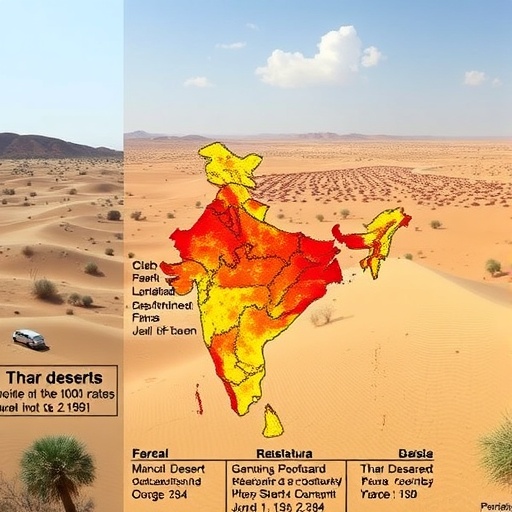
A new study published in Communications Earth & Environment is reshaping how scientists think about rainfall in the Thar Desert during the mid-Holocene—an interval roughly 6,000 years ago when Earth’s climate was notably different from today. Rather than treating the desert as a simple drought zone, the research highlights distinct hydroclimate “rhythms” that governed water availability and changed with the seasons.
Using paleoenvironmental evidence and careful climate reconstruction methods, the team investigated how precipitation patterns evolved through time and how they were organized across seasons. The results point to measurable structure in mid-Holocene rainfall, suggesting that even in a largely arid region, monsoon-linked processes could produce consistent temporal behavior rather than chaotic wet-dry swings.
A key implication is that the desert’s hydrology responded in patterned ways to broader atmospheric drivers. The reconstructed signals align with how monsoon circulation influences moisture transport over northwestern India, while also indicating that seasonal contrasts mattered for when water was most likely to arrive.
The researchers emphasize that hydroclimate variability is not only about whether rainfall increases or decreases, but also about the timing of that rainfall. Shifts in seasonal emphasis can change soil moisture storage, groundwater recharge potential, and the likelihood of extreme wet events—factors that can strongly shape ecosystems and human water strategies.
Technically, the study’s approach links environmental proxies to precipitation and seasonality metrics, allowing the authors to infer how the dominant “wet season” signature behaved during the mid-Holocene. By separating signals associated with seasonal water delivery from longer-term trends, the work improves resolution on the mechanisms behind regional climate variability.
The findings also help interpret why the Thar Desert could support different levels of hydrological activity during past warm phases. Instead of assuming uniform aridity, the data suggest a nuanced desert climate where monsoon seasonality could intermittently enhance effective moisture.
As interest grows in monsoon resilience under future warming, understanding mid-Holocene seasonal patterns becomes more than historical curiosity. The study offers a baseline for how monsoon-driven systems can reorganize rainfall timing, potentially informing models that simulate present and future hydroclimate extremes.
Overall, the work delivers a viral-science-ready message: deserts have memory, and the Thar’s mid-Holocene water cycle appears to have followed a recognizable seasonal script, not a random one.
Cite Scienmag News
Violet Maxwell. (July 28, 2026). Mid-Holocene Thar Desert hydroclimate patterns reveal seasonal shifts in India. Scienmag. https://scienmag.com/mid-holocene-thar-desert-hydroclimate-patterns-reveal-seasonal-shifts-in-india/
Violet Maxwell. "Mid-Holocene Thar Desert hydroclimate patterns reveal seasonal shifts in India." Scienmag, 28 July 2026, https://scienmag.com/mid-holocene-thar-desert-hydroclimate-patterns-reveal-seasonal-shifts-in-india/. Accessed 4 September 2026.
Violet Maxwell. "Mid-Holocene Thar Desert hydroclimate patterns reveal seasonal shifts in India." Scienmag. July 28, 2026. https://scienmag.com/mid-holocene-thar-desert-hydroclimate-patterns-reveal-seasonal-shifts-in-india/


