


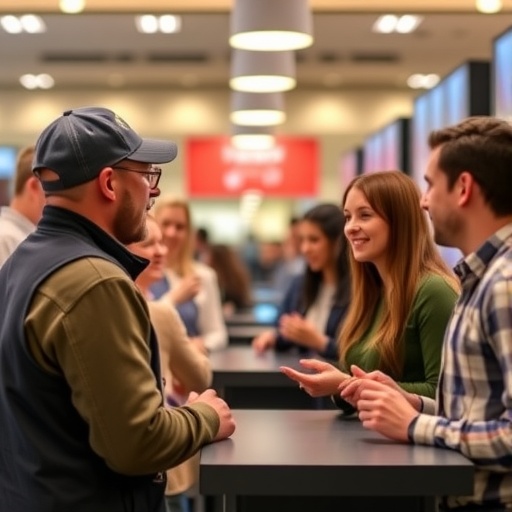
COLUMBUS, Ohio—Mobile crowdsourcing systems that broadcast real-time queue information can unintentionally create the very congestion they try to reduce. A new study argues that the culprit is predictable human behavior: when updates go stale, people flock to what appears to be the shortest or least crowded option. In service settings such as restaurants, amusement parks, and transit routes, that “selfish” switching can concentrate demand into bottlenecks, delaying fresh information for everyone else.
The researchers focus on a core challenge of dynamic queueing environments—information rapidly becomes outdated as users act on it. Interruptions and delays cause a feedback loop: individual users chase the best currently visible alternative, but their collective actions reduce system efficiency over time. The paper describes how this creates gaps in high-quality, up-to-date crowd intelligence needed for future customers.
To counter the loop, the team proposes a side-payment mechanism that periodically charges users who contribute to overcrowding while rewarding those who explore alternative routes. The goal is not simply to redirect traffic, but to realign individual decisions with long-term social welfare. By attaching penalties and rewards to the impact of user choices, the system encourages behavior that improves congestion balance and preserves information freshness.
In experiments using real-world datasets, the method demonstrates stable performance. The approach effectively trades off the cost of congestion incurred during information gathering against the public value of receiving fresh service insights. According to senior author Ness Shroff, the key is computing when updated crowd information is “worth” the temporary crowding required to obtain it, then using incentives to guide choices toward that balance.
The study frames this challenge as human-in-the-loop learning (HILL): the learning process depends on human decisions, which in turn reshape the environment from which information is collected. Lead author Hongbo Li notes that designing incentives that are consistent with both social welfare and users’ long-term utility is difficult, especially without directly harming service benefits.
A practical scenario could involve car-charging stations. A user might be rewarded for selecting a less crowded charger farther away, while a penalty could apply to choosing a nearby station that is likely to become overloaded. Although both visits produce useful data for the operator, the incentive scheme aims to suppress congestion to reduce overall system inefficiency.
Beyond accuracy, the mechanism is designed to be cost-aware. Money paid by penalized users can fund rewards, limiting the need for external subsidies. The researchers report that even “average use” under the strategy can reduce costs and energy, suggesting strong alignment with a social optimum.
Looking ahead, the team plans to test robustness when people make unexpected choices involving price sensitivity, perceived risk, and personal convenience. Their next step is to develop mechanisms that work for heterogeneous users across multiple scenarios—essential for deploying incentive-driven queueing intelligence at scale.
The work was published in IEEE/ACM Transactions on Networking.
Cite Scienmag News
Denise Maddox. (July 28, 2026). Better Consumer Choices Could Improve Next-Gen Queueing Platforms. Scienmag. https://scienmag.com/better-consumer-choices-could-improve-next-gen-queueing-platforms/
Denise Maddox. "Better Consumer Choices Could Improve Next-Gen Queueing Platforms." Scienmag, 28 July 2026, https://scienmag.com/better-consumer-choices-could-improve-next-gen-queueing-platforms/. Accessed 3 September 2026.
Denise Maddox. "Better Consumer Choices Could Improve Next-Gen Queueing Platforms." Scienmag. July 28, 2026. https://scienmag.com/better-consumer-choices-could-improve-next-gen-queueing-platforms/


