


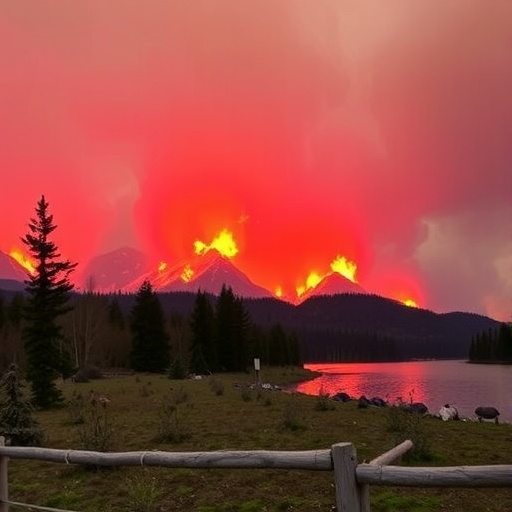
A new analysis of Canada’s 2023 wildfire season suggests that wildfire smoke didn’t just dim skies—it measurably reduced solar energy output across the country. Using observational air-quality and power-generation records, researchers estimate that particulate pollution and associated atmospheric effects contributed to a 2.8% decline in solar power generation during the smoke period. The economic implication, they report, is staggering: roughly two billion dollars in lost value tied to the shortfall in electricity production and downstream grid impacts.
Wildfire smoke contains fine aerosols that scatter and absorb sunlight. That means less solar radiation reaches photovoltaic panels, especially when smoke layers thicken or persist for days. While clouds and seasonal weather also influence production, the study isolates smoke-related reductions by correlating changes in aerosol loading with deviations in solar output relative to expected baselines.
The team also emphasizes that the effect is not merely immediate. Even after major smoke episodes, recovery can be delayed by lingering particulates, weather patterns that keep aerosols suspended, and regional transport that maintains elevated optical thickness over solar-heavy regions. In practical terms, solar plants may operate under systematically reduced irradiance conditions, lowering capacity factors and redispatch needs.
The paper’s technical framing highlights radiative transfer mechanisms: when aerosols increase the atmosphere’s optical depth, incoming solar spectra are reshaped, and panel-relevant bands can be diminished. This can degrade both total energy yield and the performance conditions under which inverters and forecasting systems plan day-ahead generation.
Beyond panels, the findings point to a wider vulnerability in clean-energy grids. Solar power variability under smoke-driven attenuation can interact with demand peaks and with other renewables, potentially increasing balancing costs. Even modest percentage drops can translate into large monetary losses when scaled nationally over months of generation.
Importantly, the results offer an actionable pathway for operators. Incorporating real-time aerosol indices into production forecasting could improve schedule accuracy, reduce uncertainty in market bidding, and help grid managers anticipate periods of depressed generation.
The study appears in Communications Earth & Environment and underscores that wildfire risk is an energy-security issue, not only an environmental one. As wildfire frequency and intensity evolve, the economic burden of smoke-related renewable disruptions may grow unless mitigation and forecasting strategies keep pace.
Cite Scienmag News
Faith Mcneil. (July 28, 2026). Canada’s 2023 wildfire smoke cut solar generation by 2.8%, costing $2B. Scienmag. https://scienmag.com/canadas-2023-wildfire-smoke-cut-solar-generation-by-2-8-costing-2b/
Faith Mcneil. "Canada’s 2023 wildfire smoke cut solar generation by 2.8%, costing $2B." Scienmag, 28 July 2026, https://scienmag.com/canadas-2023-wildfire-smoke-cut-solar-generation-by-2-8-costing-2b/. Accessed 4 September 2026.
Faith Mcneil. "Canada’s 2023 wildfire smoke cut solar generation by 2.8%, costing $2B." Scienmag. July 28, 2026. https://scienmag.com/canadas-2023-wildfire-smoke-cut-solar-generation-by-2-8-costing-2b/


