


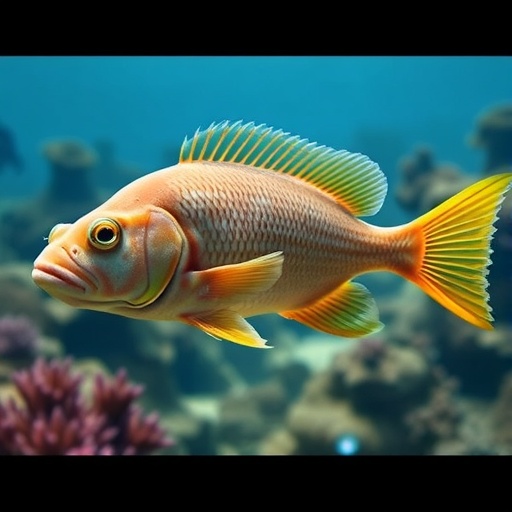
More than 120 Red Sea fish species have crossed into the Mediterranean since the opening of the Suez Canal over 150 years ago. Now, researchers at Tel Aviv University have built a statistical forecasting model designed to identify which species are most likely to become the next wave of migrants.
Using extensive field observations from both seas, the team ranked Red Sea species by invasion potential and highlighted three particularly high-risk candidates: the stellate pufferfish (Arothron stellatus), the cinnabar goatfish (Parupeneus heptacantha), and the yellowspotted trevally (Turrum fulvoguttatum).
The work, led by Dr. Shahar Chaikin under the supervision of Prof. Jonathan Belmaker, was published in the Journal of Animal Ecology and aims to move beyond explaining past invasions toward anticipating future ones—especially as Mediterranean warming accelerates the northward movement of tropical species.
To generate the evidence base for their model, the scientists deployed stereoscopic baited remote underwater video systems (stereo-BRUVs) across depths from 5 to 150 meters in the Gulf of Eilat and along Israel’s Mediterranean coast. They then analyzed hundreds of hours of footage covering 179 fish populations.
A key technical result overturned a common expectation: invasion success was not best predicted by whether a species is a “generalist” that tolerates many habitats. Instead, the strongest predictor was its lack of dependence on coral reefs.
Dr. Chaikin explains that the Mediterranean contains far fewer coral reef habitats than the Red Sea. Fish that rely on coral reefs are therefore less likely to complete the journey through the corridor of unsuitable conditions, whereas reef-independent species are more likely to establish.
The study also quantified behavioral shifts after arrival. Rather than retaining Red Sea habitat choices, successful migrants rapidly reconfigure their preferences to exploit resources available in the Mediterranean environment.
Importantly, the researchers found that invaders do not necessarily occupy “empty” ecological niches. They often use the same habitats as native species, implying intensified competition for food, shelter, and space—an effect likely to reshape local community dynamics.
Finally, the authors argue that “watchlists” derived from models like theirs could support early detection and improve management decisions. As conditions warm, predictive frameworks may become an essential tool for protecting marine ecosystems before new species become entrenched.
Cite Scienmag News
Violet Maxwell. (July 27, 2026). Which Fish Could Next Invade the Mediterranean Sea? Scienmag. https://scienmag.com/which-fish-could-next-invade-the-mediterranean-sea/
Violet Maxwell. "Which Fish Could Next Invade the Mediterranean Sea?" Scienmag, 27 July 2026, https://scienmag.com/which-fish-could-next-invade-the-mediterranean-sea/. Accessed 3 September 2026.
Violet Maxwell. "Which Fish Could Next Invade the Mediterranean Sea?" Scienmag. July 27, 2026. https://scienmag.com/which-fish-could-next-invade-the-mediterranean-sea/


