


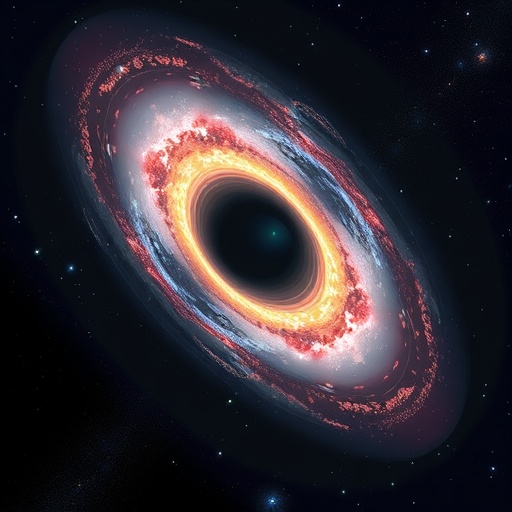
University of Maryland astronomers have reported what they call a “wandering” supermassive black hole—an object hiding in the outskirts of a galaxy rather than sitting at its center. The team’s detection hinges on a fleeting flare: a dormant black hole revealed itself when it tore apart a passing star. The discovery is described as the first clear sighting of such a quiescent black hole at this distance from galactic centers.
The result was published July 27, 2026, in The Astrophysical Journal Letters. “This is a novel result,” said co-author Suvi Gezari, emphasizing that the usual assumption—that the biggest black holes live in galaxy cores—doesn’t hold here. The finding could reshape how scientists track the merging history of galaxies over cosmic time.
Most black holes remain invisible because they are quiescent, meaning they emit little light and do not actively consume material. Theorists have long predicted that galaxies’ collisions should eject or displace black holes into extended orbits. Yet confirming those predictions has been difficult because “silent” black holes rarely announce themselves to telescopes.
In this study, the first clue came from the Zwicky Transient Facility (ZTF), a wide-field survey that repeatedly images the northern sky. With the survey generating hundreds of thousands of events nightly, manually identifying the telltale signature of a tidal disruption event (TDE) is impractical. Instead, the researchers used an AI system trained to recognize the characteristic light pattern produced when a black hole disrupts a star.
The AI approach screened the entire sky for similar flares, not just those occurring in galactic centers where TDEs are commonly found. The program began operating in August 2025, and the candidate was confirmed only three months later—prompting rapid follow-up observations from additional instruments.
The black hole lies 9.3 kiloparsecs (about 30,000 light-years) from the galaxy’s center—comparable in mass to the black hole at the heart of the Milky Way. Strikingly, no obvious host galaxy structure surrounds it, deepening the mystery of how it ended up far from any central stellar congregation.
To explain the origin, the authors propose two leading scenarios. One possibility is hierarchical cannibalism: a larger galaxy strips stars from a smaller companion until only the black hole core remains. Another involves black-hole interactions: a central binary may be perturbed by a third black hole during a merger, ejecting the smallest member into the outskirts. Continued monitoring of the TDE could help discriminate between these pathways.
Understanding quiescent black holes matters because most supermassive black holes—including ours—are inactive most of the time. Stein stressed that the odds of encountering a wandering black hole are extremely low. Meanwhile, the team is expanding the search, aiming to find many more such objects using next-generation facilities.
Using the Vera C. Rubin Observatory, the researchers expect to uncover dozens or even hundreds of wandering black holes each year. Complementary capabilities from the Lowell Discovery Telescope and its Rapid infrared IMAger-Spectrometer will also strengthen searches for tidal disruption events at even greater distances. The study’s authors describe this case as the strongest evidence for a wandering black hole currently known.
Keywords
Wandering black holes; tidal disruption event; Zwicky Transient Facility; machine learning; supermassive black holes; galaxy mergers
Cite Scienmag News
Grant Pearson. (July 27, 2026). Astronomers Detect First Wandering Black Hole on Outskirts of Galaxy. Scienmag. https://scienmag.com/astronomers-detect-first-wandering-black-hole-on-outskirts-of-galaxy/
Grant Pearson. "Astronomers Detect First Wandering Black Hole on Outskirts of Galaxy." Scienmag, 27 July 2026, https://scienmag.com/astronomers-detect-first-wandering-black-hole-on-outskirts-of-galaxy/. Accessed 3 September 2026.
Grant Pearson. "Astronomers Detect First Wandering Black Hole on Outskirts of Galaxy." Scienmag. July 27, 2026. https://scienmag.com/astronomers-detect-first-wandering-black-hole-on-outskirts-of-galaxy/


