


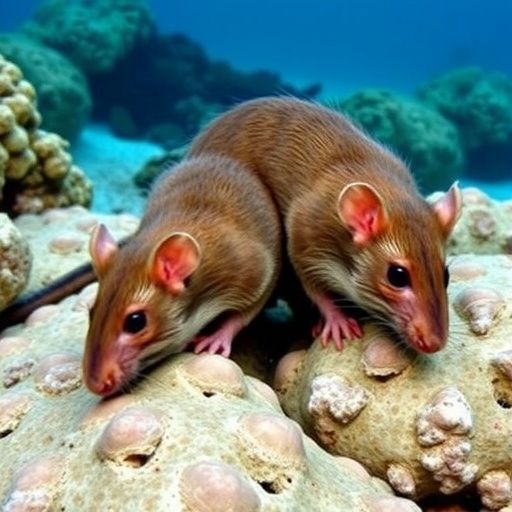
Invasive rats have created strikingly different outcomes for the reef “dark matter” of tropical ecosystems: the cryptofauna—tiny fish and invertebrates living near the seafloor. Although these organisms are small and often overlooked, they sit at a critical point in energy transfer, determining what becomes available to larger predators above them.
Marine scientists comparing reefs around islands with rats and reefs around rat-free islands report that the balance between cryptobenthic fish and small invertebrates shifts dramatically. Rat-free locations tend to be dominated by cryptobenthic fishes such as gobies and triplefins, where fish biomass can exceed invertebrate biomass by more than fivefold.
Around islands with invasive rats, however, the community structure flips. Researchers find a higher proportion of small invertebrates—coral crabs, porcelain crabs, and snapping shrimps—while cryptobenthic fish and invertebrate biomass become nearly equal. The implication is not merely a change in species counts, but a reorganization of how nutrients and energy move through the reef food web.
The mechanism traces back to birds. Rats prey on seabirds, destroying nests and reducing seabird density. On islands without rats, seabird populations are vastly higher, with nutrient-rich guano routinely delivered to surrounding waters. This seabird-derived subsidy stimulates productivity and alters resource availability across reef habitats.
Crucially, nutrient effects are not uniform. The study finds “winners and losers” among organisms competing under different nutrient regimes. When nutrients remain intact, cryptobenthic fishes appear to gain an advantage tied to their high growth and reproduction rates, which require sustained energy supply.
Competition then reshapes space and diet. More abundant cryptobenthic fishes can promote habitat colonization by excluding or displacing cryptic invertebrates, and they can also force invertebrates toward alternative, less preferred resources.
When nutrient flows are cut off by rat activity, invertebrates become relatively more successful. Lower metabolic demands may help them persist where nutrient conditions are poorer, and the reduced dominance of fish competitors opens ecological room for invertebrate populations.
Because cryptofauna often represent the first prey step connecting primary production to larger predators, these shifts are expected to cascade. Mixed carnivorous fishes increase their reliance on cryptobenthic fish in seabird environments, while productivity patterns for invertivores stall near rat-impacted islands.
Overall, the results suggest seabirds regulate not only reef productivity but trophic structure—meaning invasive rats can indirectly rewire food chains by removing a nutrient pathway. Protecting seabirds may therefore be a conservation strategy for maintaining reef ecosystem stability.
Cite Scienmag News
Violet Maxwell. (July 27, 2026). Invasive Rats Reshape Coral Reef Food Webs, Favoring Some Species. Scienmag. https://scienmag.com/invasive-rats-reshape-coral-reef-food-webs-favoring-some-species/
Violet Maxwell. "Invasive Rats Reshape Coral Reef Food Webs, Favoring Some Species." Scienmag, 27 July 2026, https://scienmag.com/invasive-rats-reshape-coral-reef-food-webs-favoring-some-species/. Accessed 4 September 2026.
Violet Maxwell. "Invasive Rats Reshape Coral Reef Food Webs, Favoring Some Species." Scienmag. July 27, 2026. https://scienmag.com/invasive-rats-reshape-coral-reef-food-webs-favoring-some-species/


