


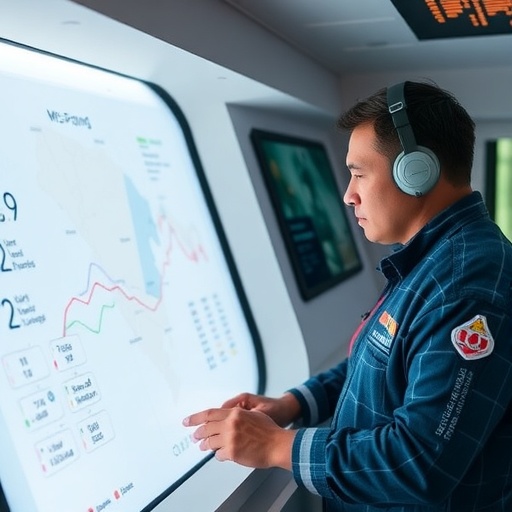
Teaching an AI to navigate a ship is turning out to be a far tougher problem than teaching it to drive a car. In places like Japan’s Seto Inland Sea, vessels must thread narrow channels crowded with ships, negotiate hundreds of islands, react to shifting conditions, and follow international navigation rules—even when the “right” move involves human judgment.
To tackle this, researchers led by Assistant Professor Takefumi Higaki at Osaka Metropolitan University built an autonomous ship-navigation system using a new training strategy. Rather than programming explicit objectives or balancing safety, efficiency, and rule compliance by hand, they learned behavior from real vessel operations.
Their approach centers on a “diffusion AI” route planner trained on maneuvers performed by the training ship Fukae-Maru from Kobe University. Instead of predicting a single optimal action in each moment, diffusion-based decision-making generates a distribution of plausible human-like trajectories, then synthesizes a whole route that respects the complex constraints of maritime navigation.
The team evaluated the model against two state-of-the-art navigation AIs that rely on conventional machine-learning with imitation learning. In confusing encounter scenarios, the diffusion AI handled uncertainties more effectively, while still managing arbitrary numbers of nearby ships, coastlines, narrow waterways, and speed control in realistic simulations.
When the researchers ran ship encounter tests, the AI consistently complied with international collision-avoidance regulations, maintaining safe separation distances rather than taking risky shortcuts. This behavior emerged without explicitly encoding a multi-objective trade-off in the model design.
Even more striking, as training progressed the AI developed unexpected “local custom” behaviors that were not explicitly programmed. For example, when passing through the Akashi Kaikyo Traffic Route, where vessels keep right inside designated lanes, the system repeatedly aligned itself with the correct lane.
According to Dr. Higaki, the standout feature is that the model was not forced to explicitly optimize a list of competing goals. Instead, it implicitly learned sophisticated ship-handling skills directly from operational data. The result is a framework that can reduce the manual burden of defining what “correct” behavior looks like.
With more real-world navigation data becoming available, such autonomous systems could spread in the same way AI-driven cars did—improving maritime safety and helping address growing labor shortages in the shipping industry, especially in Japan.
The study was published in Ocean Engineering on 21-Apr-2026.
Cite Scienmag News
Violet Maxwell. (July 27, 2026). Experienced Captains Face Conventional AI as Autonomous Navigation Charts a New Course. Scienmag. https://scienmag.com/experienced-captains-face-conventional-ai-as-autonomous-navigation-charts-a-new-course/
Violet Maxwell. "Experienced Captains Face Conventional AI as Autonomous Navigation Charts a New Course." Scienmag, 27 July 2026, https://scienmag.com/experienced-captains-face-conventional-ai-as-autonomous-navigation-charts-a-new-course/. Accessed 4 September 2026.
Violet Maxwell. "Experienced Captains Face Conventional AI as Autonomous Navigation Charts a New Course." Scienmag. July 27, 2026. https://scienmag.com/experienced-captains-face-conventional-ai-as-autonomous-navigation-charts-a-new-course/


