


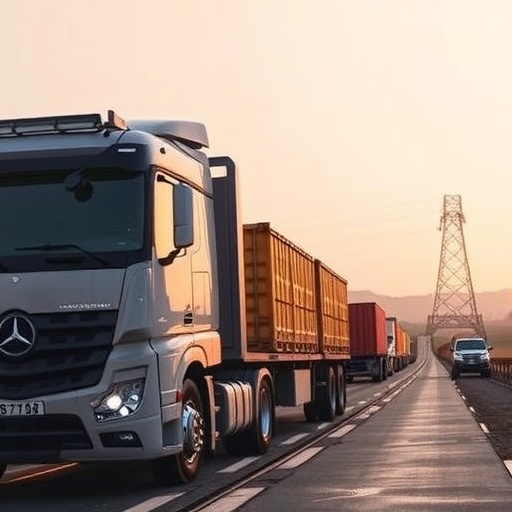
A new study in Communications Earth & Environment spotlights how China’s heavy-duty trucking system is driving unequal environmental burdens—and what kinds of transition pathways could reduce them. The research, published in 2026, links fleet and route dynamics to exposure risks faced by different communities, arguing that policy design must account for who bears the costs of emissions and pollution.
Using an environmental justice lens, the authors examine how air-quality impacts from freight corridors do not distribute evenly. The work emphasizes that the “transition” away from conventional diesel is not automatically fair: without targeted measures, cleaner technologies can be deployed in ways that still leave vulnerable populations exposed.
The paper frames the problem through transition pathways for heavy-duty transport, focusing on practical levers such as fleet modernization, charging and fueling infrastructure, and operational changes. These factors determine where emissions occur, how frequently, and at what intensity—elements that shape local air-quality outcomes more than aggregate national averages.
Technically, the analysis draws on the spatial patterning of transport activity and its emissions, connecting freight movement to environmental exposure. By coupling emissions-relevant transport characteristics with demographic and location context, the study estimates where injustice may concentrate, providing a basis for scenario comparison across policy options.
A key takeaway is that transition strategies can trade off different sources of harm. For example, switching to lower-emitting vehicles may reduce tailpipe pollution in some hotspots, while upstream impacts—such as electricity generation or supply-chain emissions—can shift burdens elsewhere if the energy system is not simultaneously decarbonized.
The authors argue for “pathways with fairness constraints,” meaning policy packages should be evaluated not only by total emission reductions, but also by changes in distributional impacts. This includes assessing whether improvements reach communities with the highest baseline exposure.
The study’s conclusions are aimed at decision-makers planning logistics decarbonization, especially where freight routes intersect dense residential areas. It suggests that fair transitions require aligning transport policy with air-quality monitoring, health risk assessment, and community-sensitive siting of infrastructure.
Overall, the findings deliver a viral-science-ready message: the move toward cleaner heavy-duty trucks in China will succeed on climate goals only if it is designed to prevent environmental harm from being displaced onto those who are least able to avoid it.
Cite Scienmag News
Russell Cooper. (July 27, 2026). Environmental Injustice and Transition Pathways for China’s Heavy-Duty Truck Transport. Scienmag. https://scienmag.com/environmental-injustice-and-transition-pathways-for-chinas-heavy-duty-truck-transport/
Russell Cooper. "Environmental Injustice and Transition Pathways for China’s Heavy-Duty Truck Transport." Scienmag, 27 July 2026, https://scienmag.com/environmental-injustice-and-transition-pathways-for-chinas-heavy-duty-truck-transport/. Accessed 4 September 2026.
Russell Cooper. "Environmental Injustice and Transition Pathways for China’s Heavy-Duty Truck Transport." Scienmag. July 27, 2026. https://scienmag.com/environmental-injustice-and-transition-pathways-for-chinas-heavy-duty-truck-transport/


