

Sunday, July 26, 2026
Science
No Result
View All Result
  • Login
  • HOME
  • SCIENCE NEWS
  • CONTACT US
  • HOME
  • SCIENCE NEWS
  • CONTACT US
No Result
View All Result
Scienmag
No Result
View All Result
Home Science News Medicine

Structure Reveals How Trypanosome Mitochondria Coordinate RNA Editing Cascade

July 26, 2026
in Medicine, Technology and Engineering
Reading Time: 2 mins read
0
Structure Reveals How Trypanosome Mitochondria Coordinate RNA Editing Cascade

Structure Reveals How Trypanosome Mitochondria Coordinate RNA Editing Cascade

65
SHARES
587
VIEWS
Share on FacebookShare on Twitter
ADVERTISEMENT

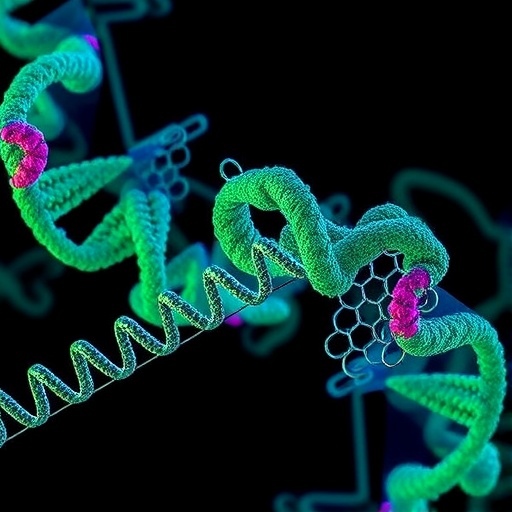
Trypanosome mitochondria rely on an RNA-editing process that rewrites transcripts through precisely timed uridine deletions and insertions, guided by complementary RNAs. For decades, researchers have known the editing is executed by a fast-moving, multi-enzyme system—but how the components coordinate their actions has been difficult to pin down.

Now, Liu and colleagues provide structural snapshots of two key editing machines by defining “editosomes” as supramolecular assemblies built from the RNA substrate-binding complex (RESC) together with either the RNA-editing catalytic complex 1 (RECC1) or complex 2 (RECC2). Using cryo–electron microscopy, they report approximately 1-MDa structures that reveal how the editing cascade is organized at near-atomic resolution.

The complexes adopt a striking architecture reminiscent of dragonflies. Each editosome includes a head-like region, a thorax-like core, and a tail and wing arrangement that correspond to distinct functional stages. RECC1 and RECC2 specialize in different chemical steps: the deletion cascade and the insertion cascade, respectively.

At the heart of each complex is a tetrameric core containing one active and three inactive RNase III domains. This core captures the guide RNA (gRNA)–mRNA duplex, creating a controlled substrate platform. Zinc-finger elements then discriminate between deletion and insertion sites, positioning the RNA for cleavage with site-specific accuracy.

Once the substrate is cleaved, peripheral modules reshape the reaction environment into a modular “reaction chamber.” Three oligonucleotide-binding-fold heterotetramers are flexibly attached to the core, suggesting that the machinery can adapt to different RNA geometries during the editing cycle.

In a coordinated handoff, the tail recruits two enzymatic activities—an exonuclease and a uridylyltransferase—responsible for removing or adding uridines (step II). Meanwhile, the wings, coordinated by an architectural transfer RNA, position RNA ligases to seal the edited message (step III).

Together, the structures unify substrate recognition, cleavage, uridine deletion and insertion, and ligation within one integrated macromolecular machine. By spatially mapping each step onto distinct subdomains, the work clarifies how information flows from gRNA recognition to final, functional mRNA production.

Subject of Research: Trypanosome mitochondrial RNA editing (uridine insertion and deletion)

Article Title: Structural basis of the RNA-editing cascade in trypanosome mitochondria.

Article References: Liu, YT., Vacas, A.F., Jih, J. et al. Structural basis of the RNA-editing cascade in trypanosome mitochondria. Nature (2026). https://doi.org/10.1038/s41586-026-10831-x

DOI: https://doi.org/10.1038/s41586-026-10831-x

Keywords: RNA editing; trypanosome mitochondria; editosomes; RESC; RECC1; RECC2; cryo-electron microscopy; RNase III; guide RNA; uridylyltransferase; RNA ligase

Share26Tweet16
Previous Post

Low-Temperature Oxide-Ion Conduction Discovered in Aurivillius-Phase Sodium Bismuth Tin Oxides

Next Post

Farmers’ Trust Crucial for Scaling Climate-Smart Innovations

Related Posts

Voxel-Scale Diffusion Tensor Imaging Maps Healthy and Pressure-Overloaded Heart
Medicine

Voxel-Scale Diffusion Tensor Imaging Maps Healthy and Pressure-Overloaded Heart

July 26, 2026
Mechanisms and Regulation of Necroptosis: Clinical Relevance Explored
Medicine

Mechanisms and Regulation of Necroptosis: Clinical Relevance Explored

July 26, 2026
Kogakuin and IIT (ISM) Dhanbad launch research on multifunctional energy glass-ceramics
Technology and Engineering

Kogakuin and IIT (ISM) Dhanbad launch research on multifunctional energy glass-ceramics

July 26, 2026
Time-Restricted Eating May Help Preserve Cognitive Function in Older Adults
Medicine

Time-Restricted Eating May Help Preserve Cognitive Function in Older Adults

July 26, 2026
Low-Temperature Oxide-Ion Conduction Discovered in Aurivillius-Phase Sodium Bismuth Tin Oxides
Technology and Engineering

Low-Temperature Oxide-Ion Conduction Discovered in Aurivillius-Phase Sodium Bismuth Tin Oxides

July 26, 2026
ENVnet launches global molecular resource for dissolved organic matter data
Medicine

ENVnet launches global molecular resource for dissolved organic matter data

July 26, 2026
Next Post
Farmers’ Trust Crucial for Scaling Climate-Smart Innovations

Farmers' Trust Crucial for Scaling Climate-Smart Innovations

  • Mothers who receive childcare support from maternal grandparents show more

    Mothers who receive childcare support from maternal grandparents show more parental warmth, finds NTU Singapore study

    27656 shares
    Share 11059 Tweet 6912
  • University of Seville Breaks 120-Year-Old Mystery, Revises a Key Einstein Concept

    1061 shares
    Share 424 Tweet 265
  • Bee body mass, pathogens and local climate influence heat tolerance

    682 shares
    Share 273 Tweet 171
  • Researchers record first-ever images and data of a shark experiencing a boat strike

    546 shares
    Share 218 Tweet 137
  • Groundbreaking Clinical Trial Reveals Lubiprostone Enhances Kidney Function

    531 shares
    Share 212 Tweet 133
Science

Embark on a thrilling journey of discovery with Scienmag.com—your ultimate source for cutting-edge breakthroughs. Immerse yourself in a world where curiosity knows no limits and tomorrow’s possibilities become today’s reality!

RECENT NEWS

  • Voxel-Scale Diffusion Tensor Imaging Maps Healthy and Pressure-Overloaded Heart
  • Mechanisms and Regulation of Necroptosis: Clinical Relevance Explored
  • HDAC6 Serves as Biomarker for B-ALL Dissemination and Relapse
  • Nonreproductive Tumor Progression Disrupts Ovarian Function via CXCL10–IL18R1 Signaling

Categories

  • Agriculture
  • Anthropology
  • Archaeology
  • Athmospheric
  • Biology
  • Biotechnology
  • Blog
  • Bussines
  • Cancer
  • Chemistry
  • Climate
  • Earth Science
  • Editorial Policy
  • Marine
  • Mathematics
  • Medicine
  • Pediatry
  • Policy
  • Psychology & Psychiatry
  • Science Education
  • Social Science
  • Space
  • Technology and Engineering

Subscribe to Blog via Email

Enter your email address to subscribe to this blog and receive notifications of new posts by email.

Join 5,146 other subscribers

© 2025 Scienmag - Science Magazine

Welcome Back!

Login to your account below

Forgotten Password?

Retrieve your password

Please enter your username or email address to reset your password.

Log In
No Result
View All Result
  • HOME
  • SCIENCE NEWS
  • CONTACT US

© 2025 Scienmag - Science Magazine

Discover more from Science

Subscribe now to keep reading and get access to the full archive.

Continue reading
