


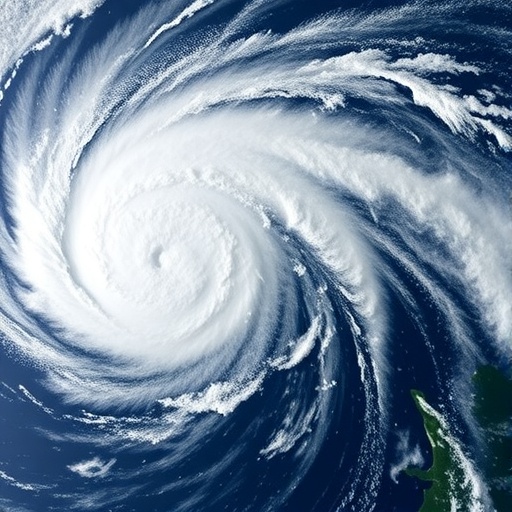
Tropical cyclones are expected to drench more intensely as the planet warms, because warmer air can hold more water. Clausius–Clapeyron scaling suggests a moisture capacity rise of roughly 7% per degree Celsius, which should translate into stronger rainfall. Yet many climate-model simulations fall short of this expectation, producing muted increases in storm rain rates compared with what thermodynamics alone would imply.
In a new study, researchers combine large-ensemble climate simulations with satellite observations and reanalysis data to pinpoint the process that suppresses rainfall intensification. Their key finding is that future tropical cyclone rain rates are limited by “absolute dryness” in the atmosphere, expressed through the saturation deficit—a measure of how far air is from saturation.
The team shows that warming does not simply increase moisture everywhere in a way that guarantees higher precipitation. Although storm systems do amplify near-Clausius–Clapeyron moistening of the atmospheric column and increased intensity tends to favor heavier rainfall, those gains are systematically counteracted. The offset comes from saturation-deficit-driven changes that reduce precipitation efficiency.
Precipitation efficiency links the amount of water that becomes rainfall to the total available atmospheric moisture. As saturation deficit rises, evaporation in and around the storm becomes more effective, siphoning condensate before it can fall as rain. The study demonstrates a negative relationship between precipitation efficiency and saturation deficit: drier, less-saturated air leads to less efficient conversion of water vapor into precipitation.
To verify that this mechanism is not only a model artifact, the authors corroborate the relationship using satellite-based precipitation estimates. Observations similarly support the idea that precipitation efficiency declines as the atmosphere becomes more capable of evaporating moisture from falling hydrometeors.
Importantly, they also connect precipitation efficiency to storm intensity. While efficiency correlates positively with intensity, attribution analyses reveal that under warming the thermodynamic dryness signal can dominate. In other words, intensity-related boosts are outweighed by evaporation losses triggered by increased saturation deficit.
The result helps explain why prior projections—often focused on storm intensification and column-water increases—may overestimate rainfall response. By highlighting atmospheric dryness as the principal thermodynamic limiter, the study reframes what constrains cyclone rainfall in a warming climate.
For residents in cyclone-prone regions, the implication is sobering: even if storms become stronger, the rainfall may not rise as fast as moisture-holding capacity would suggest. The atmosphere’s growing tendency to “desaturate” through evaporation emerges as a crucial factor in determining how much rain a cyclone can ultimately deliver.
Cite Scienmag News
Russell Cooper. (July 26, 2026). Dryer Atmosphere Limits Future Tropical Cyclone Rainfall. Scienmag. https://scienmag.com/dryer-atmosphere-limits-future-tropical-cyclone-rainfall/
Russell Cooper. "Dryer Atmosphere Limits Future Tropical Cyclone Rainfall." Scienmag, 26 July 2026, https://scienmag.com/dryer-atmosphere-limits-future-tropical-cyclone-rainfall/. Accessed 4 September 2026.
Russell Cooper. "Dryer Atmosphere Limits Future Tropical Cyclone Rainfall." Scienmag. July 26, 2026. https://scienmag.com/dryer-atmosphere-limits-future-tropical-cyclone-rainfall/


