

Saturday, July 18, 2026
Science
No Result
View All Result
  • Login
  • HOME
  • SCIENCE NEWS
  • CONTACT US
  • HOME
  • SCIENCE NEWS
  • CONTACT US
No Result
View All Result
Scienmag
No Result
View All Result
Home Science News Agriculture

Biochar from rice straw may cut heavy metal contamination risks in rice

July 17, 2026
in Agriculture
Reading Time: 2 mins read
0
Biochar from rice straw may cut heavy metal contamination risks in rice

Biochar from rice straw may cut heavy metal contamination risks in rice

65
SHARES
587
VIEWS
Share on FacebookShare on Twitter
ADVERTISEMENT

Rice straw is a cornerstone of sustainable rice farming—returned to fields to recycle nutrients and avoid open burning. But a new study suggests that what looks like a “waste-to-resource” practice may also reshape how toxic metals move from contaminated soil into the food chain.

Researchers investigated six rice straw management approaches and measured arsenic, cadmium, copper, nickel, lead, and zinc levels in rice. The work, published in Environmental and Biogeochemical Processes, is notable for treating multiple contaminants at once rather than optimizing for a single metal.

The experiments used greenhouse pots filled with cadmium-contaminated paddy soil collected from Jiangsu Province, China. Treatments included direct incorporation of untreated straw, accelerated straw decomposition, soil pH adjustment, modified water management, and application of biochar produced from rice straw.

Direct straw incorporation produced sharply contrasting outcomes across the metal suite. Arsenic in rice grains rose by 73.1%, while copper and lead dropped by 13.8% and 89.3%, respectively. Meanwhile, cadmium, nickel, and zinc showed no significant change under the conditions tested, highlighting the complexity of straw-driven chemistry.

Alternative mitigation strategies did not reliably prevent unwanted metal accumulation. Adjusting soil pH or changing decomposition timing failed to deliver consistent benefits, and modified water management could worsen risk: grain cadmium increased roughly 30-fold and exceeded China’s national food safety limit.

A key mechanism proposed by the authors involves organic matter released during straw breakdown. That material can strongly bind certain metals (such as copper and lead), yet simultaneously alter soil chemistry and microbial processes in ways that mobilize or transform other elements, including arsenic.

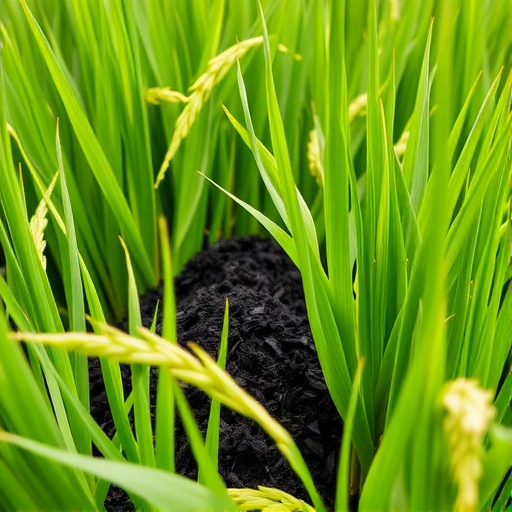
In contrast, applying rice straw–derived biochar at a relatively low dose of about 0.3% did not significantly increase any of the six metals in rice grains. The biochar treatment also reduced copper and lead accumulation, improved several soil properties, and produced the highest grain and whole-plant biomass among the tested options.

Because biochar is produced by heating biomass under oxygen-limited conditions, it is more stable than raw straw. Beyond contaminant control, converting straw to biochar can also reduce air pollution from open burning and limit greenhouse gases associated with decomposition in flooded paddies.

The authors caution that pot results may not translate directly to all field conditions. Further field trials across different soils, climates, and rice varieties are needed, alongside economic assessments of collection, production, transport, and application.

Subject of Research: Environmental and Biogeochemical Processes—rice straw management and heavy metal accumulation
Article Title: Incorporating rice straw in the form of biochar: a sustainable measure to protect humans from heavy metal exposure
News Publication Date: 30-Jun-2026
Web References: https://doi.org/10.48130/ebp-0026-0007
References: Liao J, Ning W, Gong Y, Tang W, Zhong H. 2026. Environmental and Biogeochemical Processes 2: e012. doi:10.48130/ebp-0026-0007
Image Credits: Jiannan Liao, Wenjing Ning, Yu Gong, Wenli Tang, & Huan Zhong

Keywords: rice straw, biochar, heavy metal pollution, arsenic, cadmium, food safety, soil chemistry, greenhouse pot experiment, sustainable agriculture, paddy soil

Tags: arsenic and cadmium uptake in ricebiochar application for soil remediationenvironmentally sustainable rice farming techniquesheavy metal contamination in riceheavy metal transfer from soil to rice grainsimpact of water management on metal levelsmulti-metal contamination in rice cultivationrice straw biocharrice straw decomposition effectsrice straw management strategiessoil pH modification for metal mitigationsustainable rice farming practices
Share26Tweet16
Previous Post

Asteroid impact may have reshaped tuna evolution alongside dinosaur extinction

Next Post

Texas Tech Veterinary Students Publish Research in International Journals

Related Posts

Gene edit boosts rice safety while preserving high harvest yields
Agriculture

Gene edit boosts rice safety while preserving high harvest yields

July 16, 2026
Roadless Rule Safeguards Drinking Water for 25 Million Americans, Study Finds
Agriculture

Roadless Rule Safeguards Drinking Water for 25 Million Americans, Study Finds

July 15, 2026
Deforestation declines show corporate pledges aren’t the driving force
Agriculture

Deforestation declines show corporate pledges aren’t the driving force

July 15, 2026
Sustainable Healthy Diets Could Reshape Global Agriculture
Agriculture

Sustainable Healthy Diets Could Reshape Global Agriculture

July 15, 2026
UT partners secure up to $160M NSF funding for rural innovation growth
Agriculture

UT partners secure up to $160M NSF funding for rural innovation growth

July 14, 2026
China’s Climate Targets Could Transform the Global Palm Oil Industry
Agriculture

China’s Climate Targets Could Transform the Global Palm Oil Industry

July 14, 2026
Next Post
Texas Tech Veterinary Students Publish Research in International Journals

Texas Tech Veterinary Students Publish Research in International Journals

  • Mothers who receive childcare support from maternal grandparents show more

    Mothers who receive childcare support from maternal grandparents show more parental warmth, finds NTU Singapore study

    27656 shares
    Share 11059 Tweet 6912
  • University of Seville Breaks 120-Year-Old Mystery, Revises a Key Einstein Concept

    1061 shares
    Share 424 Tweet 265
  • Bee body mass, pathogens and local climate influence heat tolerance

    682 shares
    Share 273 Tweet 171
  • Researchers record first-ever images and data of a shark experiencing a boat strike

    546 shares
    Share 218 Tweet 137
  • Groundbreaking Clinical Trial Reveals Lubiprostone Enhances Kidney Function

    531 shares
    Share 212 Tweet 133
Science

Embark on a thrilling journey of discovery with Scienmag.com—your ultimate source for cutting-edge breakthroughs. Immerse yourself in a world where curiosity knows no limits and tomorrow’s possibilities become today’s reality!

RECENT NEWS

  • UVA Engineer Geoff Geise Wins NAMS Permeance Prize for Mid-Career Excellence
  • Organic fertilizer helps biochar immobilize cadmium in contaminated soil
  • Cannabis Exposure Alters Reelin Signaling in Schizophrenia-Like Dual-Hit Mice
  • Avian Influenza Ecological Shifts After HPAIV Arrivals in Southwestern Alaska, 2011–2024

Categories

  • Agriculture
  • Anthropology
  • Archaeology
  • Athmospheric
  • Biology
  • Biotechnology
  • Blog
  • Bussines
  • Cancer
  • Chemistry
  • Climate
  • Earth Science
  • Editorial Policy
  • Marine
  • Mathematics
  • Medicine
  • Pediatry
  • Policy
  • Psychology & Psychiatry
  • Science Education
  • Social Science
  • Space
  • Technology and Engineering

Subscribe to Blog via Email

Enter your email address to subscribe to this blog and receive notifications of new posts by email.

Join 5,146 other subscribers

© 2025 Scienmag - Science Magazine

Welcome Back!

Login to your account below

Forgotten Password?

Retrieve your password

Please enter your username or email address to reset your password.

Log In
No Result
View All Result
  • HOME
  • SCIENCE NEWS
  • CONTACT US

© 2025 Scienmag - Science Magazine

Discover more from Science

Subscribe now to keep reading and get access to the full archive.

Continue reading
