


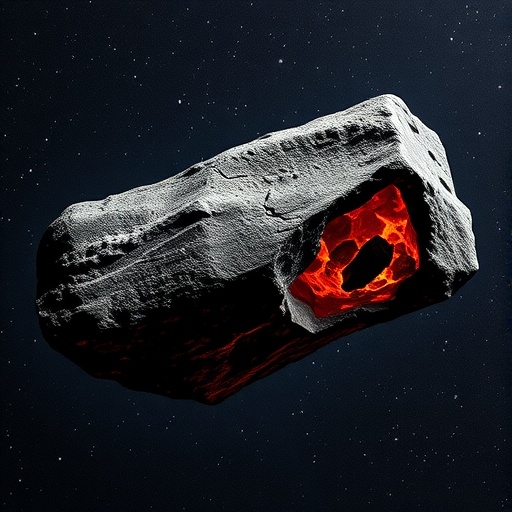
Researchers have narrowed down the composition of the asteroid that helped trigger Earth’s most famous mass extinction 66 million years ago. A rare carbonaceous meteorite class—specifically a CO chondrite—emerges as the most probable impactor responsible for the Cretaceous–Palaeogene event that erased about 75% of Earth’s species, including non-avian dinosaurs.
The new study, published in Science Advances by an international team from the University of British Columbia (UBC), Paris, Brussels, and Vienna, uses high-precision nickel isotope measurements to fingerprint the impactor. By comparing the isotopic signature preserved in globally distributed K–T boundary clay, the researchers determine that the projectile was not typical of the meteorite types commonly displayed in museums.
In particular, CO (Ornans-class) chondrites contain markedly lower amounts of volatile elements such as carbon, zinc, water, and—most notably—sulphur compared with other meteorite groups. This does not rewrite the extinction framework, but it changes a key detail: it makes sulphur an unlikely “smoking gun” for the atmospheric effects. Instead, the team argues that the finest debris lofted into the air would have played the dominant role.
To reach this conclusion, scientists performed experimental, ultra-sensitive isotopic analyses on thin sediment samples collected over multiple years. Only a tiny fraction of the original projectile is expected to remain because the impactor largely vaporized during collision with the planet.
The work also highlights how rare such a meteorite is in nature. Carbonaceous chondrites represent only about 5% of meteorites sampled on Earth, and CO chondrites constitute a small subset of that already rare category. “Being impacted by such a rare, distant projectile underscores how unlucky the dinosaurs were,” the authors note.
The Chicxulub impactor is estimated to have been roughly 10 to 15 km wide and struck at around 64,000 km/h, carving the crater later buried beneath the Yucatán Peninsula. The study suggests potential origins in outer Solar System regions rich in primitive debris, possibly even near the outer asteroid belt close to Jupiter.
By tying the K–T clay layer’s nickel isotope record to a specific meteorite family, the research provides a sharper target for future models of atmospheric chemistry, ejecta distribution, and extinction-era climate forcing—turning a long-standing mystery into a measurable geochemical clue.
News Publication Date:
17-Jul-2026
Web References:
https://doi.org/10.1126/sciadv.aef4858
References:
The findings were published in Science Advances (DOI: 10.1126/sciadv.aef4858).
Cite Scienmag News
Violet Maxwell. (July 17, 2026). Scientists identify rare oddball meteorite linked to dinosaur extinction. Scienmag. https://scienmag.com/scientists-identify-rare-oddball-meteorite-linked-to-dinosaur-extinction/
Violet Maxwell. "Scientists identify rare oddball meteorite linked to dinosaur extinction." Scienmag, 17 July 2026, https://scienmag.com/scientists-identify-rare-oddball-meteorite-linked-to-dinosaur-extinction/. Accessed 3 September 2026.
Violet Maxwell. "Scientists identify rare oddball meteorite linked to dinosaur extinction." Scienmag. July 17, 2026. https://scienmag.com/scientists-identify-rare-oddball-meteorite-linked-to-dinosaur-extinction/


